

This is Africa’s moment to recognize its strength. Recognition, however, is only the beginning. Strength must be organized. Resources must be converted into enduring assets. Population must be transformed into human capital. Knowledge must support intellectual sovereignty. Political independence must be secured by productive capability. Leadership must be restrained by law and accountable institutions. Ambazonia must absorb these lessons before independence, not after it.
By Martin S. Mungwa, PhD, MBA, PE, F.ASCE
Independentist News Contributor
THE CHILDREN THE WEST WARNS AFRICA NOT TO HAVE—UNTIL IT NEEDS THEM
The sweeping reorganization of United States foreign assistance has provoked an understandable moral outcry. Health programs have been disrupted, humanitarian organizations have lost funding, experienced personnel have been dismissed, and vulnerable communities have faced uncertainty over medicines, nutrition, vaccinations and other essential services.
A major 2025 study published in The Lancet estimated that USAID-supported programs were associated with more than 91 million deaths averted in low- and middle-income countries between 2001 and 2021. Its researchers projected that, if the severe funding reductions continued, more than 14 million additional deaths could occur by 2030, including approximately 4.5 million children under five.
These are modeled projections, not deaths that have already occurred, and they depend upon assumptions about the depth, duration and replacement of the reductions. They should therefore be presented carefully. Nevertheless, they illustrate the potentially devastating consequences of abruptly terminating programs upon which millions of people depend.
Where patients require uninterrupted HIV treatment, malaria prevention, vaccination, maternal healthcare or emergency nutrition, sudden withdrawal is not merely an administrative adjustment. It can become a matter of life and death.
Africans should acknowledge every life saved through foreign assistance. Gratitude for lifesaving cooperation, however, does not require silence about the global economic system within which that assistance operates.
The deeper question is not simply why aid is being reduced. It is why a continent possessing extraordinary natural and human wealth became so dependent upon foreign governments for medicines, food security and essential public services in the first place.
Why does the West so frequently present itself as Africa’s indispensable benefactor while Western governments, corporations, financial institutions, commodity traders and strategic agencies seek privileged access to the continent’s petroleum, gas, minerals, markets and political decisions?
Why is the withdrawal of aid described as the abandonment of Africa while the continuing removal of African wealth is treated as ordinary commerce? That is the contradiction Africa—and Ambazonia—must confront.
Aid Has Saved Lives
A fair African critique must begin with an acknowledgment that some forms of foreign assistance have produced immense human benefits.Yes. Vaccination campaigns, HIV treatment, malaria prevention, maternal healthcare, nutrition programs, emergency food relief, sanitation projects and disease-surveillance systems have saved millions of lives. PEPFAR, for example, reported that it had saved approximately 26 million lives by the end of fiscal year 2024 and enabled millions of babies to be born without HIV.
The medicine received by a sick child is real. The mother who survives childbirth because a clinic was equipped is real. The patient sustained through antiretroviral treatment is real.
Many Western physicians, nurses, researchers, civil servants, volunteers, taxpayers and charitable organizations have participated in such programs out of genuine human solidarity. It would be unfair to portray all of them as instruments of exploitation. Nor would it be intellectually honest to claim that all foreign aid has failed.
Aid has also supported schools, water systems, agricultural research, disaster relief, democratic institutions and civil-society organizations. In some circumstances, it has enabled governments and communities to accomplish things they could not immediately finance alone. The problem is not that all aid is fraudulent. The problem is that humanitarian assistance and economic extraction have frequently operated at the same time.
Aid may provide medicine without helping establish a domestic pharmaceutical industry. It may distribute food during a crisis without transforming agricultural production. It may finance schools without creating an economy capable of employing their graduates. It may train public officials while leaving essential institutions dependent upon foreign consultants and donor funding. Aid can preserve life while leaving the structures that reproduce dependency largely unchanged. It can treat the consequences of poverty without sufficiently altering the distribution of ownership, technology, industrial capacity and bargaining power that helps perpetuate poverty. Aid Is Neither Pure Charity nor Pure Conspiracy
Foreign assistance should not be understood through either of two simplistic interpretations. The first presents aid as pure generosity, detached from the donor’s political, economic and strategic interests. The second treats every humanitarian program as a disguised conspiracy to dominate Africa. Neither interpretation adequately reflects reality.
Aid can serve several purposes simultaneously. It may save lives while promoting diplomatic influence. It may contain an epidemic while protecting the donor’s own population. It may reduce suffering while discouraging migration. It may support development while competing with geopolitical rivals. It may advance human rights while opening commercial opportunities. These purposes do not automatically invalidate the assistance. Governments are rarely motivated by a single objective, and countries routinely combine moral commitments with national interests.
The United States acts primarily in the interests of the United States. Britain acts in the interests of Britain. France acts in the interests of France. China, Russia, India, Turkey and the Gulf states also pursue their own commercial and strategic objectives. Africa’s mistake has not been accepting cooperation. Its mistake has often been expecting external powers to place African development ahead of their own interests. Africa must learn to cooperate with the world while negotiating consistently in the interests of Africa. Ambazonia must learn to do the same.
The Other Side of the Ledger
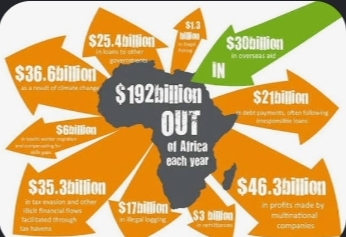
Africa’s relationship with the West cannot be judged by counting aid dollars alone. A complete accounting must also consider the value lost through illicit financial flows, unfavorable resource contracts, profit repatriation, tax avoidance, trade mispricing, external debt, corruption, imported consulting services and the migration of professionals educated with public funds.
UNCTAD estimated in 2020 that approximately $88.6 billion left Africa annually through illicit financial flows. The estimate is not a direct comparison with all forms of foreign aid, nor can every dollar be attributed to Western governments or corporations. African political and commercial actors often participate in moving or concealing the money. Nevertheless, the magnitude illustrates how much potential development financing can be lost.
The extractive pattern is familiar.
African countries export crude petroleum and import refined fuel. They export cocoa and import expensive chocolate. They export timber and import furniture. They export strategic minerals and import batteries, vehicles, electronics and industrial machinery. They educate doctors, nurses, scientists and engineers with scarce public resources, only to lose many of them to wealthier societies offering better working conditions.
Foreign firms frequently control the most profitable portions of these value chains: financing, technology, processing, shipping, insurance, intellectual property, branding, data and access to final markets.
Africa supplies the commodity. Others capture much of the added value.
A portion of the resulting wealth may later return as development assistance, sometimes accompanied by donor priorities, foreign consultants, imported equipment, procurement restrictions and externally designed measurements of success.
This does not mean that every aid agreement is a conspiracy. It means that the assistance Africa receives cannot be understood separately from the wealth Africa loses or fails to retain. A continent should not be expected to remain indefinitely dependent upon philanthropy while surrendering control of the productive assets capable of financing its independence.
The Institutional Hypocrisy
The deepest hypocrisy is not necessarily personal. It is institutional. A Western government may finance vaccination programs while supporting corporations seeking favorable access to African minerals. It may sponsor democratic-governance workshops while cooperating with authoritarian governments that protect its security or commercial interests. It may advocate transparency while financial institutions and secrecy jurisdictions under its influence receive wealth transferred from Africa through opaque companies.
Western governments regularly condemn corruption in Africa, but corrupt wealth does not hide itself. It often requires bankers, accountants, lawyers, property markets, shell companies and offshore structures operating beyond the continent.
The contradiction appears in trade and industrial policy as well. African countries may be advised to liberalize strategic sectors, reduce subsidies and limit state participation while wealthy states protect their own agriculture, technology, energy and defense industries through public investment, procurement preferences, tariffs, tax incentives and national-security restrictions.
African attempts to reserve value for domestic processing may be criticized as protectionism. Similar efforts by powerful countries are frequently described as industrial strategy or economic security. The hypocrisy becomes most visible when aid is presented as evidence of generosity while African demands for greater ownership of resources are portrayed as ingratitude, instability or hostility toward investment. Africa is encouraged to appreciate assistance but discouraged from exercising sufficient control over the wealth that could make that assistance less necessary.
Extraction Is Not Exclusively Western
A balanced argument must also recognize that extraction is not an exclusively Western practice. Chinese firms seek minerals, markets and infrastructure contracts. Russian interests pursue energy, mining and security relationships. Gulf states seek agricultural land, ports, logistics routes and commercial influence. African-owned companies and political networks can also exploit workers, communities and public resources.
Replacing a Western extractor with a Chinese, Russian, Gulf-state or African extractor does not end extraction. It changes the identity of the beneficiary. The central issue is therefore not the nationality of the investor. It is the quality of the agreement. Does the investment create local productive capacity? Does it transfer knowledge and technology? Does it train citizens and develop domestic suppliers? Does it retain a fair share of revenue within the country? Does it protect communities and the environment? Does it strengthen national institutions? Does it preserve democratic control over strategic assets?
Foreign investment can be indispensable to development when it brings capital, technology, employment, markets and expertise under fair and enforceable terms. It becomes extractive when profits are privatized, risks are transferred to the public, communities are displaced, taxes are avoided and little productive capability remains after the resource is depleted. Africa does not need isolation from foreign capital. It needs the institutional competence to distinguish productive partnership from organized dispossession.
Modern Control Without Colonial Rule
Contemporary extraction no longer requires a colonial flag or occupying administration. A country may possess formal independence while external interests influence the financing of its major projects, extraction of its resources, processing of its commodities, insurance of its exports, storage of its data and resolution of commercial disputes.
Control can operate through concessions, debt agreements, production-sharing contracts, exclusive licenses, long-term purchasing arrangements, foreign arbitration clauses, technical dependence and ownership structures concealed behind layers of subsidiaries. A mineral may be physically located in Africa while the most important decisions concerning its financing, extraction, pricing, processing and sale are made elsewhere.
A petroleum field may be described as a national asset while the technology, shipping, insurance and export markets remain externally controlled. A port may stand on African soil while its revenues are pledged to foreign creditors. A telecommunications system may appear domestically operated while its data infrastructure and critical software are controlled outside the country.
Not every such arrangement is inherently illegitimate. International commerce requires financing, risk-sharing, insurance and dispute-resolution mechanisms. The danger arises when governments lack the expertise or integrity to negotiate balanced terms, when contracts remain secret, or when obligations extend far beyond the public benefit received. Political independence without productive control can become a flag raised over an externally managed economy.
The Intellectual Architecture of Extraction
The philosophies and policies that sustain unequal economic relationships are not produced by corporations and politicians alone. Intellectuals, economists, strategists, academics, technical specialists, consultants and policy advisers also help interpret the world in which those relationships operate.
Western intelligence and national-security institutions draw upon universities, research centers, financial institutions, technology companies, professional organizations and consultancies. They require expertise to understand foreign societies, identify strategic resources, assess political movements, examine infrastructure, anticipate conflict and formulate national policy.
However, it would be inaccurate and unfair to claim that Western intellectuals as a class are leaders of extraction or that a major proportion of scholars are intelligence operatives. There is no sound basis for such a sweeping allegation. Many Western academics have opposed colonialism, exposed corporate misconduct, defended African self-determination and contributed sincerely to African education and development. The stronger argument is that knowledge and power frequently interact.
Academics and specialists may work directly for intelligence or national-security institutions, serve as advisers or contractors, participate in policy networks, receive strategically directed research funding, or produce open research that governments and corporations subsequently use.
Research concerning Africa’s minerals, political divisions, infrastructure, public attitudes, population patterns and institutional weaknesses can help African development. The same knowledge can also increase external leverage over African decisions.
Economic theories can be invoked to persuade governments to privatize strategic assets prematurely. Geological research can identify valuable resources before African states develop the ability to govern them. Political analysis can reveal divisions that outside powers may exploit. Institutional assessments can expose genuine deficiencies while simultaneously creating permanent markets for foreign consultants.
Even humanitarian and public-health information can become a source of influence when the data are collected, stored and interpreted by institutions primarily accountable to external funders.
The problem is not foreign knowledge itself. Knowledge has no nationality in its validity. The problem is dependence upon knowledge systems whose priorities, financing and strategic uses Africans do not control.
African institutions must be capable of asking: Who commissioned this research? Who owns the data? Who selected the assumptions? Who benefits from the recommended policy? What alternatives were excluded? Can the conclusions be independently verified?
When intellectual authority is used to legitimize unequal concessions, externally imposed models or foreign dominance of strategic sectors, scholarship ceases to be merely descriptive. It becomes part of the architecture of power.
Africa’s need for Intellectual sovereignty
Africa must therefore develop intellectual sovereignty: the ability to study itself, finance its own research, preserve its data, evaluate competing ideas and negotiate from independently verified evidence. Intellectual sovereignty does not mean rejecting Western scholarship. It means possessing the capacity to learn from it, challenge it and decide independently how it should be applied. A continent interpreted principally by outsiders risks becoming a continent governed by other people’s conclusions.
African Elites Cannot Escape Responsibility
External extraction could not continue at its present scale without African participation. Presidents sign concessions. Ministers approve contracts. Officials accept inducements. Legislatures fail to demand disclosure. Regulators neglect enforcement. Political elites transfer money abroad while hospitals deteriorate, public utilities fail and universities decline. Foreign companies may seek advantageous terms, but African representatives frequently authorize them.
Colonialism created many of the structures underlying contemporary dependency, but postcolonial leaders have too often preserved or personally exploited those structures. It is not enough to condemn foreign corporations while protecting the African intermediaries who facilitate their operations.
Aid can also distort accountability. When external organizations provide services that governments should deliver, rulers may face less pressure to build effective tax systems and public institutions. A donor may gain influence, a contractor may receive payment, a political elite may remain in power, and the population may remain dependent.
Yet this is not an inevitable consequence of aid. Assistance designed with strong local ownership, public accountability, measurable institutional transfer and a credible path to domestic financing can expand national capability. The decisive question is whether aid strengthens the relationship between citizens and accountable government—or substitutes indefinitely for it. Africa will not attain sovereignty merely by removing foreign actors while leaving predatory domestic institutions intact.
Is This Africa’s Moment?
Yes—but self-reliance must be understood responsibly. Africa should not respond to aid reductions by sacrificing people who need treatment today. A patient requiring HIV medication cannot wait for a domestic pharmaceutical industry to be built. A hungry child cannot survive on a twenty-year industrialization plan.
Lifesaving programs must be protected while dependency is systematically reduced. The correct transition is not from assistance to abandonment. It is from externally financed survival to African-financed capability.
Africa possesses a youthful population, critical minerals, oil and gas, arable land, biodiversity, expanding markets, a global diaspora, professional talent and the African Continental Free Trade Area. These are significant sources of potential power. But potential power is not sovereignty.
Sovereignty requires institutions capable of negotiating contracts, enforcing laws, collecting taxes, controlling corruption, refining minerals, processing agricultural products, generating energy, financing research, supporting industry and holding leaders accountable.
Africa’s awakening must therefore be institutional, technological and productive—not merely rhetorical. It is not enough to declare that the continent is rich. Africans must develop the capacity to transform natural wealth into lasting public assets. The decisive measure is not what lies beneath the soil. It is what a society can do with it.
From Aid Recipient to Productive Partner
A sovereign African development strategy should neither reject foreign cooperation nor surrender to it. Foreign capital, technology and expertise can accelerate development. The critical question is whether a partnership increases African capability or deepens dependence. Every major agreement should be tested against clear questions:
Does it create domestic productive capacity? Does it transfer useful knowledge and technology? Does it employ and train Africans? Does it develop local suppliers? Does it retain a fair proportion of profits and taxes within the country? Does it protect communities and the environment? Does it strengthen national institutions? Does it preserve public authority over strategic assets? If the answers are consistently negative, an agreement may produce short-term revenue without delivering development.
African countries should negotiate jointly where possible, particularly in markets for strategic minerals. Competition among individual states can encourage governments to offer ever-lower taxes, royalties and environmental standards. Regional coordination could strengthen bargaining power, support shared processing industries and reduce the ability of corporations to play one country against another.
The continent must also move beyond raw-material nationalism. Declaring sovereign ownership of a mineral is insufficient if the country lacks engineers, laboratories, processing facilities, dependable electricity, transportation networks and investment capital. Resource sovereignty must rest upon human capital, technology, infrastructure, finance and disciplined government.
The Productive Legacy Principle
Africa’s natural wealth should be converted into productive assets that continue generating national value long after an individual resource has been depleted. Oil and gas revenues should help build reliable energy systems and diversified industries. Agricultural wealth should finance processing, storage, research and rural transformation. Port revenues should strengthen trade corridors, logistics and industrial capacity. Mineral revenues should support laboratories, engineering education, technological development and value-added manufacturing.
Every major resource agreement should leave behind lasting capabilities. A road remains. A university remains. A power station remains. A research institution remains. A skilled workforce remains. A competitive industry remains. If the resource is exhausted and no productive capability remains, extraction has occurred without development.
Foreign assistance should be judged by the same principle. A well-designed aid program should leave stronger institutions, trained personnel, sustainable supply chains, reliable public systems and greater domestic capacity.
The measure of successful assistance is not merely the amount spent or the number of years a program operated. It is whether the country became better able to finance, manage and sustain the service itself. The long-term purpose of responsible aid should be to reduce the conditions that made the assistance necessary.
What Ambazonia Must Learn
Ambazonia should learn from both the achievements and failures of the international aid and investment systems. Humanitarian assistance, medical cooperation, responsible investment and genuine technology transfer should be welcomed. No external partner, however, should control the foundations of the future republic.
The greatest danger would be for Ambazonia to escape political dependency upon La République du Cameroun only to become economically dependent upon foreign governments, donors, creditors or corporations. Political restoration without economic sovereignty would leave the nation vulnerable to another form of external direction.
Contracts involving oil, gas, minerals, timber, ports, energy, telecommunications and other strategic assets should be subject to legislative approval, independent professional review and public disclosure, except for narrowly defined matters of legitimate national security.
The beneficial owners of participating companies should be known. Communities affected by extraction should receive an equitable share of benefits. Environmental obligations should be enforceable. Stabilization clauses should not prevent future democratic governments from protecting the public interest. Disputes should not automatically be removed from national jurisdiction through one-sided arbitration provisions.
Where commercially and environmentally viable, natural resources should be processed locally. Foreign companies should be required to train Ambazonian professionals, employ qualified citizens and develop domestic suppliers.
Resource revenues should finance productive infrastructure, education, healthcare, research and a professionally managed sovereign wealth fund—not political patronage or unsustainable consumption.
Aid-funded programs should include credible plans for institutional transfer and domestic financing. A foreign partner may initially support a clinic, laboratory or information system, but the long-term objective should be Ambazonian ownership, management and sustainability.
National data must also be treated as a strategic asset. Foreign institutions collecting geological, health, biometric, agricultural or population information should operate under clear laws governing consent, security, storage, access and lawful use.
Ambazonia will need competent geologists, engineers, economists, lawyers, tax specialists, environmental scientists, financial investigators and intelligence analysts capable of understanding sophisticated international arrangements. Patriotism is indispensable, but no patriotic slogan can substitute for technical competence.
Political, Economic and Intellectual Sovereignty
Africa’s twentieth-century independence movements concentrated primarily on political sovereignty: flags, governments, constitutions and international recognition.
The twenty-first century requires a broader emancipation.Political sovereignty means the authority to govern. Economic sovereignty means sufficient control over productive assets and public revenues to make that authority effective. Intellectual sovereignty means possessing the knowledge, evidence, research institutions and analytical capability necessary to make independent decisions. The three are inseparable.
A state that depends entirely upon outsiders to finance essential services cannot exercise complete political independence. A state that does not understand its contracts cannot protect its economy. A state whose data and policy recommendations originate principally outside its borders cannot fully determine its future.
Africa does not need isolation from Western knowledge. It needs the capacity to examine and adapt it. Africa does not need hostility toward foreign investment. It needs the competence and integrity to negotiate fair terms. Africa should not reject assistance that saves lives. It needs a strategy that converts assistance into lasting capability. The objective is partnership without subordination.
The Choice Before Africa
The dismantling or reduction of lifesaving programs reveals both the value and the danger of dependence. It demonstrates their value because millions of people have benefited from them. It demonstrates the danger because decisions made in a distant capital can determine whether clinics remain open, medicines arrive and vulnerable people receive care. No sovereign people should be comfortable with such exposure.
Africa should respond neither with ingratitude nor with helplessness. It should acknowledge every life saved while resolving to build institutions capable of protecting future generations from sudden changes in foreign policy.
The continent’s message should be clear: We appreciate every child vaccinated, every patient treated and every life saved. But assistance cannot permanently compensate for an economic system that allows Africa’s resources, profits, taxes, data and trained professionals to leave faster than lasting productive capacity is created. Africa does not seek abandonment, isolation or new masters. It seeks fair cooperation, productive investment and control over the foundations of its future.
This is Africa’s moment to recognize its strength. Recognition, however, is only the beginning. Strength must be organized. Resources must be converted into enduring assets. Population must be transformed into human capital. Knowledge must support intellectual sovereignty. Political independence must be secured by productive capability. Leadership must be restrained by law and accountable institutions.
Ambazonia must absorb these lessons before independence, not after it. A nation that permits outsiders to define its problems, finance its survival, extract its resources and supply its governing ideas may possess a flag while remaining dependent in nearly everything that matters. The final objective is not a future without partners. It is a future without masters.
Sources consulted: The Lancet study on USAID-supported programs and projected mortality; UNCTAD report on illicit financial flows from Africa; UNCTAD summary of the estimated annual loss; U.S. Department of State, PEPFAR FY2024 results; U.S. Government Accountability Office on the 2025–2026 foreign-assistance reorganization.
Martin S. Mungwa, PhD, MBA, PE, F.ASCE
Independentist News Contributor