

The greatest investment a nation can make is not merely in its roads, ports, or buildings. It is in the quality of the ideas that shape them. The future does not happen by accident. It is designed.
By the Independentist Editorial desk
Every generation inherits history. A few generations have the opportunity to write it. Across Africa, governments, scholars, investors, and development institutions are asking increasingly urgent questions about the continent’s future. How should African nations prepare for artificial intelligence, climate change, rapid urbanization, demographic expansion, energy transition, and an increasingly competitive global economy?
How can institutions become stronger than personalities? How can prosperity become broad-based rather than concentrated in the hands of a few? These are no longer academic questions. They are questions that will determine Africa’s place in the twenty-first century.
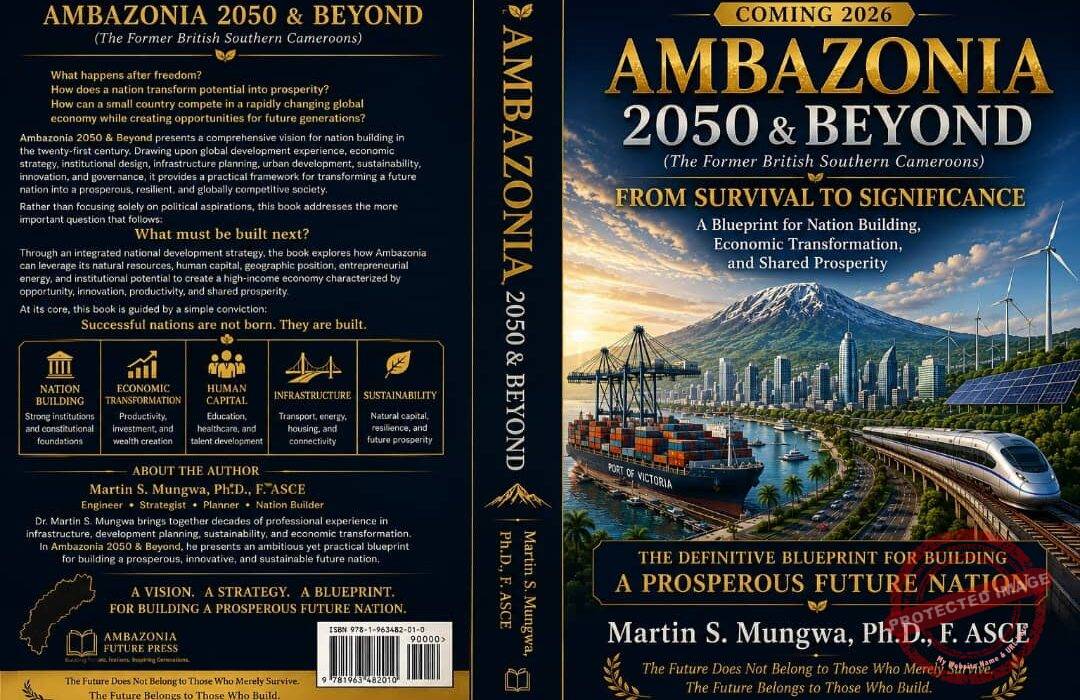
Yet remarkably few publications attempt to answer them comprehensively. Most books examine governance. Others focus on economics. Some explore constitutional law, infrastructure, education, security, or diplomacy. Rarely does a single work attempt to integrate these disciplines into one coherent vision for building a modern African state. That is what makes the forthcoming publication of Ambazonia 2050 & Beyond: A Vision for Nation Building, Prosperity, and Sustainable Development worthy of attention.
Authored by Dr. Martin S. Mungwa, PhD, F.ASCE, a civil and architectural engineer, infrastructure specialist, strategic planner, and Fellow of the American Society of Civil Engineers (ASCE), the book represents an ambitious attempt to answer one fundamental question: If a nation were designed today, with the benefit of global experience and modern knowledge, what institutions would give it the greatest chance of succeeding over the next century? This is not merely a book about politics. It is a book about civilization.
Spanning more than six hundred pages and supported by over two hundred original maps, figures, conceptual models, and institutional frameworks, the manuscript presents a comprehensive blueprint for national transformation. It integrates governance, constitutional design, economic development, infrastructure, transportation, education, healthcare, industrialization, environmental stewardship, financial systems, technology, innovation, urban planning, national security, diplomacy, and strategic foresight into a single long-term vision.
The significance of the work lies not in its scale alone, but in its philosophy. The central premise is both simple and profound: Successful nations are not built by chance. They are designed through institutions. That idea challenges much of the conventional thinking surrounding African development.
For decades, development has often been discussed in fragmented terms. Roads have been planned without industrial policy. Universities have expanded without innovation ecosystems. Financial reforms have been pursued without expanding ownership. Economic growth has too often been measured without asking who actually owns the wealth being created. The result has frequently been growth without transformation.
Ambazonia 2050 & Beyond argues that genuine national development requires systems thinking. Infrastructure must support commerce. Commerce must generate investment. Investment must finance innovation. Innovation must strengthen productivity. Productivity must expand opportunity. Opportunity must reinforce democratic stability. In other words, prosperity is an ecosystem.
This systems-based perspective reflects the author’s engineering background. Engineers understand that bridges, cities, transportation networks, and water systems function only when every component works together. The same principle, the book argues, applies to nations.
Strong institutions create confidence. Confidence attracts investment. Investment creates jobs. Jobs generate ownership. Ownership strengthens democracy. Democracy reinforces institutional stability. The cycle continues.
The work also arrives at an important historical moment. Africa is becoming one of the world’s youngest, fastest-growing, and most urbanized continents. Artificial intelligence is transforming industries. Climate resilience has become a strategic necessity. Competition for investment is intensifying. Supply chains are being reorganized. Digital finance is reshaping economies. Nations that fail to prepare today may struggle to compete tomorrow.
Against this backdrop, long-term national planning is no longer optional. It is essential. Perhaps the greatest contribution of this book is that it moves beyond the politics of protest toward the politics of preparation. Throughout modern history, many liberation movements have succeeded in achieving political independence. Far fewer have presented comprehensive frameworks for governing successfully after independence. This work attempts to fill that gap.
Whether readers ultimately agree with every recommendation is not the central question. Serious scholarship does not demand unanimous agreement. It invites informed debate. That debate is precisely what Africa needs.
Ideas remain one of the continent’s most valuable yet underutilized resources. Roads can be built. Ports can be expanded. Industries can be established. But without ideas capable of guiding institutions across generations, even the most ambitious investments struggle to achieve their full potential.
For that reason, Ambazonia 2050 & Beyond deserves attention well beyond the borders of Ambazonia. Its audience includes policymakers, engineers, economists, investors, diplomats, universities, development institutions, think tanks, entrepreneurs, and students interested in the future of African governance and development.
In the months ahead, The Independentist will introduce selected concepts from this landmark publication through a series of editorials exploring institutional excellence, infrastructure, ownership economics, financial transformation, education, technology, environmental stewardship, diplomacy, and strategic governance. These articles will not reveal the complete framework. They will simply begin a conversation.
Because every great nation begins with an idea. Every enduring institution begins with a vision. And every successful future begins with a plan. Whether one sees Ambazonia 2050 & Beyond as a blueprint for a future republic or as a contribution to broader African development thinking, one conclusion is difficult to escape:
The greatest investment a nation can make is not merely in its roads, ports, or buildings. It is in the quality of the ideas that shape them. The future does not happen by accident. It is designed.
The Independentist News editorial desk