








Commentary

We are home to news on Cameroon and the CEMAC region. We are dedicated to honest and reliable reporting. We are the voice of the Cameroonian people and their fight for freedom and democracy at a time when the Yaoundé government is silencing dissent and suppressing democratic voices.

The replacement of John Ngu Foncha by Solomon Tandeng Muna as Vice President further demonstrated Ahidjo’s ability to reshape the political landscape in ways that strengthened the center while weakening regional autonomy. By this stage, the federal system still existed on paper, but much of its practical ability to resist centralization had already been compromised.
By Ali Dan Ismael Editor-in-Chief The Independentist News
“Those who fail to learn from history are condemned to repeat it. The story of Southern Cameroons before and after reunification is not merely a historical a; it is a strategic lesson for future generations.”
The Tragedy of Division
One of the most important yet least discussed lessons of Southern Cameroons history is that nations are rarely defeated solely by external forces. More often, they are weakened from within before they are overcome from without. The story of Southern Cameroons during the years leading to and following the 1961 reunification illustrates this painful reality with remarkable clarity.
For decades, much of the historical discussion surrounding the collapse of the federal arrangement has focused on President Ahmadou Ahidjo and the centralizing policies of Yaoundé. While Ahidjo undoubtedly played a decisive role in dismantling the federal system, concentrating solely on his actions risks overlooking an equally important truth. Southern Cameroons entered one of the most consequential periods in its history deeply divided, politically fragmented, and strategically unprepared for the challenges that lay ahead.
Hon. Nerius Namaso Mbile’s memoir, Cameroon Political Story: Memories of an Authentic Eye Witness, provides one of the most valuable first-hand accounts of this period. Through the eyes of a participant who witnessed the events unfold, readers gain insight into how personal rivalries, regional loyalties, ideological disagreements, and competing political ambitions weakened Southern Cameroons’ collective bargaining position at the very moment unity was most needed.
The Endeley–Foncha Divide
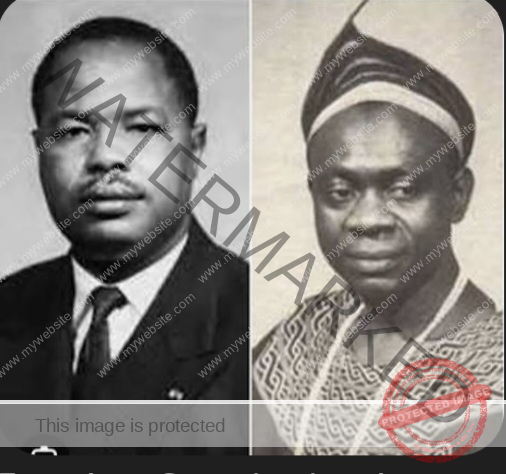
The rivalry between Dr. E.M.L. Endeley and John Ngu Foncha was perhaps the most significant political division of the era. Both men were intelligent, charismatic, and deeply committed to what they believed was best for Southern Cameroons. Yet they represented fundamentally different visions of the future.
Endeley favored continued association with Nigeria, believing that Southern Cameroons’ economic and administrative ties to Nigeria offered greater security and opportunity. Foncha, on the other hand, championed separation from Nigeria and reunification with French Cameroun, convinced that this path offered the best route to self-determination and national advancement.
These competing visions divided political parties, communities, and families. Instead of entering the decisive negotiations of the late 1950s and early 1960s with a unified constitutional position, Southern Cameroons approached its future fragmented into rival camps. The result was that energy that might have been directed toward negotiating strong constitutional guarantees was often consumed by internal political battles.
Hon. N.N. Mbile himself stood among those who opposed reunification and advocated the Nigerian option. He feared that joining French Cameroun would expose Southern Cameroons to gradual assimilation into a political system rooted in different administrative traditions, legal structures, and cultural practices. His concerns were shared by many who believed that the Anglo-Saxon institutions developed under British administration would struggle to survive within a larger Francophone-dominated state.
As the plebiscite approached and support for reunification increased, Mbile reportedly advanced proposals aimed at protecting regions that preferred continued association with Nigeria. Although those proposals never materialized, they reflected the depth of political division within Southern Cameroons at the time.
The Politics of Reunification
One of the enduring controversies surrounding reunification concerns the constitutional and legal arrangements that accompanied it. Critics have long argued that Southern Cameroons entered the federal arrangement without securing the kind of ironclad constitutional guarantees that might have protected its autonomy in the long term.
Whether one views reunification as a political necessity, a historical mistake, or a missed opportunity, what remains clear is that Southern Cameroons approached one of the most important negotiations in its history without the level of unity required to maximize its bargaining power.
The absence of a unified political strategy meant that Southern Cameroons often negotiated from a position of weakness while Yaoundé operated from a position of increasing cohesion and centralized authority.
Ahidjo’s Strategy of Consolidation
It was within this environment that Ahmadou Ahidjo demonstrated his considerable political skill. Unlike many of his opponents, Ahidjo understood that power is often accumulated incrementally rather than seized dramatically. He recognized that a divided West Cameroon presented opportunities that a united West Cameroon would never have allowed. Rather than confronting a single, coordinated political bloc, he faced multiple factions competing against one another for influence and access. The strategy was simple but effective.
Political rivals were played against one another. Regional disagreements were allowed to deepen. Personal ambitions were carefully managed and, when useful, encouraged. Leaders who aligned themselves more closely with the federal center found opportunities for advancement, while more autonomous-minded figures gradually lost influence.
Ahidjo did not have to defeat Southern Cameroons politically. In many respects, Southern Cameroons’ leaders weakened themselves through internal rivalries and competing ambitions.
The Road to Centralization
The creation of the Cameroon National Union in 1966 marked a major turning point. Presented as a solution to political instability and partisan conflict, the single-party system effectively eliminated the competitive political space that had distinguished West Cameroon. What had once been a vibrant democratic culture increasingly became absorbed into a centralized national structure dominated from Yaoundé.
The replacement of John Ngu Foncha by Solomon Tandeng Muna as Vice President further demonstrated Ahidjo’s ability to reshape the political landscape in ways that strengthened the center while weakening regional autonomy. By this stage, the federal system still existed on paper, but much of its practical ability to resist centralization had already been compromised.
The culmination of this process came with the 1972 referendum that abolished the federal structure and replaced it with a unitary state. By then, many of the institutional safeguards that might have protected West Cameroon had either been weakened, surrendered, or rendered ineffective.
The Lessons of Mbile’s Memoir
5ng aspect of this history is not Ahidjo’s political skill. Political leaders everywhere seek to consolidate power. What is striking is how effectively he was able to exploit divisions that already existed within Southern Cameroons itself. Mbile’s memoir therefore serves as more than a historical record. It serves as a warning.
The lesson is not simply that Ahidjo was clever. The lesson is that disunity carries consequences. Political fragmentation creates opportunities for stronger and more organized actors. Personal rivalries can undermine collective interests. Tactical victories can produce strategic defeats.
The tragedy of Southern Cameroons was not merely that it encountered a determined centralizing leader in Yaoundé. It was that it encountered that challenge while divided among itself.
Lessons Learned: A More United National Consciousness
Fortunately, history does not merely record mistakes; it also provides opportunities for learning and correction. One of the most significant developments within the modern Ambazonian struggle has been the emergence of a broader national consciousness that transcends many of the regional and political divisions that characterized the pre-independence era. The painful lessons of the 1950s and 1960s have not been forgotten.
The rivalries that once divided coastal and Grassfields communities, political parties, and competing leadership camps have largely given way to a shared understanding that the survival and future prosperity of the nation depend upon unity of purpose. While disagreements continue to exist—as they do in every democratic movement—few Ambazonians today question the importance of maintaining a common strategic objective.
The experiences of Foncha, Endeley, Muna, Mbile, Jua, and their contemporaries have become valuable lessons for a new generation. Many now recognize that internal fragmentation often benefits external actors more than it benefits the people themselves. The realization that political division weakened Southern Cameroons’ bargaining position during one of the most critical periods in its history has encouraged greater efforts toward cooperation and consensus-building.
This does not mean that all differences have disappeared. No healthy political movement is entirely free of debate. However, there is a growing recognition that disagreements must be managed without undermining collective national interests. The modern struggle has increasingly been shaped by the understanding that unity is not the absence of differing opinions but the ability to pursue common objectives despite those differences.
In this sense, the lessons of the reunification era have not been entirely lost. The mistakes of the past have helped cultivate a stronger appreciation for solidarity, strategic thinking, institution-building, and national cohesion. The divisions that once enabled others to shape the destiny of Southern Cameroons have, to a significant degree, been mitigated by the hard-earned wisdom of history.
This growing national consciousness is also reflected in emerging efforts to articulate a shared vision for the future. One such contribution is the forthcoming book, Ambazonia 2050 & Beyond, which seeks to move the national conversation beyond resistance and survival toward governance, economic transformation, institution-building, and shared prosperity. At its core is the belief that sustainable freedom requires more than political liberation. It requires competent leadership, accountable institutions, sound economic policies, and a unifying national vision capable of inspiring future generations.
The enduring lesson of our history is that unity alone is not enough. Unity must be organized around principles that promote good governance, economic opportunity, social stability, and national development. Prosperity is not merely the reward of freedom; it is the foundation upon which freedom becomes sustainable. A nation that governs well, creates opportunities for its citizens, and transforms its resources into shared prosperity builds the strongest defense against future instability and division.
That may ultimately prove to be one of the most important legacies of the lessons learned from the reunification era and one of the most important contributions of the next generation of Ambazonian nation-builders.
Conclusion: Unity as a Strategic Asset
History repeatedly demonstrates that external pressures become far more effective when internal cohesion collapses. Nations that cannot agree on their fundamental objectives often find their futures shaped by those who can.
Whether one supports independence, federalism, confederation, or any other political arrangement, the historical record points to a simple and enduring truth: a divided people negotiate from weakness, while a united people negotiate from strength.
The story of Southern Cameroons in the years surrounding reunification is therefore not merely a story about Ahidjo, Foncha, Endeley, Muna, or Mbile. It is a story about the cost of division and the value of unity. It is a lesson written in history, paid for by a generation, and one that future generations ignore at their own peril.
The greatest tribute that can be paid to those who lived through that era is not merely to remember their successes and failures, but to learn from them. If the past teaches anything, it is that unity remains the most powerful political asset any nation can possess. Yet history also teaches that unity without vision is fragile, and freedom without prosperity is difficult to sustain.
The challenge before this generation is therefore greater than simply preserving unity. It is to build institutions, cultivate good governance, create economic opportunity, and establish a national development framework capable of transforming political aspirations into lasting prosperity. Only then can the mistakes of the past become the foundations of a stronger future.
For a people that has learned the painful lessons of division, the next chapter must be written not merely around resistance, but around nation-building. That is the pathway through which unity becomes strength, strength becomes prosperity, and prosperity becomes the guarantor of a sustainable future.
Ali Dan Ismael Editor-in-Chief The Independentist News
Share This Post:
I DID NOT CHOOSE THIS; IT CHOSE ME
THE MENCHUM HYDROPOWER REVOLUTION: From Energy Dependency to Energy Abundance, The Blueprint for Powering Ambazonia’s Industrial Future
Related Post
WHEN INDEPENDENCE BECOMES STATECRAFT: What Scotland, Wales and Ireland’s
Dr. Martin Mungwa publishes Southern Cameroons 2050 : why
Adelle Nazarian of the Western Journal calls on the
NKAMOUNA, WASHINGTON, AND THE NEW POLITICS OF AFRICA’S STRATEGIC
When Conflict Becomes an Economy The Political Economy of
THE POLITICAL ECONOMY OF THE SOUTHERN CAMEROONS CONFLICT: Who