












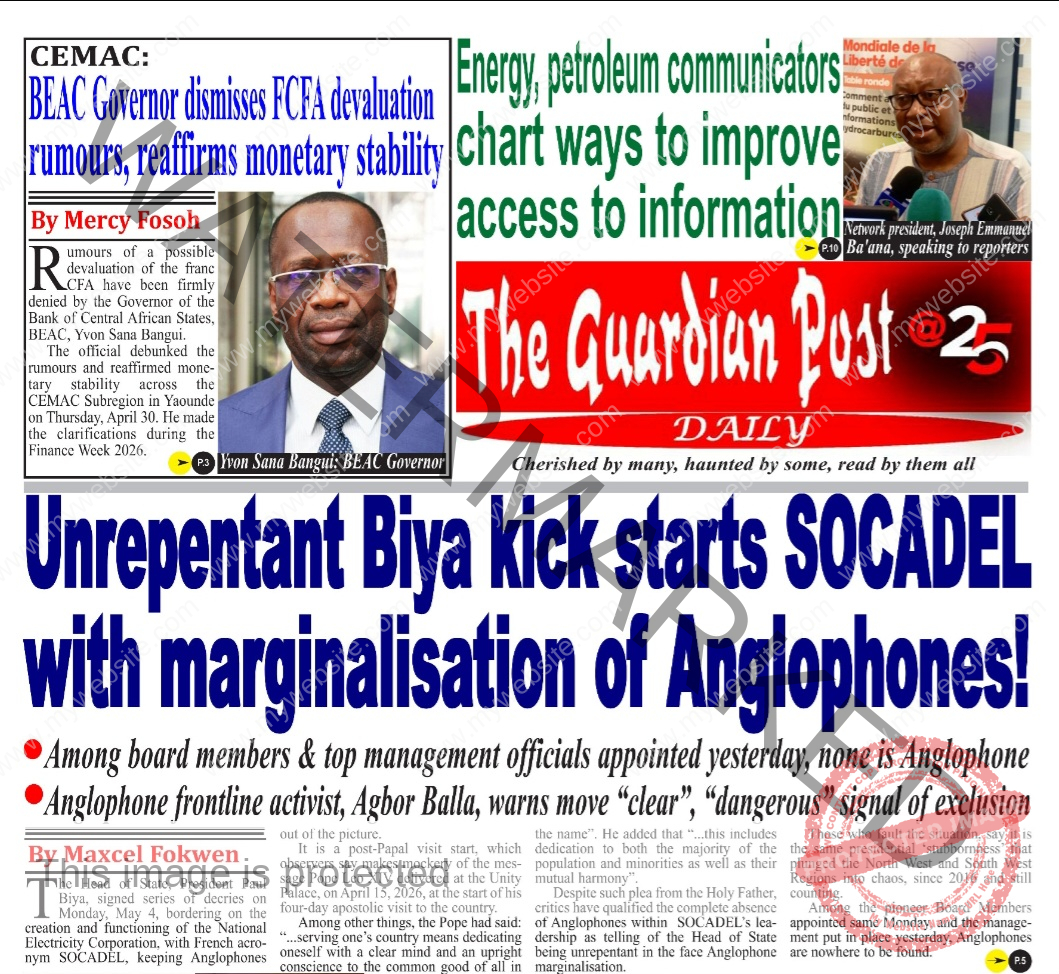
If representation can be effectively removed from the management of national resources—such as electricity—then the argument that the Anglophone crisis is administrative rather than structural becomes increasingly difficult to sustain.
By Timothy Enongene
Guest Editor-in-Chief, The Independentist News
Editor’s Note:
Timothy Enongene serves as Guest Editor-in-Chief for this special analysis series, bringing independent, policy-focused perspective to critical national developments.
5 May 2026
There are moments in the life of a nation when a single administrative decision reveals more truth than a decade of official speeches. The recent appointments to the SOCADEL board in Cameroon constitute such a moment. This is not merely a question of who sits on a corporate board. It is a question of how power is structured, how representation is defined, and whether the Anglophone population is considered a constituent part of the state—or an administrative afterthought. What has been presented as routine governance is, in fact, a revealing political signal.
The End of the “Equilibrium” Illusion
For decades, the Cameroonian state has maintained the language of “National Equilibrium”—a doctrine suggesting that the country’s diverse regions would be reflected, however imperfectly, in the composition of state institutions. The SOCADEL appointments suggest that even this minimal symbolic framework is no longer considered necessary. An overwhelmingly Francophone board overseeing a strategic national utility—electricity—cannot be dismissed as coincidence. It reflects a deeper institutional posture: that representation is optional, and that the Anglophone question has been politically neutralized. This is not inclusion. It is consolidation.
From Participation to Symbolism
The evolution is clear. There was a time when Anglophone participation in state structures, however limited, served as a legitimizing mechanism. It allowed the government to point to inclusion, even as structural grievances remained unresolved. That phase appears to be ending. The emerging model is one in which Anglophone presence is no longer required even for symbolic purposes. Participation has shifted from limited influence to near-total insignificance within critical decision-making structures. The implication is stark: the system no longer seeks to manage the Anglophone question—it seeks to outlast it.
The Role of the Intermediary Class
No system of this nature operates in isolation. It depends on an intermediary class—political, administrative, and social actors who translate state authority to their communities while transmitting compliance back to the center. For years, segments of the Anglophone elite have occupied this role. Their function has been to reassure the population of reform, frame the crisis as temporary or exaggerated, and maintain the appearance of national cohesion. The SOCADEL appointments raise an uncomfortable question: What is the value of an intermediary class when it no longer influences outcomes? If representation cannot be secured even at the level of a national utility board, then the notion of internal advocacy begins to lose credibility. This is not a moral judgment. It is a structural reality.
Governance by Signal
States communicate not only through policy, but through patterns. The pattern here is unmistakable. In the context of a prolonged conflict in the Northwest and Southwest regions—one that has resulted in significant loss of life, displacement, and institutional breakdown—the expectation would be increased sensitivity to representation, not its visible erosion. Yet the opposite is occurring. This suggests a shift toward what might be termed governance by signal: decisions that communicate strength to the center, indifference to the margins, and finality to unresolved political questions. The message is not negotiated. It is asserted.
The Strategic Implication
If representation can be effectively removed from the management of national resources—such as electricity—then the argument that the Anglophone crisis is administrative rather than structural becomes increasingly difficult to sustain. The issue is no longer one of policy adjustment or decentralization. It becomes a question of political architecture: who holds power, how it is distributed, and whether meaningful participation is structurally possible within the existing framework. This is the conversation that the SOCADEL decision forces into the open.
The Bottom Line
The SOCADEL board is not just an institutional arrangement. It is a statement. It suggests that the state no longer feels compelled to balance, to signal inclusion, or to maintain even the optics of shared governance. In doing so, it clarifies what years of rhetoric have obscured: that the crisis is not merely about language, administration, or reform. It is about power—and who is permitted to exercise it. And once that question is laid bare, it cannot easily be returned to silence.
Timothy Enongene
Guest Editor-in-Chief, The Independentist News






Leave feedback about this