

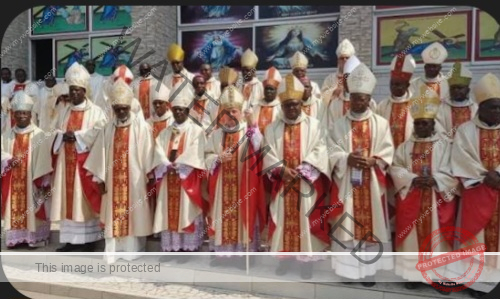


Before the elections, the Bishops of Cameroon had issued a courageous pastoral letter reminding the nation that “the will of the people must be respected.” Those words carried the weight of moral authority — a reminder that democracy is not merely a political ritual, but a sacred obligation to truth and justice. Yet, after the ballots were cast and the Constitutional Council proclaimed results that defied public expectation, the Church fell into a silence that unsettled even its most devoted faithful.
By Christopher Achobang
The Catholic Church in Cameroon remains one of the most powerful and respected institutions in the country — present in every village, trusted by nearly every household, and listened to by more people than any political party could ever hope for. Its network of parishes, priests, catechists, and lay faithful reaches places where the state itself is little more than a rumour. And yet, during the last presidential elections, this same Church — which could have stood as a moral bulwark for truth — chose to watch history unfold from the sidelines.
Before the elections, the Bishops of Cameroon had issued a courageous pastoral letter reminding the nation that “the will of the people must be respected.” Those words carried the weight of moral authority — a reminder that democracy is not merely a political ritual, but a sacred obligation to truth and justice. Yet, after the ballots were cast and the Constitutional Council proclaimed results that defied public expectation, the Church fell into a silence that unsettled even its most devoted faithful.
It is not that the bishops lacked courage; perhaps they feared confrontation in an atmosphere charged with political tension. But moral leadership is rarely convenient. The Church could have mobilized its immense human and spiritual resources — priests, nuns, and lay observers in every parish — to document and report irregularities, to serve as a moral presence where state institutions had failed. Even in regions where the ruling party had no agents, the Church could have offered eyes and ears for truth.
When it mattered most, however, the same institution that has never hesitated to condemn sin from the pulpit declined to confront political deceit in the public square. The result was more than political disappointment — it was moral failure. Silence, however well-intentioned, became complicity. It allowed manipulation to masquerade as victory, and falsehood to wear the robes of authority.
Cameroon did not need its bishops to act as politicians; it needed them to act as shepherds — to speak truth with compassion, to comfort the oppressed, and to remind rulers that power must serve justice. Instead, the shepherds chose the safety of neutrality over the risks of prophetic witness. Their prayers were earnest, but their silence was deafening.
Going forward, faith-based institutions — Catholic, Protestant, Muslim, and others — should be granted official observer status in national elections. They already possess the trust, neutrality, and nationwide reach that many self-styled “observers” do not. Their involvement could help restore both transparency and moral integrity to a democratic process that too often feels hollow.
History will remember that when Cameroon cried for witnesses, the Church was there — but only to count rosaries, not votes.
Christopher Achobang is a Pan-African Social Justice Campaigner.