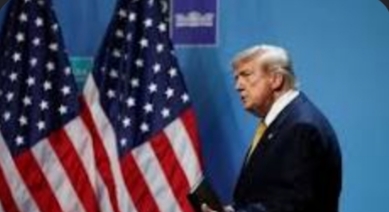


Trump has reopened that debate. His challenge is to prove that America can reduce the cost of empire, resist the doctrine of extraction and rebuild productive power without sacrificing public credit, institutional stability or the alliances that support its global influence.Tariffs can open the door to industrial renewal.Only investment, knowledge, fiscal discipline and enduring institutions can walk through it.
By Ali Dan Ismael, Editor-in-chief The Independentist News
The Return of an Old American Argument
Donald Trump presents his economic program as a revolt against globalization, political orthodoxy and the governing assumptions that shaped Washington for much of the postwar era. Yet beneath its populist language lies an argument almost as old as the United States itself. That argument belongs, in substantial part, to Alexander Hamilton.
Hamilton believed that the young American republic could not preserve political independence while remaining economically dependent on established European powers. A country that exported agricultural commodities while importing manufactured goods, technologies and strategic supplies might possess a flag and a government, but it would not possess the productive strength required for durable sovereignty.
Trump’s emphasis on tariffs, domestic manufacturing, strategic industries, reshoring and reduced dependence on foreign supply chains echoes that Hamiltonian concern. He argues that the United States surrendered too much of its industrial base in exchange for cheaper imports, corporate efficiency and an international economic order that frequently benefited producers outside the country more than workers within it. The resemblance between Trump and Hamilton is real. But it is incomplete.
Trump is reviving Hamilton’s economic nationalism more clearly than Hamilton’s complete economic system. He has restored the language of national production, strategic trade and industrial sovereignty. Yet he has not fully joined those objectives to the public credit, fiscal discipline, institutional permanence and coordinated productive investment that defined Hamilton’s larger vision.
Trump’s gamble is therefore not simply whether tariffs can change trade. It is whether economic nationalism can be transformed into a durable national development strategy.
Political Independence Without Economic Power
When Hamilton wrote his Report on Manufactures in 1791, the United States was overwhelmingly agricultural. Conventional economic thinking suggested that the new nation should exploit its agricultural advantages, export raw products and purchase manufactured goods from Europe.
Hamilton rejected that passive division of labor. He understood that countries already possessing advanced industries would preserve their advantages through accumulated capital, technology, skilled labor, commercial networks and state support. A young republic that accepted permanent specialization in agriculture could become formally independent while remaining economically subordinate.
Manufacturing, in Hamilton’s view, would diversify employment, stimulate invention, support agriculture, expand markets and reduce dependence on foreign powers. Government therefore had a legitimate role in encouraging industries that private capital might not establish quickly enough on its own.
Hamilton was not merely trying to protect individual factories. He was trying to create national capability. He wanted the United States to produce more of what it consumed, acquire technical knowledge, develop financial institutions and participate in international commerce from a position of increasing strength.
Trump begins from a similar anxiety. He argues that decades of globalization encouraged companies to move factories, knowledge and supply chains abroad while American communities absorbed the social and economic damage. Corporate profits rose, consumers gained access to inexpensive products and financial markets expanded, but many industrial towns lost employment, tax revenue, technical skills and social stability. In Trump’s interpretation, this was not simply economic evolution. It was a national strategic failure.
His answer is to use federal power—especially tariffs—to change the calculations of companies, investors and foreign governments. Imported goods should become more expensive. Domestic production should become more attractive. Foreign governments should face pressure to open markets, contribute more to shared security and reduce practices Washington considers unfair. This is recognizably Hamiltonian in instinct.
Tariffs as Instruments of National Power
Trump does not treat tariffs merely as taxes on imports. He treats them as instruments of industrial policy, negotiation, national security and political leverage. A tariff can protect a domestic producer from lower-cost foreign competition. It can encourage a company to relocate production. It can generate government revenue. It can also be threatened, increased or suspended to secure concessions from trading partners.
This approach rejects the assumption that the principal purpose of trade policy should be to deliver the lowest possible consumer price. Trump’s argument is that inexpensive imports may carry hidden national costs.
A country may enjoy cheap goods while losing factories. It may enjoy corporate efficiency while losing technical knowledge. It may enjoy access to foreign products while becoming unable to manufacture essential equipment during war, pandemics, supply disruptions or geopolitical confrontation. What appears efficient on a corporate balance sheet may leave the nation strategically exposed.
Hamilton would have recognized this concern. He believed that productive capacity was closely connected to national defense. Dependence upon foreign powers for essential supplies could become a political weakness when relations deteriorated.
Trump is therefore reviving a long American tradition in which commerce, production and national power are inseparable. But tariffs are only instruments. Their value depends on the productive strategy they serve.
The Doctrine of Extraction
Behind Hamilton’s economic nationalism stood a rejection of what may be called the doctrine of extraction. The great European empires did not generally develop colonies as equal participants in a shared system of prosperity. They organized many colonial economies to extract raw materials, labor, agricultural products and strategic resources while concentrating manufacturing, finance, shipping, insurance and technological power in the imperial center.
The colony supplied cocoa, cotton, timber, minerals, rubber, oil or other commodities. The imperial economy processed, financed, insured, transported and marketed those resources. The most valuable stages of production remained concentrated at the center, while the periphery was left dependent upon imported finished goods.
Extraction was therefore more than the physical removal of resources. It was the removal of value. It was a system in which one society supplied the raw material while another accumulated the capital, knowledge, technology and ownership generated from it. Infrastructure in the colony was often designed primarily to move resources from the interior to the port rather than to connect domestic communities or stimulate balanced national development.
Hamilton understood that the early United States could fall into a comparable relationship with Europe. It might remain independent in law while serving as a supplier of raw products to more industrialized countries. His manufacturing program was therefore not merely economic policy. It was an anti-extraction strategy.
He wanted the United States to move beyond supplying the raw materials of other nations’ prosperity. He wanted Americans to manufacture, finance, transport, invent and retain a greater share of the value created from their own resources and labor.
Trump’s economic nationalism also presents itself as a revolt against extraction, although in a modern form. He argues that multinational corporations, foreign governments and global supply chains extracted productive capacity from American communities. Factories moved abroad, intellectual property was transferred or copied, trade deficits widened and the United States became the consumer of products it had once manufactured.
In this account, the modern doctrine of extraction did not remove American raw materials. It extracted factories, employment, technical capacity and economic confidence.
The political force of Trumpism comes partly from communities that believe they were treated as internal colonies of globalization—useful as consumers, voters and military recruits, but increasingly abandoned as centers of production.
Whether this interpretation explains every dimension of industrial decline is debatable. Automation, technological change, productivity gains and shifting consumer demand also transformed employment. Yet Trump’s larger point resonates because economic systems can increase aggregate wealth while concentrating the costs of adjustment in particular regions and classes. The people who lost factories were repeatedly told that the national economy was succeeding. Their lived experience told them otherwise.
The Cost of Empire
Trump’s economic nationalism also reflects his view that the United States has carried too much of the cost of empire. America does not describe itself formally as an empire in the classical European sense. It does not generally govern large overseas colonies through appointed governors. Yet it maintains military bases, alliance commitments, global financial influence, maritime security responsibilities and political interests across much of the world.
This international system has given the United States extraordinary benefits. It has supported the global use of the dollar, expanded markets for American firms, protected shipping routes and allowed Washington to shape international institutions.
But power also carries costs.
The United States spends heavily on defense, maintains forces across several continents and assumes major responsibilities for deterring adversaries and protecting allies. Its market has often remained more open than those of certain trading partners. Its consumers have absorbed vast quantities of imported goods, while the dollar’s international role has helped finance persistent trade imbalances and government borrowing.
Trump views many of these arrangements as unfair exchanges. He questions why American taxpayers should carry a disproportionate share of alliance costs. He asks why countries protected by American military power should also run large trade surpluses with the United States. He challenges a system in which America provides security, market access and financial stability while receiving what he considers insufficient economic reciprocity. His worldview is transactional but internally consistent.
Security should be paid for.
Market access should be reciprocal. Allies should contribute more. Foreign investment should produce American employment. Trade relationships should deliver measurable national advantage. In this sense, Trump is not seeking to abandon American power. He is attempting to make others pay more for the system that power sustains.
The old empire extracted tribute from the periphery.
Trump wants the center to stop subsidizing the periphery. That is one of the most important changes in the contemporary American debate. The question is no longer simply whether the United States should remain globally engaged. It is whether the economic and military architecture of American leadership still produces an acceptable return for the American public.
When the Hegemon Pays for the System
Empires and hegemonic powers face a recurring contradiction. They create systems that expand their influence, but maintaining those systems eventually becomes expensive. Military commitments multiply. Allies grow accustomed to protection. Administrative responsibilities expand. Domestic industries may weaken as the leading power opens its markets, supports the global currency and tolerates trade imbalances in exchange for broader geopolitical influence.
The benefits of leadership may be widely distributed among corporations, financial institutions and international partners, while its costs become concentrated among taxpayers, soldiers and industrial communities.
Trump has converted this contradiction into a political doctrine. He argues that the United States can no longer act as the world’s insurer, consumer of last resort and principal security provider without demanding greater compensation. Tariffs, defense burden-sharing and investment agreements become ways of renegotiating the price of American leadership. But this approach contains risks.
Alliances are not ordinary commercial contracts. Their value cannot always be calculated through immediate financial contributions. A military partnership may prevent a larger conflict whose avoided cost cannot be placed neatly on a balance sheet. Open markets may strengthen political relationships even when bilateral trade is uneven. The dollar’s international role lowers some borrowing costs and expands American financial influence even as it contributes to economic distortions.
The cost of empire is therefore real, but so are the benefits of leadership.
Trump’s challenge is to reduce the burden without destroying the system from which American power continues to profit. Trump Is More Protectionist Than Hamilton The comparison with Hamilton becomes less exact when their instruments are examined closely.
Hamilton supported tariffs, but his program was more nuanced than the popular image of an uncompromising protectionist. He also favored direct incentives, financial institutions, infrastructure, access to capital and technological acquisition.
He understood that excessively high tariffs could raise prices, weaken competition, reduce imports and diminish customs revenue. The young federal government depended heavily on import duties, so eliminating trade would also eliminate an important source of public income. Trump places much greater political weight on tariffs themselves.
This difference is crucial because tariffs can create breathing space for domestic producers, but they do not automatically create competitive industries. They cannot by themselves train skilled workers, construct modern factories, expand electricity generation, finance scientific research or build efficient transportation networks.
Protection may give an industry time to develop. It may also allow an inefficient industry to postpone development. The outcome depends on what follows the tariff. A genuinely Hamiltonian policy would demand productive transformation in exchange for protection. Companies benefiting from tariffs should invest in plants, train workers, improve productivity, develop technologies and strengthen domestic supply chains. Without such requirements, protection may strengthen corporate profits more effectively than national capability.
From Tariff Policy to Industrial Strategy
Industrial policy is not merely a wall against imports. It is a coordinated system for creating capabilities that markets alone may develop too slowly or unevenly. A serious industrial strategy requires research institutions, technical education, energy infrastructure, supply-chain finance, public procurement, transportation systems and partnerships among government, universities and private enterprise.
Trump’s program includes elements of this broader approach. His administration promotes deregulation, energy development, domestic investment and the relocation of manufacturing. But the effectiveness of those policies must be measured through sustained results rather than announcements.
A factory announcement is not a factory. A completed factory is not necessarily a competitive industry. A competitive industry is not necessarily an innovative ecosystem. The true test is whether the United States accumulates knowledge, technical capability, intellectual property and ownership that remain valuable after protection is reduced. Tariffs can influence where final assembly occurs. They cannot alone determine where advanced research, engineering, patents and strategic decision-making will reside. Trump’s Hamiltonian gamble will be decided by whether protection becomes a bridge to productivity or a shelter from competition.
Public Credit: The Missing Hamiltonian Foundation
The greatest difference between Trump and Hamilton lies not in trade but in public finance.
Hamilton regarded public credit as one of the indispensable foundations of national power. The United States emerged from the Revolution burdened by debt and uncertain financial credibility. Hamilton believed the federal government had to honor legitimate obligations, organize its debt and prove that the republic could be trusted.
Debt, in his view, was not automatically destructive. Properly managed borrowing could finance national development and strengthen confidence in the federal government. But public debt had to be supported by reliable revenue, competent administration and confidence that obligations would be honored. Trump’s program is less Hamiltonian on this front.
The United States continues to carry large fiscal deficits and rising debt. The cost of servicing that debt increasingly competes with defense, infrastructure, research and social programs.
Trump and his supporters argue that tax reductions, deregulation, energy production, tariffs and faster growth can improve the fiscal position. Growth certainly matters. A larger and more productive economy can carry public obligations more easily than a stagnant one. But growth cannot replace arithmetic.
If revenues remain below expenditures, deficits continue. If tariff income is expected to replace conventional taxation, policymakers must confront the fact that successful protection may reduce the very imports upon which tariff revenue depends. Hamilton’s doctrine of public credit requires a credible relationship among borrowing, revenue and productive national capacity.
A government following Hamilton’s full example would distinguish between debt that builds future capability and debt that postpones present choices. Borrowing for infrastructure, defense production, scientific research or technological transformation may expand future power. Permanent structural deficits without a credible path to stabilization may weaken the credit upon which national power depends.
The Cost of Empire and the Debt State
The financial burden of global leadership makes this problem more severe. The United States finances a military establishment capable of operating across the world. It supports alliances, intelligence systems, naval patrols, overseas facilities and advanced weapons programs. Many of these commitments are strategically justified, but together they carry enormous long-term costs.
At the same time, the government supports domestic programs, responds to emergencies and manages the political difficulty of raising taxes or reducing spending. The result is a state that attempts to finance both imperial reach and domestic prosperity through persistent borrowing.
This arrangement can continue for a long time because the dollar occupies a privileged position in the international system. Global demand for American financial assets gives Washington a borrowing capacity unavailable to most governments. But privilege can become temptation.
A country able to borrow easily may postpone difficult choices longer than a country forced to live within immediate financial constraints. Over time, the interest burden grows, fiscal flexibility declines and more national revenue is devoted to servicing past commitments rather than building future capacity.
Trump wants to reduce the external cost of American leadership, but tariffs alone cannot solve the fiscal burden of empire. Allies may contribute more, yet America will still need to decide which commitments remain essential, which can be shared and which no longer justify their cost.
Hamilton would likely have insisted that national ambition remain connected to national credit. Power financed without discipline eventually weakens the financial foundation upon which power rests.
Institutions, Not Presidential Bargains
Hamilton’s economic nationalism was inseparable from institution-building. He helped establish a Treasury capable of managing federal finances. He supported a national bank that could facilitate payments, expand credit and connect private capital to national development. He designed systems that could survive changes in leadership.
Trump’s style is more personal and transactional. He frequently presents economic outcomes as the result of direct presidential bargaining. Tariffs are imposed, threatened or adjusted as negotiations develop. Companies announce investments after discussions with the administration. Foreign governments are pressed to make visible concessions. This style can produce speed. It can also produce uncertainty.
Industrial investment requires predictable rules. Companies building semiconductor plants, steel mills, pharmaceutical facilities or advanced manufacturing centers make decisions that take years to complete and decades to repay. They need confidence that tariff rates, tax policies, investment conditions and regulatory expectations will remain sufficiently stable.
A policy that changes rapidly may obtain short-term concessions while discouraging long-term capital formation. Hamilton’s deeper lesson is that national strategy must become larger than one president. It must be embedded in laws, institutions, professional administration and durable priorities. Otherwise, industrial policy risks becoming political theater that is reversed whenever power changes hands.
Tariffs Cannot Manufacture Skills
Modern industry depends on engineers, technicians, scientists, machinists, software specialists and workers capable of operating sophisticated systems. A tariff can make an imported product more expensive. It cannot produce the skilled labor required to manufacture its replacement.
An American industrial revival therefore depends on education and training as much as trade enforcement. Community colleges, apprenticeships, technical institutions, engineering schools and employer-based training systems must be treated as strategic infrastructure.
Workers displaced by industrial decline cannot simply be instructed to enter advanced manufacturing. They require access to knowledge, credentials, mobility and employers willing to invest in their development. A fully Hamiltonian strategy would connect protection to preparation.
It would ask not only where factories are being built, but who will operate them, who will design their technologies, who will finance their expansion and who will own the resulting productive wealth. Without this human-capital foundation, reshoring may produce isolated facilities while leaving deeper technical dependencies unresolved.
The Consumer and the National Interest
Economic nationalists are correct to question a system that treats the cheapest product as the highest national objective. But consumers cannot simply be dismissed. Tariffs may raise costs for importing firms, manufacturers that depend on foreign components and households purchasing finished goods. Trading partners may retaliate, affecting exporters and agricultural producers.
This does not mean every tariff is misguided. Governments routinely accept short-term costs to achieve national objectives. Defense, infrastructure and environmental protection all impose costs because societies value more than immediate consumption. The relevant question is whether the sacrifice produces lasting capacity. Citizens may accept higher short-term prices to rebuild strategically necessary industries. They are less likely to accept permanent costs when the beneficiaries are protected corporations that fail to invest or innovate.
A Hamiltonian tariff should therefore have clear objectives, performance standards and periodic review. Protection should be linked to productivity, investment and national-security requirements—not granted indefinitely because a politically influential industry demands it.
Extraction Can Also Occur at Home
The doctrine of extraction is usually associated with colonial relationships, but extraction can also occur within a nation. Financial centers may accumulate wealth while industrial regions decline. Corporations may remove profits from communities without reinvesting in local infrastructure, schools or productive capacity. Workers may contribute decades of labor while ownership and decision-making remain concentrated elsewhere.
In this sense, parts of the United States experienced an internal extraction economy. Factories produced wealth, but corporate headquarters moved. Communities trained workers, but investment shifted abroad. Local governments built roads, utilities and schools, but the tax base disappeared when companies relocated. The profits of globalization were nationalized among shareholders and consumers, while many of its social costs were localized in towns that lost employment and population. Trump’s political success cannot be understood without recognizing this geography of abandonment.
His promise to restore manufacturing is not merely an economic proposition. It is a promise to restore dignity, visibility and national purpose to communities that believe the previous order extracted their productive life and then blamed them for failing to adapt. Whether his policies can deliver that restoration remains uncertain. But the grievance is real.
The Danger of Reversing Extraction With Another Extraction
Trump’s program also carries the risk of replacing one form of extraction with another. A tariff system can become a mechanism through which politically connected firms extract higher prices from consumers without delivering productivity. Government contracts can enrich favored companies. Industrial subsidies can become permanent claims on public revenue.
Economic nationalism can protect workers. It can also protect monopolies. The difference depends on transparency, competition and accountability. A serious industrial strategy must require performance. Firms receiving protection or public support should demonstrate investment, innovation, workforce development and domestic value creation. Otherwise, the state may use the language of national renewal while transferring wealth from the public to private interests.
Hamilton’s system was designed to mobilize finance for national development. It should not be reduced to an arrangement in which private beneficiaries capture the rewards while taxpayers and consumers carry the risks.
Negotiation Is Not Development
Trump frequently uses tariffs as leverage. Duties may be announced, raised, postponed or reduced to secure concessions. As a negotiating instrument, this can be powerful. The size of the American market gives Washington enormous influence over companies and countries that depend on access to American consumers. But negotiation and development are not the same.
A foreign government may offer concessions without changing the underlying industrial balance. A company may announce an American facility while keeping its most valuable research and intellectual property abroad. An investment promise may receive publicity long before construction begins.
The number of agreements signed is therefore less important than the productive consequences that follow. Are supply chains becoming more resilient? Is domestic value creation increasing? Are strategic dependencies declining? Are workers earning higher real wages? Is productivity rising? Are American companies developing technologies rather than merely assembling imported components? Those questions determine whether economic nationalism creates national power.
The Unfinished Hamiltonian Return
Trump did not single-handedly restore industrial policy to American politics. Concern about supply chains, semiconductors, energy, advanced manufacturing and strategic competition had already become increasingly bipartisan.
The deeper transformation is that the old free-trade consensus has weakened. Leaders across the political spectrum now recognize that markets do not always produce nationally desirable outcomes, especially where security, technology and concentrated foreign production are involved.
Trump’s contribution has been to place tariffs and economic nationalism at the center of political debate. He has returned the country to Hamilton’s original question: Can a republic remain politically independent if it loses control over the productive foundations of its power?Hamilton’s answer was no. Trump’s answer is also no. But Hamilton joined protection to credit, finance, infrastructure, administration and institutional development. Trump has revived the alarm. He has not yet completed the architecture.
What a Complete Hamiltonian Strategy Would Require
A complete Hamiltonian strategy would integrate tariffs into a broader national system. Protection would be targeted toward sectors with genuine strategic, technological or security importance. It would be linked to measurable investment, productivity and workforce-development goals.
Industrial finance would support firms capable of building domestic supply chains and advanced technologies rather than merely capturing political favor. Public revenue would be managed in ways that strengthened national credit. Borrowing would be directed toward long-term productive capacity rather than permanent structural imbalance.
Infrastructure, energy systems, research institutions and technical education would develop alongside tariff protection. The cost of global leadership would be reviewed honestly. Allies would carry a fairer share, but America would preserve partnerships that strengthen its security and influence. Most importantly, the strategy would be institutionalized so that it could endure beyond one administration.
Hamilton’s achievement was not that he discovered tariffs. Governments had used them for centuries. His achievement was that he connected finance, manufacturing, credit and national power within one developmental framework. Trump has revived an important part of that framework. He has not yet demonstrated the same integration.
Hamiltonian in Instinct, Incomplete in Execution
Trump is Hamiltonian in his conviction that productive capacity is inseparable from national sovereignty. He is Hamiltonian when he rejects permanent dependence on foreign powers for critical industrial goods. He is Hamiltonian when he treats government as an active force capable of shaping markets in the national interest. He is also Hamiltonian when he challenges a system that extracts value from productive communities while concentrating wealth and decision-making elsewhere.
But he is less Hamiltonian when tariffs substitute for a comprehensive industrial strategy, when fiscal deficits threaten public credit, when policy depends heavily upon presidential bargaining and when the long-term cost of American global power remains unresolved.
Trump’s Hamiltonian gamble may succeed in important respects. It may accelerate factory investment, diversify supply chains and restore political attention to communities damaged by industrial decline. It may also impose substantial costs without creating the competitive industries its supporters anticipate.
The final judgment will not be determined by rhetoric, tariff announcements or ceremonial investment pledges. It will be determined by whether the United States emerges with greater productivity, deeper technological capability, stronger public finances and institutions capable of sustaining national development beyond Trump’s presidency.
Hamilton understood that economic nationalism was not simply about restricting what entered the country. It was about increasing what the country could create. He also understood that a republic should not remain trapped within an extractive relationship in which others capture the highest value from its labor and resources.
Trump has reopened that debate. His challenge is to prove that America can reduce the cost of empire, resist the doctrine of extraction and rebuild productive power without sacrificing public credit, institutional stability or the alliances that support its global influence.Tariffs can open the door to industrial renewal.Only investment, knowledge, fiscal discipline and enduring institutions can walk through it.
Ali Dan Ismael, Editor-in-chief The Independentist News