








Commentary

We are home to news on Cameroon and the CEMAC region. We are dedicated to honest and reliable reporting. We are the voice of the Cameroonian people and their fight for freedom and democracy at a time when the Yaoundé government is silencing dissent and suppressing democratic voices.

Nine years later, its meaning remains contested, but its historical significance cannot simply be erased. Whatever political future ultimately emerges, the events of September 22 will remain part of the story of how Ambazonia’s contemporary struggle entered a new and irreversible phase.
By Timothy Enongene
Associate Editor-in-Chief,
The Independentist News
As Amazon associate this site earns from qualifying purchases
Buy Southern Cameroons 2050; why America must care. By Martin Mungwa
https://www.amazon.com/s?k=Southern+Cameroon+2050+by+Martin+mungwa&i=specialty-aps&srs=121082092011&crid=165NADKY1TYO0&sprefix=southern+cameroon+2050+by+martin+mungwa%2Cspecialty-aps%2C862&linkCode=ll2&tag=njokings-20&linkId=1ea5f1bedc9b164acccc20a189670ad3&language=en_US&ref_=as_li_ss_tl
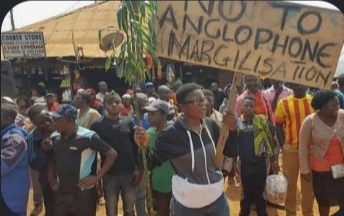
BUEA – 22 September 2026 – Nine years ago today, on 22 September 2017, thousands of people across Ambazonia walked into the streets in one of the largest and most consequential demonstrations in the history of the territory’s political struggle. From communities across the Midland, Savannah and Atlantic Zones, ordinary men, women and young people came out carrying branches, placards and messages demanding political change.
It was far more than another protest. September 22 marked a decisive moment in the evolution of the Ambazonian political consciousness, demonstrating that the grievances that had initially brought lawyers, teachers and civil-society actors into the streets had developed into a much broader popular movement. Contemporary reporting described demonstrations in Buea, Bamenda, Kumba, Kumbo, Mamfe, Limbe, Fontem and other communities, with protesters increasingly expressing demands for independence and the release of detained activists.
The timing was significant. While President Paul Biya was in New York attending the United Nations General Assembly, thousands of people in the territory were demonstrating at home. The contrast was striking: Cameroon’s government was presenting its position on the international stage while, inside Ambazonia, a mass movement was publicly challenging the political status quo.
THE DAY THE STREETS SPOKE
The scale of the mobilization caught national and international attention. Human Rights Watch later described the September 22 demonstrations as involving tens of thousands of people supporting independence. In many communities, demonstrators carried fresh branches and leaves, symbols that conveyed a desire to demonstrate peacefully while making their political demands unmistakably clear.
In Buea, people from surrounding communities joined the demonstrations, while similar gatherings took place in towns and villages across the territory. What had begun in 2016 as protests by lawyers and teachers over issues including the legal and educational systems had evolved into a movement in which the question of political status was increasingly central.
For many participants, September 22 therefore represented a public declaration of political identity. The demonstrations made visible something that could no longer be contained within professional associations or civil-society meetings: a substantial section of the population was openly demanding a different political future.
FROM SEPTEMBER 22 TO OCTOBER 1
September 22 was not October 1, but the two dates are inseparable in the history of the Ambazonian Restoration movement. The mass demonstrations demonstrated the extent of popular mobilisation and the strength of the independence sentiment. Nine days later, on 1 October 2017, Ambazonian leaders proclaimed the independence of the Federal Republic of Ambazonia.
The sequence is historically significant. September 22 provided a powerful demonstration of public political expression; October 1 transformed that political momentum into a formal declaration. The period between the two dates remains one of the defining moments in the modern history of the Ambazonian question.
THE PRICE OF SEPTEMBER 22
The demonstrations did not pass without violence and casualties. Contemporary reports documented deaths and injuries as security forces confronted protesters in different locations. Cameroon News Agency reported at least three people killed and several others injured in locations including Buea, Limbe, Santa, Kumbo and Mamfe, although other accounts reported different figures.
The precise death toll remains contested, but the broader historical record establishes that people were killed and injured during the events surrounding the September 22 mobilization. The violence marked an important turning point, as confrontation between the government and the increasingly assertive movement intensified in the months that followed.
For the families of those who died, September 22 was therefore not simply a political milestone. It became a day associated with personal loss, grief and the beginning of a much more devastating phase of the conflict.
A TERRITORY SPEAKING TOGETHER
One of the most important features of September 22 was the breadth of the mobilization. It was not confined to a single town or county. Demonstrations occurred across different parts of the territory, illustrating the extent to which the political crisis had become a territory-wide issue.
Today, Ambazonians refer to the territory through the Midland, Savannah and Atlantic Zones, encompassing communities with different histories, cultures and local circumstances. September 22 demonstrated that those differences did not prevent large numbers of people from identifying with a common political cause. That collective mobilization remains an important part of the historical significance of the day.
NINE YEARS LATER
Nine years have now passed since those demonstrations. The years that followed brought armed conflict, mass displacement, destruction of communities, deaths, arrests and profound social and economic disruption. Families were separated, communities were transformed and an entire generation grew up amid political uncertainty and violence.
Yet the fundamental political question that came to the forefront on September 22, 2017 remains unresolved. For those committed to the Ambazonian Restoration project, the objective remains independence and sovereignty; the government of Cameroon, meanwhile, continues to maintain its position on the territorial integrity of the country.
That unresolved political dispute is precisely why September 22 remains relevant. It was a moment when political demands that had previously been expressed largely through professional and civil-society channels became a mass public movement.
WHAT SEPTEMBER 22 LEFT BEHIND
The anniversary should therefore be understood not merely as a commemoration but as an opportunity to examine the political journey that followed. The people who marched in 2017 could not have known the scale of the crisis that would unfold in subsequent years. They could not have predicted the displacement, destruction and loss of life that would follow.
But they demonstrated something that remains central to understanding the conflict: political questions cannot simply be wished away. When large numbers of citizens mobilize around a question of political identity and self-determination, the underlying grievances require political engagement and serious attention.
For today’s generation of Ambazonians, September 22 is also part of a historical inheritance. Those who were children in 2017, and those born since, are growing up with the consequences of decisions made and events that unfolded during that period. Preserving an accurate record of what happened is therefore essential.
REMEMBERING THE DAY
On this ninth anniversary, Ambazonians remember the men, women and young people who came into the streets across the territory. They remember those who were arrested, injured and killed, as well as the families whose lives were permanently changed by the events that followed.
September 22, 2017 remains one of the defining dates in the modern political history of Ambazonia. It demonstrated the scale of popular mobilization, accelerated the movement toward the October 1 declaration and marked the beginning of an even more dangerous confrontation between the government and the independence movement.
Nine years later, its meaning remains contested, but its historical significance cannot simply be erased. Whatever political future ultimately emerges, the events of September 22 will remain part of the story of how Ambazonia’s contemporary struggle entered a new and irreversible phase.
As Amazon associate this site earns from qualifying purchases
Buy Southern Cameroons 2050; why America should care. By Martin Mungwa
https://www.amazon.com/s?k=Southern+Cameroon+2050+by+Martin+mungwa&i=specialty-aps&srs=121082092011&crid=165NADKY1TYO0&sprefix=southern+cameroon+2050+by+martin+mungwa%2Cspecialty-aps%2C862&linkCode=ll2&tag=njokings-20&linkId=1ea5f1bedc9b164acccc20a189670ad3&language=en_US&ref_=as_li_ss_tl
Timothy Enongene, Associate Editor-in-chief The Independentist News
Share This Post:
A President Unseen, a Country Waiting: Yaoundé’s Succession Uncertainty and the Questions Facing Ambazonia
Related Post
A President Unseen, a Country Waiting: Yaoundé’s Succession Uncertainty
BEYOND THE FLAG: THE HARDER QUESTION OF BUILDING AMBAZONIA
EKONA UNDER FIRE: THREE CIVILIANS REPORTED KILLED AS RESIDENTS
The Government of the Federal Republic of Ambazonia (in
À PARAÎTRE EN DÉCEMBRE 2026: UN AUDIT DE L’ÉCONOMIE
WHO BORROWS? WHO OWNS? WHO EXITS? Cameroon’s FCFA 250