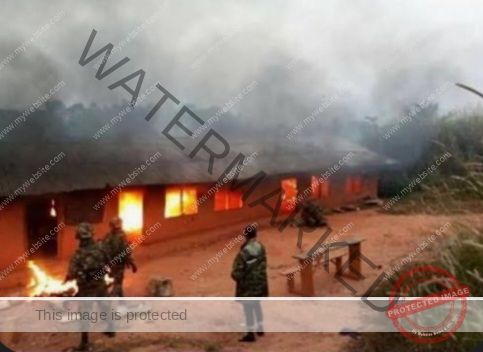


The burning of Kwakwa: Elderly civilians burned alive inside their homes. The Ngarbuh massacre: Pregnant women and children slaughtered, with homes set ablaze. Systematic village torching: Widespread destruction across Bafut, Muyuka, Bali, Batibo, and numerous other communities. Burning of hospitals and schools: Deliberate attacks designed to depopulate entire regions.
By Timothy Enongene
Guest Editor-in-Chief, The Independentist News
On Special Assignment in Washington, DC — January, 2026
In the modern strategic landscape of the present year, victory is defined by a disciplined hierarchy: Communication wins the mind, diplomacy wins the peace, and force merely enforces what the first two have already decided. These tiers form a single ecosystem. When communication is built on falsehoods, diplomacy becomes a sham, and force degenerates into indiscriminate violence.
It is within this framework that we must address the recent “open letter” published by The Guardian Post. By blaming the ongoing carnage in Ambazonia on what he calls “Amba fighters,” the publisher has engaged in a calculated act of narrative sabotage. Most astonishingly, he asserts that virtually all Anglophones would vote to remain in a so-called one and indivisible Cameroun. This is not journalism; it is a hallucinatory script better suited to the offices of Paul Atanga Nji.
The Weaponization of Communication
Communication is the primary weapon of war. During the Second World War, the United States launched Voice of America to dismantle authoritarian propaganda with verifiable truth. In the present moment, The Guardian Post is doing the opposite, employing the language of “strategic communication” to obscure a genocide.
For the record, the phrase “Amba fighters” is a fabrication designed to criminalize a people’s struggle. The resistance began with the Ambazonian Restoration Forces and later evolved into the Ambazonian State Army, a structured force operating under a political mandate. By parroting regime terminology, Kristian Ngah Christian attempts to strip the ASA of institutional legitimacy, thereby foreclosing the second tier of victory: diplomacy.
Diplomacy Versus the “Referendum of the Dead”
The claim that nearly all Southern Cameroonians favor a one and indivisible Cameroun insults the memory of the many thousands of unarmed civilians killed since the conflict escalated, beginning with the martyrdom of Akum Julius in Bamenda. Diplomacy requires truth. What is offered instead is a referendum of the dead.
There is no public record, now or at any point in the last decade, of a referendum proposed by the Yaoundé regime. Historically, the state has rejected such democratic exercises precisely because they acknowledge the possibility of self-determination. This is not the reporting of policy; it is the manufacture of an outcome to rationalize state violence.
If the true sources of carnage and displacement are to be documented, the military record is unambiguous, State-engineered displacement: Formal administrative orders in Manyu Division forced entire communities to evacuate or be treated as accomplices before military operations commenced.
The Manyu atrocities: Documented destruction of civilian homes and extrajudicial killings in Kembong, Babong, and Ebam. The burning of Kwakwa: Elderly civilians burned alive inside their homes. The Ngarbuh massacre: Pregnant women and children slaughtered, with homes set ablaze. Systematic village torching: Widespread destruction across Bafut, Muyuka, Bali, Batibo, and numerous other communities. Burning of hospitals and schools: Deliberate attacks designed to depopulate entire regions.
To suggest that a people whose ancestral homes were reduced to ash by state policy would willingly choose to remain with their executioners is gaslighting of the highest order.
Force: The ASA Versus State-Sponsored Proxy Militias
Kinetic force is the final tier. Observed from Washington, DC, the Ambazonian State Army exists to enforce the political will of a people seeking restoration. By contrast, the so-called “Amba fighters” cited by regime-aligned commentators often refers to state-sponsored proxy militias, armed groups created, financed, and deployed to commit atrocities that are later blamed on the revolution.
Sidebar: The Washington, DC Perspective
From a professional policy and security standpoint, legitimacy in modern conflict flows upward from political mandate to organized force, not the other way around. Movements deprived of truthful narrative are denied diplomatic space. Diplomacy denied gives rise to coercion. Coercion without legitimacy collapses into war crimes. The Ambazonian case illustrates a deliberate inversion by the state: criminalize language, poison diplomacy, and justify force. History shows this sequence always fails.
Conclusion: Restore the Order of Victory
Ambazonia’s path forward is not blocked by fighters, but by false words. Restore truthful communication and diplomacy becomes possible. Restore diplomacy and force becomes limited, disciplined, and accountable. Any media platform that chooses to invert this order, by laundering regime vocabulary and inventing imaginary plebiscites, chooses complicity over credibility. Truth wins the mind. Justice wins the peace. Force must answer to both.
Timothy Enongene
Guest Editor-in-Chief,