










Commentary

We are home to news on Cameroon and the CEMAC region. We are dedicated to honest and reliable reporting. We are the voice of the Cameroonian people and their fight for freedom and democracy at a time when the Yaoundé government is silencing dissent and suppressing democratic voices.

This is the moment regimes fear—not uprising, not protest, not even international pressure. But clarity. Because once the truth is spoken in a language the world understands, control begins to erode—not suddenly, but steadily and Irreversibly.
By Ali Dan Ismael
Editor-in-Chief, The Independentistnews
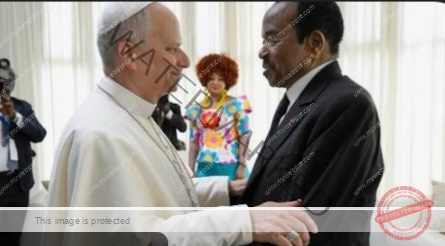
There are moments when diplomacy ends—and truth begins. This was one of them. On a carefully staged platform in Yaoundé, two men spoke of peace. One spoke as a shepherd of conscience. The other as a custodian of power. The words sounded similar. The meanings were not. Because when Pope Leo XIV spoke, he did not decorate the moment—he detonated it.
THE LANGUAGE OF BLOOD VS THE LANGUAGE OF CONTROL
The Pope did something regimes fear more than rebellion: he named reality. Not “challenges.” Not “difficulties.” Not “complex situations.” He spoke of: lives lost, families uprooted, children stripped of education, a future stolen in plain sight, He dragged the crisis out of the comfort of abstraction and placed it, unmistakably, in the realm of human suffering. And in that moment, every carefully crafted narrative collapsed.
Across from him, Paul Biya responded with the precision of a system that has survived by mastering one thing: control of language. “Crises.” “Efforts.” “Hope.” Words polished to the point of sterility. Because when reality becomes unbearable, power does not deny it. It renames it.
PEACE: THE MOST DANGEROUS WORD IN THE ROOM
Both men spoke of peace. But only one defined it. The Pope dismantled the illusion in a single stroke: A peace built on fear is not peace. A peace enforced by force is not peace. A peace proclaimed without justice is not peace. That was not a sermon. That was an exposure. Because what has long been presented as “stability” now stands revealed for what it is: containment. And containment is not peace. It is delay.
WHEN POWER IS FORCED TO HEAR WHAT IT WILL NOT SAY
Then came the most subversive act of all. Not accusation. Not confrontation. Definition. Invoking Augustine of Hippo, the Pope issued a quiet command disguised as reflection: Those who govern do not own power. They answer for it. They do not command to dominate. They command to serve. Simple words. Fatal implications. Because in a system where: voices are unheard, regions feel abandoned, participation is constrained. such a definition is not philosophical. It is surgical. It cuts straight to legitimacy.
THE PERFORMANCE OF LISTENING
What followed was not dialogue. It was performance. The state aligned itself—visibly, repeatedly—with the language of peace. It welcomed it. Praised it. Elevated it. But it never engaged it. There was no reckoning with: the scale of suffering, the depth of division, the failure of inclusion.
Instead, there was reassurance—delivered with the confidence of a system that believes survival is proof of success. But survival is not legitimacy. Endurance is not justice. And repetition is not truth.
THE MOMENT THE MASK SLIPPED
Here is what the world witnessed—whether it chooses to admit it or not: A moral authority speaking in the language of consequence. A political authority responding in the language of preservation. They stood on the same stage. They did not occupy the same reality. And in that divergence, something irreversible happened. The mask did not fall dramatically. It slipped—quietly, and unmistakably.
THIS WAS NOT A VISIT. IT WAS A LINE IN HISTORY.
Because once suffering is named publicly, it cannot be unnamed. Once peace is defined truthfully, it cannot be rebranded. Once power is measured against responsibility, it cannot hide behind ceremony. The Pope did not come to mediate a conflict. He came—and perhaps knowingly—to redefine it.
THE FINAL BREAK
The most dangerous sentence spoken that day was not shouted. It was asked: “Where do we stand?” It was a question directed at a nation. But it now belongs to history. Because when a system cannot answer that question honestly, it answers it anyway—through silence, through distance, through contradiction. And the world is listening. More closely than before.
THE CONSEQUENCE
This is the moment regimes fear—not uprising, not protest, not even international pressure. But clarity. Because once the truth is spoken in a language the world understands, control begins to erode—not suddenly, but steadily and Irreversibly.
And from that point forward, every statement, every policy, every gesture will be measured not against what is said— but against what has already been revealed. Peace was spoken. Power was exposed. The difference will define what comes next.
Ali Dan Ismael
Editor-in-Chief, The Independentistnews
Share This Post:
THE DOVE THAT FELL — AND THE TRUTH IT LEFT BEHIND
When the Wires Shift, the World Follows How global news agencies are quietly moving the Ambazonian question onto the international stage
Related Post
IS THE WORLD LISTENING: THREE DAYS FOUR FRONTLINES, ASA
SEPTEMBER 24, 1965, THIS DAY IN HISTORY: From Equal
AMBAZONIA’S WAR- IS BIGGER THAN YAOUNDÉ: BRITAIN, FRANCE AND
THE DAY SEPTEMBER 22 1961: — WHAT AMBAZONIA CAN
TRUMP’S “SUPER INTELLIGENCE” ERA: WHAT IT REALLY MEANS —
Why Is Ambazonia More Powerful Than many Imagine.