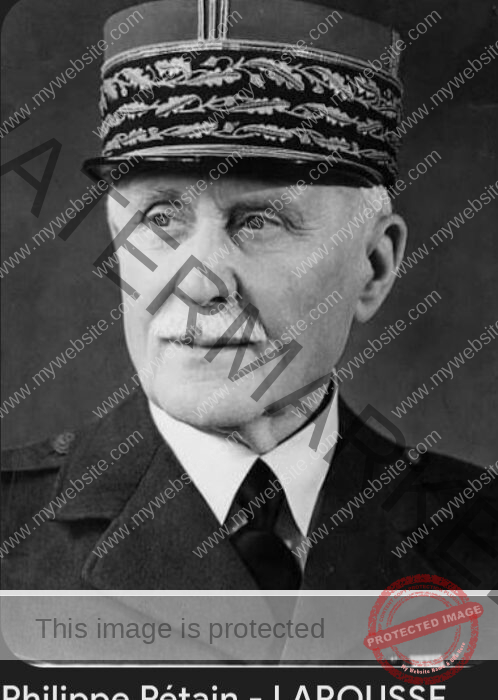


Philippe Pétain’s trial in nineteen forty-five symbolized the reckoning of collaboration. Paul Biya’s own judgment may not come in a courtroom, but in the verdict of history and the awakening of a people. As France rebuilt after Pétain’s fall, Ambazonia too will rebuild — not on bitterness, but on moral renewal.
By Ali Dan Ismael and Eposi Lum, The Independentist
The Hero of Verdun — A Nation Saved
In the bitter winter of nineteen sixteen, France was on the brink of collapse. The Battle of Verdun had drained morale and blood. Out of the chaos rose General Philippe Pétain, who restored discipline and uttered the immortal words: “Ils ne passeront pas” — They shall not pass! He became the “Saviour of Verdun,” elevated to Marshal of France, and symbolized national courage. For two decades, Pétain’s name inspired pride, discipline, and patriotism. He was the man France trusted in moments of despair.
From Hero to Collaborator
By the summer of nineteen forty (1940), Nazi tanks rolled into Paris and France fell within weeks. Parliament, desperate for stability, handed Marshal Pétain full powers to lead the country in crisis.
Instead of resistance, he chose submission — creating the Vichy regime, which collaborated with Hitler’s Germany. Under the pretext of “national renewal,” he implemented censorship, deportations, and persecution of the French Resistance and Jewish people.
Pétain’s regime betrayed the French Republic even as his rhetoric invoked “saving” it. When Germany fell in nineteen forty-five, the liberators found the “Saviour of Verdun” guilty of high treason. Once revered, Pétain died in nineteen fifty-one (1951) in isolation and disgrace — a tragic reminder that patriotism can decay into tyranny.
Paul Biya and the Mirage of Unity
Four decades later, in the early nineteen eighties, another turning point came — this time in Africa.
Paul Biya, successor to Ahmadou Ahidjo, ascended as President of Cameroon. Like Pétain, Biya projected calmness, intellect, and discipline. His promise of “rigor and moralization” ignited hope.
But soon, the moral rhetoric became a mask for political entrenchment.
Over four decades later, Biya’s rule has outlasted most African leaders — longer than Pétain’s entire life after Verdun. He consolidated control under the ideology of “national unity,” which, in reality, erased the identity and rights of the people of Southern Cameroons — who had freely joined Cameroon as an equal partner in a federation that no longer exists.
The Betrayal — The Disappearing Federation
In October nineteen sixty-one (1961), the British Southern Cameroons attained independence through a United Nations–supervised plebiscite and entered a federation with La République du Cameroun. That federation was dismantled unilaterally by President Ahidjo in nineteen seventy-two (1972), creating a unitary state that violated United Nations Resolution sixteen zero eight (1608).
When Biya came to power, he completed the erasure by restoring the old name “La République du Cameroun” in nineteen eighty-four (1984) — symbolically undoing the union. To the people of Southern Cameroons, this act was equivalent to Pétain signing the armistice — an erasure of national dignity for the illusion of unity.
The War Against the Resistance
In October twenty sixteen, Southern Cameroonian teachers and lawyers launched peaceful protests demanding respect for the English legal and educational systems. Biya’s response echoed Pétain’s repression of the French Resistance — brute force. By the following year, peaceful strikes turned into armed conflict. Entire villages were razed, civilians massacred, leaders imprisoned or exiled. Biya called it a “war on terrorism”; Ambazonians called it a war of recolonization. Yet amid the flames, the spirit of resistance rose — from the forests of Manyu to the hills of Mezam — echoing the resilience of the French Maquis who defied Nazi rule.
The Ambazonian Power Brokers — Collaboration in the Shadows
Every resistance breeds its own Pétains — men who wrap collaboration in the language of pragmatism.
In Ambazonia’s case, power brokers have emerged who publicly claim to fight for the cause but privately trade influence, appointments, or money with the enemy. Some politicians in Yaoundé — once claiming Ambazonian roots — became instruments of suppression.
Figures such as Atanga Nji, Paul Tasong, Felix Mbayu, Victor Mengot and others have justified their collaboration as “service to the state,” mirroring Pétain’s own defence — “I chose the lesser evil to save the nation.” Their reward? Titles, budgets, and short-lived prestige — the same empty honours Vichy loyalists once received from their occupiers. Meanwhile, the genuine patriots — teachers, farmers, journalists, and mothers — bear the suffering for refusing to kneel.
The Ambazonian Diaspora as Exiled Patriots
If the occupied homeland is Ambazonia’s Vichy, then the— the Ambazonian diaspora — is its London exile. Just as Charles de Gaulle led Free France from London, Ambazonian activists in the United States, the United Kingdom, Canada, and across Europe have become the lifeline of the struggle.
Through organizations, humanitarian appeals, and online advocacy, they sustain resistance, document atrocities, and finance survival. Some have been mocked by their own — accused of living comfortably abroad while others die at home.
Yet history reminds us: the exiles of today often become the architects of tomorrow’s restoration.
An early Ambazonian leader in Washington once declared,
“We may be scattered across continents, but our geography has changed — not our citizenship.” Another activist in Germany remarked, “If Pétain’s France could fall, and De Gaulle’s France could rise, then Ambazonia too will rise from Yaoundé’s betrayal.”
The Mirage of Unity — The Argument of the Regime to maintain fairness.
It must be acknowledged that Biya and his allies insist their policy is one of national preservation. They argue that secession threatens Cameroon’s territorial integrity and stability — that unity, even if imperfect, is better than chaos. But this logic — identical to Pétain’s justification for surrender — ignores a deeper truth: peace built on subjugation is only the silence before the next storm. Unity without justice is not a bond; it is a chain.
Judgment of History
Philippe Pétain’s trial in nineteen forty-five symbolized the reckoning of collaboration.
Paul Biya’s own judgment may not come in a courtroom, but in the verdict of history and the awakening of a people. As France rebuilt after Pétain’s fall, Ambazonia too will rebuild — not on bitterness, but on moral renewal. The Ambazonian diaspora, though scattered, continues to be the conscience of the nation. The Ambazonian Resistance at home continues to assert that sovereignty cannot be begged, only lived.
The Pétain–Biya DNA of Betrayal
Both Philippe Pétain and Paul Biya came as “saviours” in crisis and ended as betrayers of their nations’ souls. Both justified submission as patriotism. Both surrounded themselves with courtiers who mistook collaboration for diplomacy. And both faced a generation that refused to forget.
Yet history also shows that for every Pétain, there arises a De Gaulle; and for every Biya, a Sako — men who dare to say, “We came as equals; we shall leave as free men.”
Ambazonia’s struggle, like France’s, is not merely about power. It is about moral resurrection — the reclaiming of truth in a world that rewards betrayal.
The Eleventh Province diaspora and the patriots on the ground now carry that torch — not for revenge, but for remembrance, resilience, and rebirth.
Eternal Lesson
The flag of freedom is never raised by those who collaborate, but by those who resist even when the world calls them rebels.
By Ali Dan Ismael and Eposi Lum
The Independentist