

They thought they were publishing control. Instead, they published evidence—evidence that the crisis is real, that the grievances are valid, and that the world is beginning, slowly and reluctantly, to see it. The Pope may have spoken in diplomacy, but history will interpret in truth.
By Ali Dan Ismael
Editor-in-Chief, The Independentistnews
There are moments in history when truth does not arrive as a declaration. It slips through the cracks of controlled narratives. It appears—uninvited—inside the very machinery designed to suppress it. This is one of those moments.
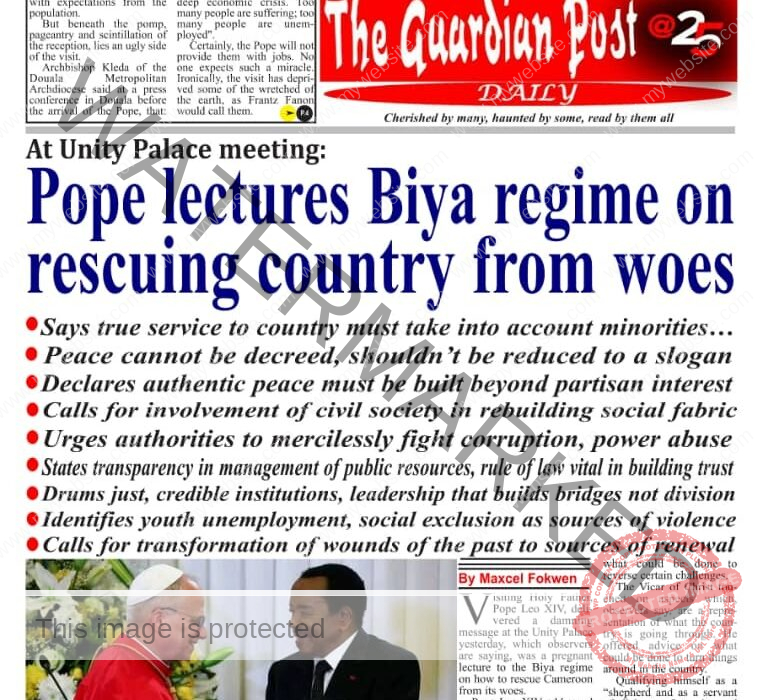
The headline screams: “Pope lectures Biya regime on rescuing country from woes.” And yet, buried beneath the careful wording, the diplomatic restraint, and the calculated omissions, lies something far more dangerous to the regime in Yaoundé than any protest, any resistance, any armed defiance: an unintended confession.
When Pope Leo XIV speaks of a country where peace cannot be decreed, where minorities are ignored, where youth are excluded, and where corruption and abuse of power thrive, he is not offering polite advice. He is issuing a moral indictment. The most remarkable thing is not that he said it, but that the regime’s own media allowed it to be printed. Not because they wanted to, but because they could no longer avoid it.
They call it “woes.” Not war. Not occupation. Not systemic violence. Just… woes. A word so soft it dissolves accountability, so vague it protects power. But reality does not bend to language. Burned villages are not woes. Mass displacement is not woes. Militarized repression is not woes. They are the consequences of a system that has mistaken domination for governance.
Hidden in plain sight is the most dangerous line of all: “True service must take into account minorities.” Minorities? This is the intellectual fraud at the heart of the state narrative. A people with a defined territory, a distinct legal heritage, a historical identity, and an internationally documented claim to self-determination is reduced—by design—to a demographic inconvenience. This is not semantics. This is strategy. Because once you call a people a “minority,” you deny them the right to be a nation.
The Pope’s message carried moral clarity. What we are witnessing is not what was said—it is what was allowed to be heard. The regime has taken a message of justice, accountability, and structural change and diluted it into reform, improvement, and administrative correction. This is how power survives. Not by denying truth outright, but by shrinking it until it is no longer dangerous.
And then, almost conveniently, we are told: “Separatists declare three-day ceasefire.” Observe the framing. The conflict is reduced to an action by one side that can be turned on and off. This is not reporting. This is narrative engineering. It subtly shifts the question from why there is a conflict to why it does not stop, and in that shift, the origin of the crisis is erased.
What this front page reveals is what the regime never intended to show. It reveals that pressure is working, that silence is no longer sustainable, and that even controlled media can no longer fully contain reality. You do not print criticism unless the narrative is cracking. You do not acknowledge failure unless denial has become impossible.
The greatest illusion being maintained is that the system can be repaired without confronting the fundamental question of legitimacy. It cannot. You cannot centralize power, suppress identity, and militarize dissent, and then resolve the consequences with speeches about peace. Peace is not a slogan. Peace is not a decree. Peace is a consequence of justice, and justice begins with truth.
The truth is this: a state that must constantly redefine its crisis is a state that has lost control of its narrative. A regime that must translate moral condemnation into administrative advice is a regime in retreat. And a system that reduces a people to a “minority” is a system that fears what that people truly represents.
They thought they were publishing control. Instead, they published evidence—evidence that the crisis is real, that the grievances are valid, and that the world is beginning, slowly and reluctantly, to see it. The Pope may have spoken in diplomacy, but history will interpret in truth. And truth, once exposed—even in fragments—has a way of finishing what it starts.
Ali Dan Ismael
Editor-in-Chief The Independentistnews