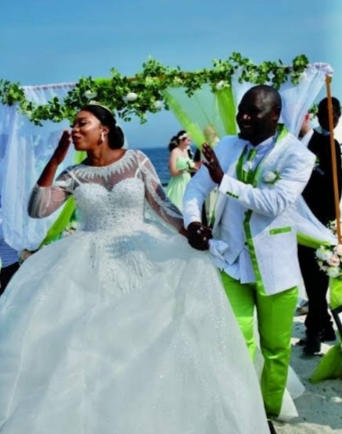


What appears to be “marrying down” according to one measure may be a carefully chosen partnership across several forms of value. The future of marriage in the African diaspora may therefore depend less on finding a man who stands above a woman and more on finding two people capable of standing together.
By Ali Dan Ismael, Editor-in-chief The Independentist News
Across much of the African diaspora, an old social expectation is colliding with a new demographic reality. For generations, many women were encouraged to marry a man who was older, more educated, more financially established, or socially better positioned. The husband was expected to be the principal provider, the household leader, and the partner whose status equaled or surpassed that of his wife.
That model has not disappeared, but the conditions that sustained it are changing rapidly. Black and African women are advancing through universities, professions, entrepreneurship, public service, and global institutions in growing numbers. In some communities, women now outnumber men among university graduates and established professionals. Yet many still enter adulthood carrying expectations formed when men generally possessed greater educational and economic power.
The result is a fundamental marriage-market question: are African diaspora women increasingly marrying “down,” or are they simply learning to measure compatibility differently?
The answer is more complicated than either celebration or alarm. Educational hypogamy—relationships in which the woman possesses more formal education than the man—is becoming more visible and socially acceptable. Economic and occupational hypogamy also appear to be increasing in some settings. But this does not necessarily mean that women have abandoned hypergamy. In many cases, they have broadened the qualities through which a man’s value is assessed. What is emerging may be less the end of hypergamy than its reinvention.
When Education Changes Faster Than Culture
Marriage customs normally develop around the economic and social structures of their time. When men dominated higher education, formal employment, property ownership, and political authority, it was statistically easier for women to find husbands who were older, better educated, and wealthier. That environment is changing.
African diaspora women are entering medicine, law, engineering, finance, academia, government, technology, and business in unprecedented numbers. Many attain advanced degrees, become homeowners, establish enterprises, and achieve financial independence before marriage. Their success should be celebrated as evidence of social progress.
Yet educational advancement does not automatically rewrite cultural expectations. A highly educated woman may still be taught that her husband should earn more, occupy a more prestigious profession, possess greater social influence, and assume primary financial responsibility. Men may similarly be raised to believe that their masculinity depends upon earning more than their wives.
When both partners accept these expectations, a woman’s success can unintentionally narrow her marriage market. The more she advances, the fewer men appear to meet every traditional condition of status superiority. This is especially true when her search is further limited by nationality, ethnicity, religion, age, immigration status, geography, and family approval.
The problem is not that successful women have become “too educated” or “too independent.” The problem is that educational and economic realities have changed faster than some cultural definitions of a suitable husband.
What Does It Mean to Marry “Down”?
The phrase “marrying down” is frequently used as though human worth could be measured on a single ladder. In reality, social position contains several dimensions. A woman may possess more education while her partner earns more. She may have a prestigious professional title while he owns a successful business. She may earn more today while he has stronger long-term entrepreneurial prospects. She may possess financial capital while he contributes emotional stability, practical competence, cultural knowledge, family leadership, or extensive community networks.
A man may also be working below his true capacity. African immigrants frequently encounter difficulty transferring academic credentials and professional licenses across national borders. An engineer may initially drive a taxi. A teacher may become a security officer. A trained administrator may work in a warehouse. Judging such a man exclusively by his current occupation ignores his education, experience, adaptability, and future potential.
Conversely, formal qualifications should not be romanticized. A university degree does not guarantee discipline, responsibility, emotional intelligence, financial competence, or the ability to sustain a family. A less-educated man who is industrious, dependable, entrepreneurial, and emotionally mature may be a more compatible partner than a highly credentialed man who lacks purpose or integrity.
Therefore, educational hypogamy does not automatically mean economic, intellectual, or social hypogamy. It may simply mean that the partners possess different but complementary forms of capital.
The Diaspora Is Not One Marriage Market
The African diaspora cannot be treated as a single cultural community. African Americans, Afro-Caribbeans, recent African immigrants, second-generation Africans, Black Europeans, Afro-Latinos, and Africans living temporarily abroad do not experience identical marriage markets.
Recent immigrants may retain stronger expectations concerning ethnicity, lineage, religion, age, bridewealth, family approval, and male financial leadership. Some families continue to regard marriage as an alliance between communities rather than merely a private relationship between two individuals.
Second-generation Africans may approach marriage more individualistically. They may place greater emphasis on emotional compatibility, shared values, domestic cooperation, and personal fulfillment. Nevertheless, even among younger generations, expectations of male provision and leadership can remain powerful.
African American and Afro-Caribbean women may face different historical and economic pressures, including unequal access to education, employment, wealth, and stable family formation. Black women in Britain, France, Canada, Brazil, the Caribbean, and the United States also live within different immigration systems, labor markets, welfare structures, and racial environments.
The direction of change is therefore uneven. Some women expand their search across African nationalities or ethnic groups. Others consider partners outside the African diaspora. Some accept a man with less education but comparable ambition and character. Others delay marriage rather than compromise their expectations. Still others build relationships in which the woman is the permanent principal earner. These are distinct responses to changing circumstances, not evidence of one universal diaspora trend.
Hypergamy May Be Changing Its Currency
Traditional hypergamy measured a man largely through education, income, occupation, age, family status, and material provision. The modern marriage market increasingly includes additional currencies. Migration status can be a form of capital. So can emotional intelligence, spiritual grounding, domestic reliability, cultural fluency, entrepreneurial ability, physical security, social networks, and the capacity to raise children cooperatively.
A man with less formal education may bring valuable technical skills, business experience, property, or strong community relationships. Another may provide the emotional steadiness that enables a highly pressured professional woman to thrive. A younger man may have less accumulated wealth but greater adaptability and a clearer partnership orientation.
This does not mean that women should ignore economic responsibility or accept chronic dependency. There is a major difference between a man who currently earns less and a man who refuses to work; between limited credentials and limited ambition; between temporary hardship and permanent irresponsibility.
The emerging model should not require women to carry men who lack discipline, purpose, or willingness to contribute. Nor should it shame men merely because their wives possess higher degrees or temporarily earn more.
The important question is not simply, “Who has more?” It is, “What does each partner bring, and can they convert their combined strengths into a stable household?”
The Persistence of the Male-Provider Ideal
Although women’s economic position has changed, the male-provider ideal remains deeply rooted. Many women who earn substantial incomes still desire husbands who can provide at an equal or higher level. Many men remain uncomfortable when their wives earn more, especially when relatives or communities interpret the difference as evidence of male weakness.
This creates tension inside relationships that appear progressive from the outside. A couple may accept the woman’s superior education but still expect the man to finance most major expenses. A wife may be the higher earner but deliberately minimize her status to protect her husband’s pride. A husband may support his wife’s career publicly while privately feeling displaced by it.
These pressures show that hypergamy is not merely an individual preference. It is reinforced by family expectations, religious interpretations, gender socialization, peer judgment, and ideas about masculinity and femininity.
Until communities develop a broader understanding of male contribution, many couples will continue negotiating modern economic realities through traditional gender language. Some will succeed. Others will experience resentment, secrecy, competition, or instability.
Interracial Marriage Is Not Automatically Hypergamy
Discussions of diaspora marriage sometimes treat interracial or intercultural partnering as evidence that a Black woman has married “up” or “down.” That interpretation is both morally troubling and analytically weak.
Race is not a legitimate measure of human worth. An interracial marriage may be educationally equal, economically unequal, socially balanced, or divided along several dimensions. Its character must be evaluated through the actual circumstances of the partners—not through inherited racial hierarchies.
Nevertheless, interracial and intercultural relationships may become more common when women broaden their search beyond a limited ethnic, national, or racial pool. This expansion does not necessarily represent rejection of African men or African culture. It may reflect geography, education, professional networks, delayed marriage, personal compatibility, or the practical realities of diaspora life.
The relevant question is not whether a partner comes from inside or outside a particular racial group. It is whether the relationship provides mutual dignity, cultural respect, reciprocity, and a fair distribution of responsibility.
The Risk of Calling Every Compromise “Settling”
Social media has made marriage-market discussions increasingly combative. Men accuse successful women of being unrealistic. Women accuse men of insecurity or underachievement. Relationships are reduced to income rankings, academic credentials, physical appearance, and online slogans. Within this environment, compromise is often confused with defeat.
Every successful marriage requires compromise. No partner will possess the highest education, income, beauty, emotional intelligence, spiritual maturity, family background, and social status simultaneously. Choosing a partner necessarily involves deciding which qualities are essential and which are negotiable.
But compromise should not mean abandoning fundamental standards. A woman should not be pressured to accept abuse, indiscipline, financial exploitation, or emotional neglect merely because the marriage market is difficult. A man should not be treated as inferior merely because his wife holds more degrees or earns a higher salary.
The healthier distinction is between status compromise and character compromise. Education, income, and occupation can change. Character, responsibility, integrity, and willingness to grow are often more consequential over the life of a marriage.
From Rank Matching to Partnership Building
The strongest relationships may increasingly be those that replace rigid status ranking with partnership building. Under this model, the couple does not ask who is superior. They ask whether their combined resources can produce security, purpose, healthy children, family continuity, and intergenerational progress.
A woman’s education becomes a household asset rather than a threat to male authority. A man’s entrepreneurship, technical ability, or community leadership becomes valuable even if he has fewer academic qualifications. Domestic labor and caregiving are recognized as contributions rather than invisible obligations. Financial decisions are based on competence and transparency rather than gender pride.
This approach does not eliminate distinct roles. Couples may still choose traditional, egalitarian, or hybrid arrangements. The critical difference is that the roles are consciously negotiated and supported by economic reality.
Marriage should function as a productive union in which both partners contribute to sustaining and expanding the household. If one person’s advancement repeatedly requires the other’s diminishment, the relationship is not truly cooperative.
A Challenge for African Men
The changing marriage market also presents a serious challenge to African diaspora men. Women’s advancement should not be treated as an attack on masculinity. The appropriate response is not to discourage female success but to expand male opportunity, preparation, and adaptability.
Educational underachievement, unemployment, social disconnection, weak mentorship, incarceration, migration barriers, and economic instability affect many Black men differently across diaspora societies. These conditions require institutional responses from families, schools, religious organizations, professional networks, businesses, and governments.
Men must also be encouraged to develop forms of strength that are not limited to earning more than a woman. Integrity, emotional discipline, fatherhood, intellectual curiosity, practical competence, spiritual maturity, and the ability to build with a successful partner are equally important.
A man does not lose his dignity because his wife earns more. He loses dignity when pride prevents him from contributing responsibly, celebrating her success, or developing his own capacity.
A Challenge for African Women
Successful women must likewise examine whether some inherited expectations remain realistic or internally consistent. It may be difficult to demand full professional equality in public life while insisting that a husband must always possess superior economic status in private life.
This does not require women to abandon standards. It requires separating standards that protect dignity and stability from status preferences inherited from a different economic era.
Women should ask whether they are evaluating a man only by his present salary or by his character, trajectory, competence, and willingness to build. They should also consider whether the desire for a higher-status partner reflects genuine compatibility or external pressure to present a socially impressive marriage.
At the same time, women should resist narratives that blame them for structural imbalances or pressure them into relationships they do not want. Marriage is not an obligation owed to society. A woman has the right to remain single rather than enter a partnership that violates her fundamental values.
The Reinvention of Hypergamy
The African diaspora does appear to be moving toward greater educational hypogamy. More women will marry men who have less formal education. More households will contain women who earn more, own more, or occupy more prestigious positions. Some women will marry younger men, cross national and cultural boundaries, or become the principal financial providers. Yet hypergamy is not simply disappearing. Its currency is changing.
Women may become less concerned about whether a man has a higher degree while remaining deeply concerned about ambition, financial discipline, emotional strength, immigration stability, entrepreneurship, family reputation, or spiritual leadership. The hierarchy is becoming multidimensional.
What appears to be “marrying down” according to one measure may be a carefully chosen partnership across several forms of value. The future of marriage in the African diaspora may therefore depend less on finding a man who stands above a woman and more on finding two people capable of standing together.
The real transformation will occur when education is no longer treated as a threat, income is no longer confused with total human worth, and masculinity is no longer measured by the suppression of female achievement.
The end of rigid hypergamy need not represent the collapse of standards. It can mark the beginning of more honest standards—ones based on character, reciprocity, growth, responsibility, and the ability to create lasting value together.
The question is no longer simply whether African diaspora women are marrying “down.” The more important question is whether men and women are learning to build upward together.
Ali Dan Ismael, Editor-in-chief The Independentist News