









Commentary

We are home to news on Cameroon and the CEMAC region. We are dedicated to honest and reliable reporting. We are the voice of the Cameroonian people and their fight for freedom and democracy at a time when the Yaoundé government is silencing dissent and suppressing democratic voices.

The resulting arrangement is a double colonial chokehold. Britain hides behind the visibility of France. France hides behind the formal sovereignty of La République du Cameroun. Yaoundé describes the Southern Cameroons question as an internal linguistic disagreement, thereby concealing the deeper international and constitutional history. The flags changed, but the gate remained in the same hands.
By Ali Dan Ismael, The Independentist News Editor-in-chief.
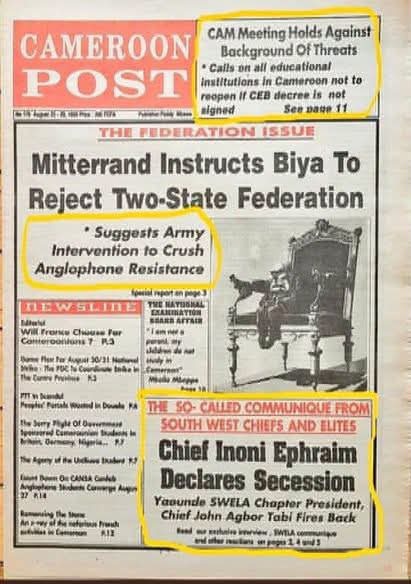
The faded front page of Cameroon Post carries a headline whose implications remain explosive: “Mitterrand Instructs Biya to Reject Two-State Federation.” Beneath it appears the further allegation that the French president suggested military intervention to crush Anglophone resistance.
The newspaper page is not, standing alone, conclusive proof that François Mitterrand personally issued those precise instructions. Establishing that fact beyond reasonable historical dispute would require the complete article, its underlying sources, French presidential archives, diplomatic cables, intelligence records, and corroborating Cameroonian documentation. Yet the front page remains a significant contemporaneous exhibit. It records how French influence over the constitutional choices of La République du Cameroun was understood at a decisive moment in the struggle over federation.
More importantly, the headline reveals the architecture of the choke point. A genuine two-state federation would not merely have changed administrative boundaries. It would have divided constitutional power. It would have restored a second government possessing territorial legitimacy, legislative authority, fiscal responsibilities, inherited institutions, and a distinct legal and educational tradition. It would have weakened the centralized presidency through which external influence, domestic patronage, military command, resource concessions, and national revenue were concentrated.
France did not need to control every village in Cameroon. It needed to influence the gateway through which every consequential national decision passed. That gateway was Yaoundé. Britain created the conditions that made such control possible. France occupied and defended the strategic opening. Paul Biya inherited the system, personalized it, and converted the preservation of the presidency into the organizing purpose of the state.
The resulting arrangement is a double colonial chokehold. Britain hides behind the visibility of France. France hides behind the formal sovereignty of La République du Cameroun. Yaoundé describes the Southern Cameroons question as an internal linguistic disagreement, thereby concealing the deeper international and constitutional history. The flags changed, but the gate remained in the same hands.
Britain Constructed the First Choke Point
Britain’s historical responsibility did not begin on the eve of the 1961 plebiscite. It arose from the manner in which British Southern Cameroons was administered throughout the mandate and trusteeship periods. British Cameroons was administered through the machinery of Nigeria rather than developed as a fully equipped, internationally prepared political entity. British archival guidance itself states that British Cameroons was administered as part of Nigeria until 1960. This arrangement subordinated the institutional development of Southern Cameroons to Britain’s wider Nigerian administrative priorities.
Southern Cameroons nevertheless developed elected institutions, political parties, a parliamentary culture, courts, schools, and a recognizable territorial identity. What Britain did not adequately develop was the complete sovereign infrastructure required to make separate independence appear practical and internationally convenient.
There was no independent Southern Cameroons defence force capable of protecting the territory’s constitutional position. International relations remained under the administering authority. Critical administrative and economic systems were intertwined with Nigeria. Britain could therefore present the territory as politically mature enough to vote but institutionally dependent enough to require incorporation into one of its neighbours. This was manufactured constitutional scarcity.
The people were offered a choice, but Britain and the United Nations determined the boundaries of what could be chosen. The 1961 plebiscite asked whether Southern Cameroons would achieve independence by joining the Federation of Nigeria or by joining the already independent Republic of Cameroun. Separate sovereign independence was not placed on the ballot. United Nations Resolution 1608 subsequently endorsed the result and provided for the trusteeship agreement to terminate when Southern Cameroons joined the Republic of Cameroun on October 1, 1961. This was not self-determination in its fullest meaning. It was self-determination confined within a corridor constructed by others.
A people may select freely between the options appearing on a ballot while still being denied the option they might have preferred most. The election can be procedurally genuine while the architecture surrounding it remains restrictive. Britain controlled the gate. Southern Cameroons was allowed to decide which neighbouring state it would enter, but not whether it wished to stand independently.
Independence by Joining: The Constitutional Contradiction
The language used by the United Nations contained an unresolved contradiction: Southern Cameroons was to “achieve independence by joining” another sovereign state. Joining could have produced a lawful and durable federation if the relationship had been negotiated between equal political entities, embodied in an enforceable constitutional compact, protected by institutions, and supported by credible international guarantees. Instead, Southern Cameroons entered an arrangement marked by extreme disparities in population, military power, diplomatic recognition, territory, and access to international institutions.
The federal constitution initially recognized West Cameroon and East Cameroon as constituent states, but the arrangement rested upon a profoundly unequal balance of power. The International Crisis Group has described the federation as unstable and characterized by an unequal distribution of authority between the two components. Britain knew, or should have known, that the weaker party required safeguards stronger than promises.
It should have insisted upon a clearly negotiated union instrument, internationally verifiable guarantees, protected constitutional amendment procedures, defined revenue arrangements, enforceable judicial remedies, and mechanisms preventing the larger party from unilaterally absorbing the smaller. Instead, Britain treated the termination of trusteeship as the termination of responsibility.
Once the papers were signed and the flag lowered, Southern Cameroons was left to defend an unequal federal bargain within a state whose security and political architecture had been shaped by France. Britain did not merely walk away from a former territory. It walked away from the foreseeable consequences of a settlement it had helped design.
How France Helps Britain Hide
France’s influence over La République du Cameroun has been more visible, more militarized, and more openly connected to the postcolonial state. That visibility has given Britain an extraordinary narrative advantage. Britain can point toward French military cooperation, the CFA monetary system, French commercial interests, French-trained officials, and the historical machinery of Françafrique. It can portray the Southern Cameroons conflict as the product of French centralism and Paul Biya’s authoritarian rule. Those factors are real, but they do not absolve Britain.
France could consolidate influence over the constitutional center because Britain delivered Southern Cameroons into the relationship without a durable shield. Yaoundé could dismantle federal institutions because Britain failed to secure the weaker party’s protection before withdrawing. France could become the dominant external patron because Britain treated Southern Cameroons as a completed administrative file rather than as a former trust territory whose political future remained structurally vulnerable.
France has consequently become Britain’s most effective hiding place. The French hand is visible. The British hand is quieter. Quiet hands are not necessarily clean. Britain’s method was not the same as France’s. Britain did not construct the post-independence security state in Yaoundé. It did, however, control the constitutional departure gate through which Southern Cameroons had to pass. France later controlled the centralized state into which Southern Cameroons had been delivered. The two powers operated at different stages of the same historical corridor.
France’s Colonial War Did Not End in 1960
The claim that French power departed from Cameroon at formal independence is no longer sustainable. The France-Cameroon Multidisciplinary Joint Committee examined the role of France and Cameroon in suppressing independence and opposition movements between 1945 and 1971. The committee reviewed extensive archival material, including declassified documents, and submitted an almost 1,000-page report to the French and Cameroonian presidents in January 2025. France’s own Foreign Ministry states that the inquiry addressed France’s role in repression and that French archives were opened to the researchers.
In 2025, President Emmanuel Macron formally acknowledged that France had conducted a war involving violent repression in Cameroon and that the conflict continued beyond formal independence with French support for actions undertaken by the independent Cameroonian authorities. This acknowledgment is historically devastating. It confirms that the transfer of formal sovereignty did not terminate French involvement in the machinery of political repression. France assisted in shaping and supporting the state under Ahmadou Ahidjo, within which Paul Biya later rose to the highest levels of government before succeeding Ahidjo.
The postcolonial state did not emerge on neutral institutional ground. It inherited methods, security relationships, administrative habits, and centralizing assumptions developed during the suppression of the country’s genuine independence movement. The presidency was not merely an elected office. It became the strategic gate through which military cooperation, diplomatic relations, contracts, political patronage, and access to the state flowed. France did not require a colonial governor when the centralized presidency could preserve continuity more efficiently.
The Cameroon Post Headline and the Fear of Federation
The allegation reported by Cameroon Post fits this wider political logic. A restored two-state federation would have interrupted the central gateway. West Cameroon would have regained constitutionally protected executive, legislative, and administrative authority. Its institutions could have exercised greater control over education, law, local development, land, public administration, and perhaps portions of public revenue and natural-resource governance.
Such an arrangement would have challenged Biya’s centralized presidency. It would also have complicated the external networks accustomed to negotiating Cameroon’s strategic affairs through one political center. Two constitutionally protected centers are more difficult to control than one. A genuine federation would have given Southern Cameroons an institutional voice rather than leaving its people to petition ministries controlled from Yaoundé. It would have transformed grievances over language, courts, schools, development, and representation into questions governed through constitutionally assigned authority. Federalism was therefore not simply an administrative concession. It threatened the choke point.
The headline’s allegation that Mitterrand instructed Biya to reject federation must still be corroborated before being presented as settled historical fact. But the strategic proposition underlying the allegation is credible: France had an interest in the continuity of a centralized partner state with which it maintained political, economic, defence, and security relationships. France’s own Foreign Ministry continues to describe its security and defence cooperation with Cameroon as important, particularly in military and security training institutions.
The question is therefore not whether France has relationships with Cameroon; that is publicly acknowledged. The question is how far those relationships shaped the rejection of constitutional arrangements that might have diluted Yaoundé’s authority. That remains an urgent subject for archival investigation.
Biya and the Intelligence-State Inheritance
Claims that Paul Biya was personally recruited as an agent of French intelligence should not be stated as proven without direct documentary evidence. No publicly verified file presently establishes such a formal relationship. But reducing the argument to whether Biya possessed an intelligence-service membership card misses the larger point. Biya emerged from an administrative and security system developed under Ahidjo, a system whose formative years were supported by France during and after the violent suppression of opposition and independence movements. He inherited a presidency designed for central command, political surveillance, elite management, territorial control, and the concentration of national decision-making. His relationship with French colonial networks was therefore structural before it was personal.
He did not need to be a formally recruited operative to serve a system whose institutional incentives aligned domestic regime survival with external strategic continuity. The relevant questions are more serious than the search for a secret file. Which external relationships strengthened the presidency? Which governments continued defence and security cooperation despite authoritarian practices? Which commercial arrangements benefited from political continuity? Which diplomatic partners treated the survival of the regime as preferable to the uncertainty of democratic or constitutional transformation?
Biya has remained at the center of the state since succeeding Ahidjo in 1982, building one of the world’s longest-running presidencies. Such longevity cannot be explained by one foreign patron alone. It has required domestic security institutions, electoral control, administrative patronage, elite alliances, fragmented opposition, constitutional manipulation, and the weakness of independent institutions. Foreign relationships did not create every component of the system. They helped make the system more durable.
The Regime-Survival Bargain
The logic of the postcolonial security state is straightforward. The external patron values stability, access, predictability, commercial continuity, military cooperation, and diplomatic alignment. The domestic presidency values recognition, training, intelligence relationships, elite legitimacy, financial access, and international insulation. The two interests meet at the choke point. The ruler protects the strategic gateway. The external network helps protect the ruler.
Citizens are told that this arrangement preserves national stability. Yet stability is often defined as the absence of threats to the presidency rather than the presence of functioning institutions, accountable government, productive employment, reliable infrastructure, and constitutional justice. The president’s security becomes confused with national security. The ruling coalition’s survival becomes confused with state continuity. Criticism becomes subversion. Federalism becomes dismemberment. Decentralization becomes danger. Civilian resistance becomes a security problem rather than evidence of a failed political settlement. This inversion allows the state to spend enormous political energy defending the center while leaving the productive assets of the country underdeveloped.
Personal Wealth and the Politics of Opacity
Public discussion frequently attributes enormous personal wealth to Biya and members of the governing elite. Precise claims must be approached cautiously because transparent, independently verified asset declarations are unavailable, and many popular estimates are speculative. The more defensible indictment concerns the system rather than an unverified number. A political order characterized by weak transparency, opaque contracting, concentrated executive power, prolonged public-project delays, exceptional spending procedures, and limited accountability creates ideal conditions for elite accumulation.
The IMF has identified serious weaknesses in Cameroon’s public-investment management. In a review of major externally financed projects, only about one-quarter were implemented on time, while three-quarters were delayed by at least two years. The IMF associated delays with weaknesses in project preparation, procurement, management, cash planning, and governance, noting significant cost overruns and opportunity costs while debt service continued.
This is the architecture through which public debt can produce private opportunity. The state borrows. A contract is awarded. The project is delayed. Fees and interest continue. Costs rise. Citizens begin repaying before the asset delivers its expected benefit. The political and commercial intermediaries are protected from the full consequences, while the public treasury carries the burden.
One does not need access to a president’s private bank account to identify the institutional danger. When borrowing, procurement, implementation, and accountability are separated, debt becomes a channel through which public obligation and private advantage can coexist.
Cameroon’s Debt Is More Dangerous Than Its Ratio Suggests
Cameroon’s public debt cannot honestly be described as the largest in Africa solely by reference to its debt-to-GDP ratio. The IMF estimated public debt at 43.4 percent of GDP in 2024 and 40.3 percent in 2025. Yet it continued to classify the country as facing a high risk of debt distress because of liquidity constraints, financing pressures, arrears, fiscal weaknesses, and the structure of upcoming obligations. The true danger lies not only in how much is owed but in what the borrowing produced.
Debt that finances electricity, transportation, irrigation, ports, schools, hospitals, industrial systems, and productive technology may enlarge the economy’s future ability to repay. Debt that finances delayed projects, inflated contracts, patronage, repeated studies, political consumption, and infrastructure disconnected from wider productive systems mortgages the future without strengthening it.
Cameroon’s economy remains dependent on volatile commodity exports, while the IMF continues to call for stronger governance, transparency, spending efficiency, public-investment management, and state-owned-enterprise reform. This is why the debt burden is politically colossal even where the headline ratio appears moderate.
A weakly governed debt of forty percent can be more destructive than a productively invested debt of eighty percent. The decisive question is not the size of the loan. It is what remains after the money is spent.
Extraction Without Productive Sovereignty
La République du Cameroun possesses oil, gas, timber, minerals, agricultural land, rivers, ports, and a large population. The World Bank describes it as richly endowed with natural resources, including petroleum, mineral ores, valuable timber, cocoa, coffee, cotton, maize, and cassava. Yet natural wealth has not produced corresponding national capability. Raw materials leave with limited domestic transformation. Finished products return at higher prices. Infrastructure projects are delayed. Public debt is serviced. Young professionals emigrate. Farmers remain exposed to buyers and international prices they do not control. The regime continues.
This is not merely economic underperformance. It is the predictable outcome of a system that protects extraction more effectively than transformation. Productive transformation creates independent citizens, strong municipalities, competitive businesses, autonomous research institutions, organized farmers, and a technically competent middle class. Such forces can demand accountability. Extraction creates dependency. Dependency strengthens the gatekeeper.
The Five Tests in Ambazonia 2050 & Beyond
Ambazonia 2050 & Beyond treats this history not simply as an indictment of Britain, France, or Yaoundé but as a warning to Ambazonians themselves. A movement may correctly diagnose foreign domination and still reproduce its structures. It can condemn French centralization while concentrating authority around one leader. It can denounce Britain’s betrayal while entering opaque agreements with a new patron. It can criticize Cameroon’s debt while borrowing without productive discipline. It can condemn state violence while excusing abuses committed by actors claiming to fight for liberation. It can demand recognition while neglecting the institutions required to govern.
The five tests of readiness—constitutional legitimacy, administrative effectiveness, civilian protection, productive capacity, and external relations—are therefore not public-relations exercises. They are barriers against the reproduction of the choke point under a different flag.
Constitutional Legitimacy: Who Owns the Gate?
The first test asks whether political authority arises from a credible constitutional compact or from proclamation, force, personality, foreign sponsorship, or control of armed organizations. Southern Cameroons entered the 1961 arrangement without an adequately protected constitutional settlement. Ambazonia must not answer that injustice by creating another state whose constitutional rules are written after power has already been captured. The distribution of authority must precede the struggle for offices.
A legitimate constitutional process must involve the counties, local communities, women, youth, traditional institutions, professionals, civil society, the diaspora, religious communities, vulnerable populations, and competing political traditions. The constitution must prevent any president, party, military commander, donor, county, corporation, or religious authority from becoming the new gateway through which every national decision must pass.
Judicial independence, fiscal federalism, local authority, enforceable rights, lawful succession, civilian control of security institutions, transparent amendment procedures, and limits on executive power cannot be postponed until after recognition. A people who enter independence without protecting themselves against internal domination will have changed the owner of the choke point, not dismantled it.
Administrative Effectiveness: Can the State Function Without a Personality?
The second test is whether institutions can perform the ordinary work of government. A nation cannot be administered indefinitely through declarations, emergency committees, social-media announcements, rival cabinets, and personal networks. It must keep records, collect lawful revenue, protect property, regulate commerce, educate children, manage land, maintain roads, administer justice, support agriculture, provide health services, and publish credible accounts.
The Biya system demonstrates the danger of concentrating the state inside the presidency. When every serious matter awaits instructions from the center, government becomes slow, opaque, and dependent on one office. Ambazonia must build the opposite architecture: distributed authority, competent county institutions, merit-based public service, professional records management, independent auditing, reliable data, transparent procurement, and continuity across changes of leadership. A credible state is not measured by the volume of its proclamations. It is measured by the predictability of its services.
Civilian Protection: The People Are the Productive Source
The third test is whether political and military actors protect the people in whose name they claim to act. Human Rights Watch has documented abuses by government forces and armed separatists, including unlawful killings, destruction of civilian property, torture, attacks on schools, and violence against students, teachers, aid workers, and suspected collaborators.
No liberation movement proves readiness for statehood by surviving violence alone. It proves readiness by imposing discipline upon itself. Civilian life must remain the purpose of the struggle, not expendable material within it.
A credible Ambazonian security doctrine must protect schools, hospitals, children, women, detainees, humanitarian workers, political critics, and communities holding different views. It must establish rules of engagement, civilian oversight, disciplinary systems, documentation of violations, and meaningful accountability. The moral legitimacy of a cause does not legalize every method employed in its name. France helped construct a colonial security system that used violence to preserve the gateway. Ambazonia must never reproduce that model.
Productive Capacity: What Will Independence Produce?
The fourth test asks whether Ambazonia can convert land, agriculture, energy, ports, knowledge, finance, and human intelligence into productive systems. Political recognition without productive capacity merely changes the flag above dependency. Ambazonia must not reproduce the Cameroon model in which raw materials leave, finished goods return, projects are delayed, debt accumulates, and external financiers retain leverage.
Agriculture must connect to processing, storage, research, energy, insurance, transportation, branding, and regional markets. Energy must power manufacturing, irrigation, refrigeration, health care, digital infrastructure, education, and industry. Ports must become platforms for domestic production rather than terminals through which unprocessed resources depart.
Public borrowing must be tied to identifiable productive returns. Every major loan should disclose its purpose, lender, interest rate, repayment source, contractors, beneficial owners, implementation schedule, and expected economic effect. The measure of development is not how much money enters the treasury. It is how much capability remains after the money is spent.
External Relations: No New Colonial Patron
The fifth test asks whether Ambazonia can engage the world without becoming the property of another power. Britain and France teach the same lesson in different ways: foreign governments do not organize their policies around sentimental loyalty to another people. They pursue interests.
The United States, Britain, France, Nigeria, Brazil, China, Russia, the European Union, the African Union, corporations, foundations, and international financial institutions will all approach Ambazonia according to their own strategic calculations. The answer is not isolation. It is diversified and transparent diplomacy.
Ambazonia must not depend upon one state, one intelligence service, one corporation, one church network, one donor, or one diaspora financier. Resource agreements must be public. Defence partnerships must remain under constitutional authority. Treaties must preserve regulatory space. Foreign investment must create local skills, processing, taxation, and productive capability. The purpose of diplomacy is not to find a new master who opposes the old one. It is to create enough partners, competence, and leverage that no single partner can close the national gate.
The Real Meaning of the Newspaper Front Page
The Cameroon Post front page matters because it reveals what was allegedly at stake when the demand for two-state federation re-emerged. Federalism would have distributed authority. It would have restored Southern Cameroons as a constitutionally protected political center. It would have weakened the monopoly of Yaoundé. It would have complicated France’s relationship with the centralized state. It would have exposed Britain’s failure to protect the federation its policies helped bring into existence. That is why the federation question was never simply administrative. It concerned ownership of the gate.
Britain Must Not Escape Accountability
France must answer for its colonial war, its support for post-independence repression, and the networks through which it preserved strategic influence. The Biya system must answer for authoritarian centralization, civilian suffering, economic underperformance, opaque administration, and the subordination of national development to regime continuity.
But Britain must also answer. It administered Southern Cameroons through Nigeria. It participated in restricting the final plebiscite to two forms of incorporation. It terminated trusteeship without ensuring a durable and enforceable constitutional settlement. It departed while the weaker party remained institutionally exposed. It has since benefited from France becoming the more visible postcolonial offender. Britain cannot present itself as a neutral humanitarian observer of a political tragedy whose constitutional foundations it helped construct.The British role may be quieter. It is not historically innocent.
Conclusion: Dismantle the Gate
The struggle for Ambazonia cannot be reduced to removing Yaoundé’s authority from Buea. It must dismantle the architecture that permits any foreign power, domestic presidency, military organization, oligarch, donor, or personality to own the gateways of national life.
Constitutional legitimacy must replace imposed political arrangements. Administrative effectiveness must replace government by personality. Civilian protection must replace security through terror. Productive capacity must replace extraction and improvident debt. Diversified external relations must replace colonial patronage.
These are the five readiness tests embedded in Ambazonia 2050 & Beyond. They are not merely arguments for independence. They are protections against the corruption of independence after it is achieved. Britain’s conduct teaches that constitutional options can be restricted while still being called self-determination.
France’s conduct teaches that formal independence can coexist with external control.The Biya system teaches that the security of a ruler can be elevated above the development of a nation. Cameroon’s debt experience teaches that borrowed money without productive transformation can mortgage citizens who received little of the benefit.
The Southern Cameroons experience teaches that a people may possess territory, history, law, resources, and identity but remain trapped when they do not control the gateways through which those assets must pass. The task before Ambazonia is therefore larger than separation. It is the construction of a republic in which no foreign capital, intelligence service, colonial network, presidency, corporation, army, donor, or religious personality can privately own the national future.
The answer is not to seize the choke point and install new gatekeepers. The answer is to widen the passage, distribute authority, create alternatives, protect the productive source, and ensure that power always returns to the people. That is the double colonial choke point Ambazonia must expose. That is the gate a credible republic must finally break.
Selected References
France, Ministry for Europe and Foreign Affairs. (2025). Work of the France-Cameroon Multidisciplinary Joint Committee.
France, Ministry for Europe and Foreign Affairs. (n.d.). France and Cameroon.
International Crisis Group. (2017). Cameroon’s Anglophone crisis at the crossroads.
International Crisis Group. (2023). A second look at Cameroon’s Anglophone special status.
International Monetary Fund. (2025). Cameroon: Seventh reviews under the extended arrangements and second review under the Resilience and Sustainability Facility.
International Monetary Fund. (2026). Executive Board concludes the 2026 Article IV consultation with Cameroon.
The National Archives of the United Kingdom. (n.d.). Colonial administration records: British Cameroons.
United Nations General Assembly. (1961). Resolution 1608 (XV): The future of the Trust Territory of the Cameroons under United Kingdom administration.
Ali Dan Ismael, Editor-in-chief The Independentist News
Share This Post:
INDONESIA FOUGHT BACK—BUT INDEPENDENCE WAS ONLY THE BEGINNING: What Indonesia’s Long Struggle Against Colonial Extraction—and the SOSUCAM Experience—Teach Ambazonia About Sovereignty, State-Building, and Productive Power
THE END OF HYPERGAMY—OR ITS REINVENTION?African Diaspora Women and the Changing Marriage Market
Related Post
AMBAZONIA’S WAR- IS BIGGER THAN YAOUNDÉ: BRITAIN, FRANCE AND
THE DAY SEPTEMBER 22 1961: — WHAT AMBAZONIA CAN
TRUMP’S “SUPER INTELLIGENCE” ERA: WHAT IT REALLY MEANS —
Why Is Ambazonia More Powerful Than many Imagine.
THIS DAY IN HISTORY SEPTEMBER 22, 2017: THE DAY
A President Unseen, a Country Waiting: Yaoundé’s Succession Uncertainty