

For Ambazonia, therefore, September 22 can be more than a date in American history. It can be an invitation to think beyond personalities. Build the institution. Strengthen the institution. Hold the institution accountable. Correct it when necessary. Protect it from abuse. And, above all: Make the institution bigger than any individual who temporarily occupies it.
By Lester Maddox
Guest Contributor
Independentist News
Oakland, California
As Amazon associate this site earns from qualifying purchases
Buy Southern Cameroon 2050; why America should care. By Martin Mungwa on Amazon
https://www.amazon.com/s?k=Southern+Cameroon+2050+by+Martin+mungwa&i=specialty-aps&srs=121082092011&crid=165NADKY1TYO0&sprefix=southern+cameroon+2050+by+martin+mungwa%2Cspecialty-aps%2C862&linkCode=ll2&tag=njokings-20&linkId=a5892ed5e7e1800d57a0e9fce94147bc&language=en_US&ref_=as_li_ss_tl
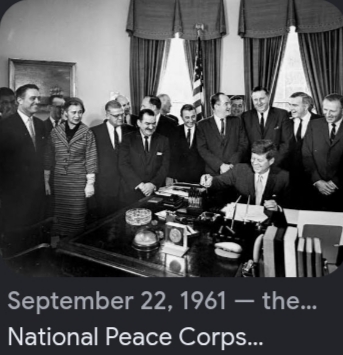
Washington DC – September 24, 2026 – History sometimes leaves lessons that become more important than the events that produced them. September 22, 1961, is one such date. On that day, President John F. Kennedy signed the Peace Corps Act into law, giving permanent statutory authority to an initiative he had launched earlier that year. Kennedy had established the Peace Corps through Executive Order 10924 on March 1, 1961. Congressional legislation then gave the agency a firmer and more durable legal foundation.
The significance of that moment extends beyond the history of the Peace Corps. It offers a lesson about leadership, governance and institution-building—and one worth considering in any movement that aspires to build durable systems of government. Kennedy understood a principle every serious nation-builder eventually confronts: leaders are temporary; institutions can endure.
A leader can articulate a vision, mobilize people, establish priorities and provide the political energy necessary to launch an initiative. But if everything depends upon the continued presence of that individual, then what has been created is not yet institutionally secure. The deeper test of leadership is whether the structures established during one leader’s tenure can continue functioning after that leader is gone. The Peace Corps provides a striking example.
Kennedy was assassinated on November 22, 1963, a little more than two years after signing the Peace Corps Act. Yet the Peace Corps did not disappear with him. Its statutory mandate, administrative machinery, personnel and mission continued under successive administrations. Kennedy died. The institution survived. That is the lesson Ambazonia should examine carefully.
AMBAZONIA MUST BUILD WHAT CAN OUTLIVE ITS LEADERS
Any political movement seeking to construct durable governing institutions must eventually move beyond dependence on personalities. Leaders matter. Institutions matter more. A national project cannot permanently depend upon whether one individual is available, whether another agrees with him, whether a particular officeholder remains popular, or whether activists on social media approve of every decision being made.
The question must therefore become larger than who is leading today. The more consequential question is: What are we building today that will still function tomorrow, regardless of who occupies the office? That is the institutional question.
For Ambazonia, that means thinking seriously about constitutional mechanisms, administrative procedures, diplomatic structures, communication systems, financial accountability, institutional records, clearly defined offices, succession arrangements, dispute-resolution procedures and mechanisms through which decisions can be reviewed and corrected.
These are not merely accessories for some future government. They are part of the political culture required to sustain one. The more deeply this principle is understood, the easier it becomes to distinguish criticism of an officeholder from opposition to the institution itself.
ACCOUNTABILITY DOES NOT REQUIRE PUBLIC WARFARE
Institutional strength does not mean that institutions—or the people who lead them—should be beyond question. Quite the opposite. Durable institutions require accountability. Officials can make mistakes. Policies can fail. Decisions can be challenged. Leaders should receive serious, evidence-based and constructive criticism. But there is an important distinction between institutional accountability and institutional destruction.
Mature systems create mechanisms for resolving disagreements. An official can be approached. A superior authority can be contacted. A proposal can be submitted. A decision can be reviewed. Evidence can be presented. An explanation can be demanded. Where necessary, established procedures can be invoked.
Public scrutiny will sometimes be necessary, particularly when internal mechanisms fail. But a political culture in which every disagreement immediately becomes a personal battle or social-media confrontation risks replacing governance with permanent conflict. If Ambazonia seeks a culture of disciplined government in the future, it must also develop habits of institutional discipline in the present. We cannot demand disciplined government tomorrow while normalizing political indiscipline today.
THE INSTITUTION MUST BE BIGGER THAN THE OFFICEHOLDER
Institutional government also requires a gradual shift in loyalty—from personalities to rules, offices and legitimate procedures. There is a fundamental difference between saying: “I support this individual regardless of what he does.” and saying: “I support the institution, and I expect whoever occupies that office to operate according to established rules and procedures.”
The second principle is central to constitutional government. No officeholder should be beyond accountability simply because of the importance of the position occupied. At the same time, disagreement with an officeholder should not automatically become an attack on the legitimacy of the institution itself.
Institutions must be protected from both extremes: blind personal loyalty on one side and indiscriminate institutional destruction on the other. That distinction is essential to the development of a mature political culture.
KENNEDY DID NOT BUILD ONLY FOR KENNEDY
The history of the Peace Corps is especially instructive because the concept did not originate with Kennedy alone. The National Archives records that congressional proposals for an overseas volunteer program preceded his presidency. In 1960, Senator Hubert Humphrey proposed establishing a Peace Corps, while Representative Henry Reuss proposed that the federal government study the concept. Kennedy subsequently embraced the idea, gave it presidential momentum, established the agency by executive order and signed the legislation giving it statutory authority.
That history provides another useful lesson: Institutions are often larger than the individuals most closely associated with them. Kennedy became inseparable from the history of the Peace Corps because he transformed an emerging idea into presidential policy and gave it extraordinary national visibility. Sargent Shriver and others then developed its administrative capacity, while Congress supplied the legislative foundation that helped make the institution durable. That is how enduring institutions work. The institution should not belong to the individual. The individual should serve the institution.
FROM ACTIVISM TO GOVERNANCE
Ambazonia’s political struggle has produced activists, organizers, diplomats, communicators, administrators and political leaders. Whatever one’s assessment of particular personalities or organizations, there is a larger institutional question that deserves attention: how does a political movement develop the habits required for governance?
Activism and governance are not the same thing. Activism is often driven by urgency. Governance requires continuity. Activism asks: “How do we force attention onto this problem?” Governance must also ask: “What institution will manage this problem over time?” Activism may focus on the person responsible for today’s decision. Governance asks what law, procedure or institution will ensure that tomorrow’s decision is made according to established principles. Activism mobilizes. Governance institutionalizes.
Both can play important roles at different stages, but a movement aspiring to govern must eventually build systems capable of functioning when urgency fades, personalities change and new generations assume responsibility. The transition from personalities and immediate reactions toward systems and institutional continuity is therefore one of the most consequential transitions any political movement can undertake.
WHAT SHOULD AMBAZONIA LEARN FROM SEPTEMBER 22?
The lesson is not that Ambazonia should copy the United States. The histories, political circumstances and institutional traditions are different. The lesson is more fundamental: Durable political systems deliberately construct institutions capable of outliving the people who establish them. Every leader should therefore ask: What happens to this institution when I am gone?
Every official should ask: Am I strengthening the office I occupy, or making that office dependent upon my personality? Every activist should ask: Am I demanding accountability in a way that improves the institution—or merely attacking the individual? And every citizen should ask: Do I want personalities to rule, or institutions to govern? These are not abstract questions. They go directly to the character of whatever political system Ambazonians ultimately seek to build. The Peace Corps Act of September 22, 1961, offers one historical illustration.
Kennedy provided presidential leadership. Congress provided statutory authority. Sargent Shriver and other administrators built organizational capacity. Volunteers carried out the mission. Successive administrations maintained the institution. When Kennedy was gone, the institution remained. That may be the most enduring lesson of September 22: Do not build institutions that depend upon the life, popularity or authority of one leader. Build institutions strong enough to survive the leader. Leaders will come and go. Officeholders will change. Governments will change. Generations will succeed generations. But when institutions are properly designed, legally grounded, accountable and capable of renewing themselves, the larger project can continue.
For Ambazonia, therefore, September 22 can be more than a date in American history. It can be an invitation to think beyond personalities. Build the institution. Strengthen the institution. Hold the institution accountable. Correct it when necessary. Protect it from abuse. And, above all: Make the institution bigger than any individual who temporarily occupies it. That is how activism begins acquiring the habits of governance. And that is how the work of one generation can leave behind institutions capable of serving the next.
As Amazon associate this site earns from qualifying purchases
Buy Southern Cameroons 2050; Why America should care . By Martin Mungwa on Amazon
https://www.amazon.com/s?k=Southern+Cameroon+2050+by+Martin+mungwa&i=specialty-aps&srs=121082092011&crid=165NADKY1TYO0&sprefix=southern+cameroon+2050+by+martin+mungwa%2Cspecialty-aps%2C862&linkCode=ll2&tag=njokings-20&linkId=a5892ed5e7e1800d57a0e9fce94147bc&language=en_US&ref_=as_li_ss_tl
Lester Maddox
Guest Contributor
Independentist News
Oakland, California