







Spiritual commentary

We are home to news on Cameroon and the CEMAC region. We are dedicated to honest and reliable reporting. We are the voice of the Cameroonian people and their fight for freedom and democracy at a time when the Yaoundé government is silencing dissent and suppressing democratic voices.

Pope Leo’s April 2026 visit to Cameroon also demonstrated that spiritual authority can create political space. His itinerary included Bamenda, where he held a Mass and a meeting for peace amid a conflict that has killed thousands and displaced large populations.
By Judith Elondo
Spiritual Leader and contributor to The Independentist News
www.judithspiritualteaching.com
Pope Leo XIV recently acknowledged that his maternal family history includes both enslaved people and slave owners. That statement reaches far beyond genealogy. It reveals an uncomfortable truth about human history: the victim and the beneficiary of injustice do not always remain in separate families, nations, churches, or institutions. Their inheritances can eventually meet within the same bloodline.
For Ambazonia, this is not merely an interesting story about the ancestry of an American pope. It is a spiritual and moral lesson about memory, responsibility, and the danger of believing that suffering automatically makes a person righteous. A family can carry the wounds of enslavement and still inherit some of the advantages created by those who enslaved others. A church can comfort the oppressed while carrying unresolved records of accommodation with power. A nation can celebrate liberty while preserving institutions originally designed for domination. A liberation movement can oppose injustice and yet begin reproducing the conduct of the system it condemns. History is rarely as clean as political slogans suggest.
The Victim and the Beneficiary May Share the Same History
Ambazonians understand what it means to inherit a wounded political history. The former British Southern Cameroons entered a federal arrangement in 1961 after a United Nations plebiscite that did not offer a stand-alone independence option. Its distinct institutions were subsequently weakened and dismantled as political and administrative power became increasingly centralized in Yaoundé.
Yet the history of Southern Cameroons is not populated only by innocent victims on one side and obvious oppressors on the other. Some political leaders resisted centralization, while others accommodated it. Some traditional authorities defended their communities, while others accepted appointments, favors, or protection from the centralized state. Some professionals served the system because they needed to support families or preserve careers, while others actively defended structures that reduced the political autonomy of their own people.
This does not mean that everyone who worked within the system was automatically a traitor. People living under domination often make difficult compromises. They seek employment, education, physical security, and access to institutions controlled by those in power. The spiritual problem begins when compromise is rewritten as complete innocence.
Healing requires more than identifying what was done to us. It also requires asking what we defended, tolerated, concealed, or benefited from. Pope Leo’s acknowledgment matters because it does not sanitize the family archive. It accepts that one family may carry both the wound and the privilege of an unjust system. Ambazonia will need the same maturity. We must be able to examine our political organizations, churches, traditional institutions, diaspora associations, and families without protecting everyone who belongs to our preferred group.
Suffering Does Not Automatically Produce Justice
One of the most dangerous beliefs in liberation politics is the assumption that people who suffered oppression will necessarily govern fairly after acquiring power. History repeatedly disproves that expectation.
A colonized people may later marginalize minorities inside its own borders. A liberation organization may denounce arbitrary imprisonment and later punish critics without due process. An armed group may condemn government extortion while collecting money through threats. A political administration may criticize secrecy in Yaoundé while refusing to disclose its own finances, appointments, or decision-making procedures.
The blood of the victim does not automatically remove the temptation to become the master. That is why Ambazonia must prepare institutions capable of restraining leaders, including respected leaders who served the struggle. Good intentions cannot replace a constitution. Revolutionary credentials cannot replace elections. Personal sacrifice cannot justify permanent entitlement to public office.
A future republic must be built around accountable institutions, independent courts, transparent public finance, protected opposition, civilian control of security forces, and the right of citizens to remove their leaders peacefully. A commander may have fought courageously and still abuse civilians. A diaspora organizer may have raised substantial funds and still refuse financial accountability. A religious leader may have prayed for the people and still manipulate political loyalty. A victim of yesterday may become the gatekeeper of tomorrow.
The constitution must therefore protect the republic not only from known enemies, but also from what trusted people can become when power is placed beyond scrutiny.
The Church Must Examine Compassion and Complicity
Pope Leo’s statement has special significance because it comes from the leader of a global church whose long history includes both the defense of human dignity and periods of accommodation with slavery, imperial power, and colonial authority.
Churches frequently prefer to confess the sins of particular individuals while preserving the innocence of the institution. They may condemn a cruel slave trader, violent ruler, or corrupt official without examining the religious language, institutional silence, political access, or material interests that allowed the injustice to continue.
Southern Cameroons must ask similar questions of its religious institutions. What did churches say as the federal arrangement was dismantled? How did they respond when communities were militarized, schools disrupted, families displaced, and civilians killed? Did religious leaders speak with equal courage to government authorities and armed separatist groups? Did some protect their access to political power while preaching patience to wounded people? Did churches relieve suffering without confronting the political structures repeatedly producing it?
These questions are not attacks on Christianity. They are demands for spiritual consistency. A church that welcomes refugees must also ask why those refugees were forced to leave. A church that speaks about justice must examine the institutions responsible for injustice. A church that condemns trafficking and modern slavery must also confront the political and economic systems that make displaced Africans vulnerable to traffickers. Compassion at the end of the journey is necessary. Justice also requires examining who made the journey necessary.
The Archbishop of Canterbury Comes to Cameroon
The recent visit of Archbishop Sarah Mullally, the Archbishop of Canterbury, brought these questions closer to home. Her West African pastoral tour included Ghana and Cameroon and was her first visit to Africa after her installation as Archbishop of Canterbury. Before entering Cameroon, she visited Cape Coast Castle in Ghana, where enslaved Africans were imprisoned before transportation across the Atlantic on British slave ships.
She then traveled to Cameroon, where she met and worshipped with Anglicans in several cities. In her message to Christians there, she spoke of war, fear, oppression, displacement, division, and the assurance that God had not forgotten those who suffered.
Her presence was pastorally significant. Many Christians living through conflict need to hear that their suffering is visible and that the wider church remembers them. But pastoral comfort should become the beginning of moral inquiry, not the end of it.
The Archbishop of Canterbury leads the established church of the country that administered Southern Cameroons under international trusteeship. The Church of England is not identical to the British government, and the Archbishop does not control British foreign policy. Nevertheless, Britain’s religious, political, and imperial institutions developed through a closely connected history.
This makes several questions unavoidable. Can the Church of England confront British involvement in slavery while remaining silent about Britain’s unfinished trusteeship legacy in Southern Cameroons? Can it acknowledge the suffering of displaced Anglicans without examining the constitutional history that contributed to their present condition? Can it speak of healing while avoiding the responsibility of truth?
The Archbishop’s visit should encourage the Church of England to examine its missionary, colonial, and ecclesiastical archives relating to Southern Cameroons. It should ask what Anglican leaders understood about the 1961 transition, whether they warned about the vulnerabilities of the proposed federation, and how British church institutions responded as the political identity of West Cameroon was dismantled. A pastoral visit becomes historically meaningful when compassion leads to truth, and truth leads to responsible action.
Pope Leo’s Visit and the Power of Spiritual Restraint
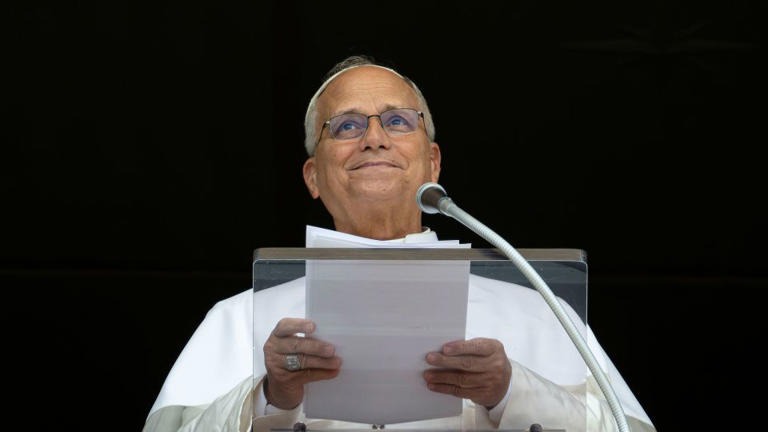
Pope Leo’s April 2026 visit to Cameroon also demonstrated that spiritual authority can create political space. His itinerary included Bamenda, where he held a Mass and a meeting for peace amid a conflict that has killed thousands and displaced large populations.
Ahead of the visit, a separatist alliance announced a three-day safe-travel period intended to allow civilians and pilgrims to move during the papal events. The measure did not end the conflict, but it showed that spiritual authority could temporarily encourage restraint among political and armed actors.
During his Cameroon visit, Pope Leo also denounced corruption, called for respect for human rights, urged leaders to listen to citizens, and appealed for an end to violence and exile. These interventions do not amount to papal recognition of Ambazonian independence and should not be presented as such. Their importance lies in demonstrating that spiritual leadership can challenge governments, encourage restraint, defend human dignity, and bring international attention to suffering that political institutions have normalized.
Britain and France Cannot Select Only the Innocent Parts of History
Pope Leo’s morally mixed family history also offers a lesson for Britain and France. Britain cannot preserve only the memory of its abolitionists while neglecting the conduct of its colonial administration. It cannot celebrate the struggle against slavery while refusing to examine its role in a trusteeship transition that left Southern Cameroons without a stand-alone sovereign option.
France cannot celebrate liberty, equality, and fraternity while overlooking the centralized administrative, military, commercial, and political structures through which its influence continued across former colonies.
Every nation wants to inherit the heroes of its history and abandon the estate papers of those who benefited from domination. But moral inheritance cannot be divided so conveniently. Britain must carry both William Wilberforce and the Colonial Office. France must carry both the Declaration of the Rights of Man and the history of colonial assimilation. Churches must carry both their martyrs and their compromises with political authority. Ambazonians must carry both courageous resistance and wrongs committed in the name of liberation.Historical maturity requires the full archive.
Ambazonia Must Tell the Truth About Itself
It would be easy to use the pope’s statement and the Archbishop’s visit only to criticize Britain, France, La République du Cameroun, and foreign churches. That would miss the deeper spiritual lesson.
Ambazonia must examine itself. We must record abuses committed against our people by government forces, but we must also acknowledge civilians harmed by armed groups claiming to act in our name. We must honor the sacrifices of the diaspora while also examining financial secrecy, rivalry, personality worship, and the commercialization of public suffering. We must condemn centralized power in Yaoundé while rejecting the concentration of unquestionable authority inside liberation organizations.
A national history that records only the crimes of the opponent becomes propaganda rather than truth. This does not mean pretending that all parties possess equal power or equal responsibility. A recognized state controls armies, prisons, budgets, diplomatic relationships, and public institutions. Its obligations are consequently greater. But unequal responsibility does not make a lesser abuse morally acceptable. A credible Ambazonian history must be able to say that one wrong was committed against us and another was committed in our name.
From Confession to Repair
Confession has little value when it produces no repair.A slaveholder’s descendant does not repair history merely by acknowledging slave ownership in the family tree. A former colonial power does not discharge responsibility by creating a museum exhibition. A church does not resolve complicity through one sermon. A liberation movement does not become accountable by admitting unspecified mistakes while protecting those responsible.
Truth must lead to action. For the Church of England, that may include archival transparency and honest examination of Britain’s trusteeship legacy. For the Catholic and Anglican churches, it should include stronger support for displaced families, trauma healing, civilian protection, mediation, education, and moral accountability. For Britain and France, it requires moving beyond humanitarian observation toward honest engagement with historical and institutional responsibility. For Ambazonians, it requires transparent leadership, protection of civilians, rejection of intimidation, and preparation for a constitutional order capable of preventing new forms of domination. Confession without repair becomes another ceremony.
What Will We Do With the Truth?
Pope Leo’s family history is important to Ambazonia not because it proves or endorses our political claims. It does not. The Archbishop of Canterbury’s visit is important not because it constitutes British recognition of Ambazonian sovereignty. It does not.
Their significance lies in the moral questions they raise about inherited injustice, institutional silence, historical memory, migration, and the responsibility of former victims not to become future masters.
Southern Cameroons carries a morally mixed inheritance: British trusteeship, French-supported centralization, African collaboration, courageous resistance, religious compassion, religious silence, diaspora sacrifice, and factional rivalry.
A spiritually mature nation does not hide any part of that history. It studies it, names the victims, identifies the beneficiaries, examines its institutions, and accepts responsibility for wrongs committed in its name. It then builds safeguards so that injustice cannot be reproduced under another flag. The decisive question is no longer simply what our ancestors experienced. It is what we will do with the truth now that it has reached us.
The blood of the oppressed does not guarantee justice. Religious language does not guarantee righteousness. Political independence does not automatically guarantee freedom. Only truth, accountability, repentance, and institutions governed by moral restraint can prevent the victim from inheriting the throne of the master.
By Judith Elondo
Spiritual Leader and contributor to The Independentist News
Share This Post:
WHEN THE STARS ALIGN: Why Ambazonia Must Convert a Rare Historical Opening into National Readiness
THE NATION BEGINS AT HOME : Why Ambazonia Must Rebuild Its Families Before It Rebuilds the Republic
Related Post
AMBAZONIA’S WAR- IS BIGGER THAN YAOUNDÉ: BRITAIN, FRANCE AND
THE DAY SEPTEMBER 22 1961: — WHAT AMBAZONIA CAN
TRUMP’S “SUPER INTELLIGENCE” ERA: WHAT IT REALLY MEANS —
Why Is Ambazonia More Powerful Than many Imagine.
THIS DAY IN HISTORY SEPTEMBER 22, 2017: THE DAY
A President Unseen, a Country Waiting: Yaoundé’s Succession Uncertainty