

If the issue is framed as an “Anglophone problem,” the solution will always be limited to reforms within the existing state. But if it is understood as a question of territorial sovereignty, then the conversation shifts entirely—to restoration, legality, and historical accountability.
By Ali Dan Ismael, Editor-in-Chief The Independentistnews
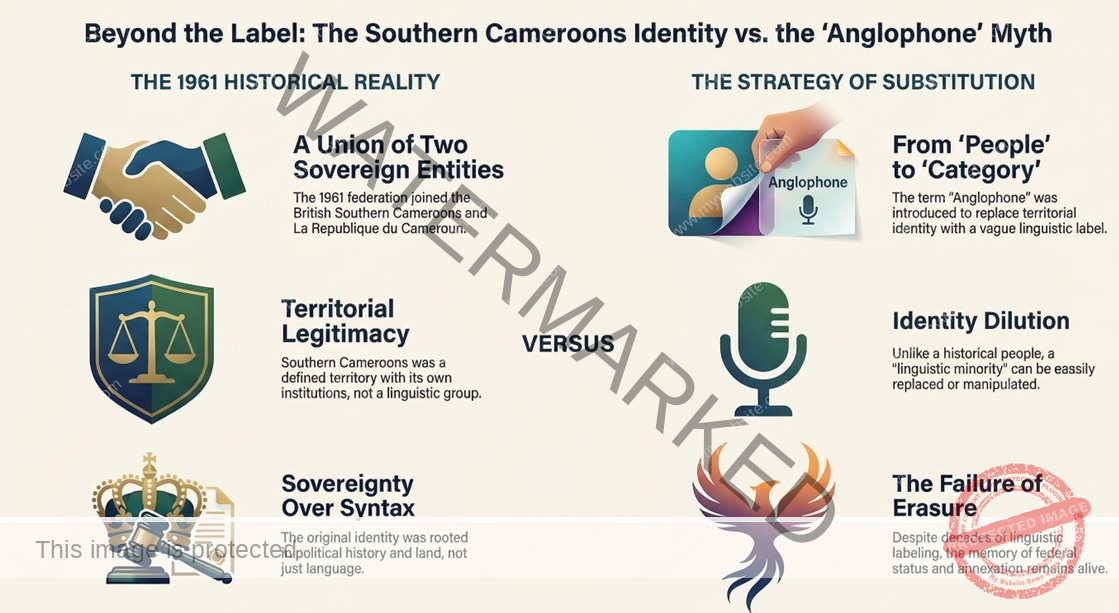
To understand the crisis surrounding the former British Southern Cameroons, one must go back to 1961—not as a matter of language, but as a matter of law and history. That year did not mark the coming together of “Anglophones” and “Francophones,” as it is often casually described today.
It marked something far more significant: the union of two distinct political entities. On one side stood the British Southern Cameroons, a United Nations Trust Territory on the path to independence. On the other stood La République du Cameroun, already an independent state.
This was not a cultural arrangement. It was not a linguistic compromise. It was a treaty-based federation, supervised at the international level, designed to preserve the identity and autonomy of both parties. Each had its own institutions, its own legal system, and its own territorial boundaries. The agreement was meant to protect those differences—not erase them.
But over time, something deliberate began to happen. The original framework—rooted in territorial sovereignty—was quietly replaced by a new narrative built around language. Instead of speaking about two states, the discourse shifted to “Anglophones” and “Francophones.” What had once been a question of international law became recast as a domestic issue of linguistic coexistence. This shift was not accidental. It was strategic.
By replacing the name “Southern Cameroons” with the label “Anglophone,” the very foundation of identity was altered. A people once defined by their land, their history, and their legal status were redefined by the language they spoke. And language, unlike territory, is fluid. It can be adopted, reassigned, and manipulated.
This is what can be described as a strategy of substitution. First, the original name is erased from official use. Then, a new label is introduced—one that has no grounding in international law. Next, the people are reduced from a political entity to a linguistic minority. Finally, their connection to land is weakened, as identity becomes something spoken rather than something inherited. Once this transformation is complete, the implications are profound.
A territorial people—with a legitimate claim to sovereignty—becomes just another demographic group within a larger state. Their struggle is no longer seen as a question of self-determination, but as a complaint about marginalization. The legal argument disappears, replaced by a sociological one. Even more significantly, the new label allows for demographic dilution.
Because “Anglophone” simply refers to English speakers, it can include individuals with no historical or territorial ties to the Southern Cameroons. People from entirely different backgrounds can be administratively inserted into the category, gradually blurring the identity of the original population. Over time, the distinctiveness of that identity is weakened, not by force alone, but by redefinition.
And yet, despite all this, the strategy has not fully succeeded. There are limits to what language can erase. The history of the Southern Cameroons remains documented and undeniable. Its existence as a UN Trust Territory, its participation in a federated union, and its distinct institutions are not matters of opinion—they are matters of record.
The memory of that history also endures. It lives in legal traditions, in administrative practices, and in the lived experience of the people. Most importantly, it is anchored in the land itself. Territory is not abstract. It is physical, historical, and deeply rooted.
This is why the imposed narrative continues to face resistance. You can rename a people, but you cannot erase their history. You can redefine identity, but you cannot sever it from the land that gave it meaning. For any meaningful resolution to emerge, the conversation must return to its original foundation.
This is not a dispute between language groups. It is a dispute between two political entities whose union has failed to preserve its legal integrity. It is not about inclusion within a system—it is about the breakdown of a treaty that once defined that system. The distinction is critical.
If the issue is framed as an “Anglophone problem,” the solution will always be limited to reforms within the existing state. But if it is understood as a question of territorial sovereignty, then the conversation shifts entirely—to restoration, legality, and historical accountability.
In the end, identity is not determined by vocabulary. It is determined by history, by law, and by land. And those are far more difficult to erase.
Ali Dan Ismael, Editor-in-Chief The Independentistnews