











Only those who have carried the dreams of millions can understand the loneliness that descends when the music stops. Only those who have stood upon the summit can comprehend the sorrow of taking the final steps down. And sometimes, folks, even kings must weep so that the kingdom may understand the cost of glory.
By M. C. Folo, The Independentist News contributor
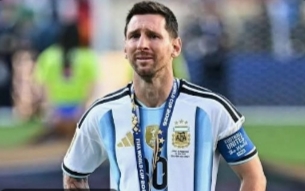
When Lionel Messi wept beneath the cold lights of MetLife Stadium, it was not merely the cry of a defeated athlete. It was the lament of a king who had reached the edge of his own legend—a man who had carried a nation on his back for two decades, only to discover that even gods have sunsets. His tears were not water. They were history melting upon his face.
Spain did not merely defeat Argentina; they smothered them. They pressed with the zeal of a rising empire—a new generation unafraid of the old gods. Messi, the eternal conductor, found himself trapped in a maze of red shirts, unable to summon the sorcery that had carried Argentina through the tournament. Spain ultimately prevailed 1–0 after extra time, ending Argentina’s dream of retaining the World Cup. For 120 minutes, Messi was a man fighting time itself. And time, that undefeated opponent, finally scored.
Argentina does not simply send its players to the World Cup; it sends its soul. Messi has long been the vessel of that soul—the boy from Rosario who became his country’s second religion. Every touch he takes is a prayer. Every goal is a hymn. Every victory is received as a national blessing.
So, when the final whistle sounded, he did not cry only for himself. He cried for more than 45 million people who had believed that he could bend destiny one more time. He cried for the children who wear his number. He cried for the old men who still compare him with Maradona. He cried for the mothers who whisper his name during penalties. He cried because he could not deliver the miracle that millions had already begun celebrating in their hearts. Messi had stood on the brink of the perfect ending: a second consecutive World Cup, a possible Golden Boot, a potential ninth Ballon d’Or, and a final dance seemingly scripted by the gods themselves. But football, like life, is a jealous storyteller. It often denies perfection so that the myth may endure.
Messi’s tears were the price of almost touching immortality. This was not his first heartbreak on American soil. Ten years earlier, on the same ground, he had cried after losing the Copa América final. He briefly retired from international football that night, broken by the accumulated weight of expectation. MetLife Stadium is therefore not merely a venue for Messi. It is a shrine of sorrow.
When Spain’s victory sealed Argentina’s fate, the ghosts of 2016 seemed to rise from the turf and wrap themselves around his ankles. Messi slumped to the ground, overcome by a flood of tears. He did not weep simply because Argentina had lost. He wept because he knew that this was probably the last time he would walk into a World Cup arena with the entire world expecting magic.
He wept because he could feel the curtain touching his shoulders. He wept because he knew that the next World Cup would belong to the children—to Lamine Yamal, Pau Cubarsí, Alejandro Garnacho, and the gifted young men who had grown up watching him. They would inherit the stage he had once ruled.
He wept because greatness is not eternal, even when its memories are. Messi’s tears were also a ceremony—a final libation poured upon the grass for all the battles he had fought, all the miracles he had delivered, and all the burdens he had carried. He cried because he loved. He cried because he had given everything. He cried because he understood that the story was ending.
The world had watched Messi climb every mountain football placed before him. It had watched him endure criticism, defeat, comparison, doubt, and national disappointment. It had also watched him return, rebuild, conquer South America, and finally lift the World Cup.
He had already given Argentina what generations had demanded of him. He had already entered the sacred chamber reserved for the immortals of the game. Yet the heart does not measure accomplishment through trophies alone. It remembers the final chance, the missed opportunity, the fading light, and the knowledge that some doors, once closed, will never open again. That was why Messi wept. Those tears were not a repudiation of greatness. They were its final proof.
Only those who have carried the dreams of millions can understand the loneliness that descends when the music stops. Only those who have stood upon the summit can comprehend the sorrow of taking the final steps down. And sometimes, folks, even kings must weep so that the kingdom may understand the cost of glory.
M. C. Folo, The Independentist News contributor






Leave feedback about this