









Commentary

We are home to news on Cameroon and the CEMAC region. We are dedicated to honest and reliable reporting. We are the voice of the Cameroonian people and their fight for freedom and democracy at a time when the Yaoundé government is silencing dissent and suppressing democratic voices.

No conference, however well staged, can substitute for a credible political process. No collection of carefully selected participants can replace genuine representation. And no amount of diplomatic language can conceal a simple truth: A process that avoids the core of a conflict cannot resolve it.
By Lester Maddox
Guest Contributor, The Independentist News
Oakland County, California | April 26, 2026
There are moments in history when a political proposal must be judged not by its language, but by its timing.The sudden resurrection of the All Anglophone Conference III (AAC III) is one of those moments. Let us be clear from the outset: this is not a peace initiative. It is a political instrument—carefully timed, carefully packaged, and dangerously misleading. A Dead Idea Recycled at a Convenient Hour
For years, Christian Cardinal Tumi pleaded for dialogue. He did so when dialogue could still prevent escalation, when communities were not yet fractured beyond repair, and when trust—however fragile—still existed. He was ignored. Marginalized. Blocked.
Now, after years of bloodshed, displacement, and hardened positions, the same establishment that dismissed dialogue suddenly “anticipates” a conference. What changed? Not conscience. Not conviction. Only pressure.
The Optics Strategy: Manufacturing Legitimacy
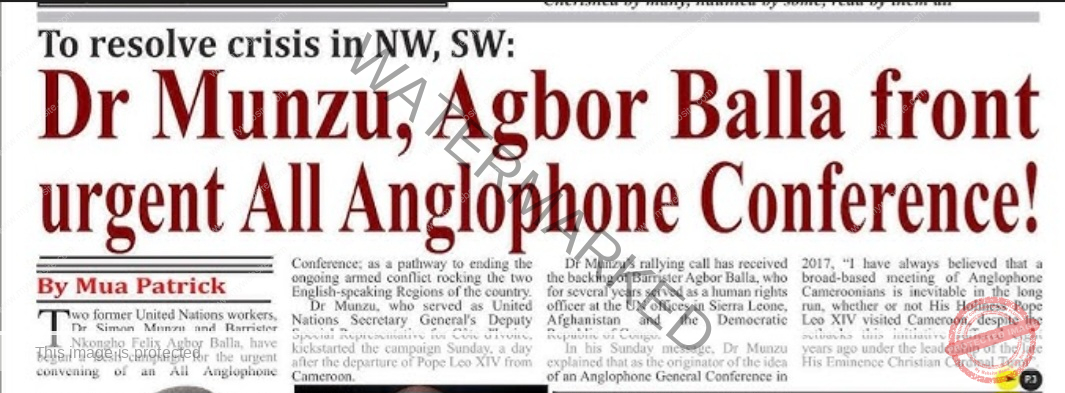
The inclusion of figures such as Simon Munzu and Felix Agbor Balla is not accidental. It is strategic. This is not about empowerment. It is about presentation. A conference populated with recognizable Anglophone names provides something the current system desperately needs: a visual narrative of inclusion. But optics are not legitimacy. And participation is not representation. A process that does not address the fundamental political dispute cannot resolve it—no matter how many familiar faces are placed at the table.
The Core Evasion: Refusing to Name the Conflict
AAC III is built on a foundational evasion. It frames the crisis as an internal Anglophone conversation—when the conflict itself is not an intra-community disagreement, but a political rupture over governance, authority, and sovereignty. You cannot resolve a structural conflict by redefining it as a community dialogue. That is not mediation. That is misdirection.
A Conference Without Consequence
What, precisely, will AAC III produce? Resolutions? Communiqués? Recommendations? We have seen this script before. Documents are drafted. Statements are issued. Applause is manufactured. And then—nothing changes. No enforcement. No binding commitments. No structural reform. A conference without consequence is not a solution. It is a delay mechanism.
The Real Question: Who Is This For?
If AAC III were genuinely designed to resolve the crisis, it would confront the central issues directly: Political authority. Security realities. Competing claims of governance. The conditions for a negotiated settlement. Instead, it offers a controlled environment, a curated narrative, and a predictable outcome. So the question must be asked—directly and without illusion: Is this conference designed to resolve the conflict, or to manage perception? History Will Not Be Kind to Substitutes
There is a difference between dialogue that transforms and dialogue that absorbs pressure. The former confronts reality. The latter avoids it. AAC III, as currently conceived, risks becoming a textbook example of the second. History has little patience for processes that substitute symbolism for substance. It records them not as solutions—but as detours that prolonged crises and deepened mistrust.
The Bottom Line
No conference, however well staged, can substitute for a credible political process. No collection of carefully selected participants can replace genuine representation. And no amount of diplomatic language can conceal a simple truth: A process that avoids the core of a conflict cannot resolve it.
Until that reality is confronted—directly, structurally, and without illusion—AAC III will remain what it increasingly appears to be: Not a path forward, but a carefully constructed pause. A pause designed not to end the crisis — but to outlast it.
Lester Maddox
Guest Contributor, The Independentist News
Share This Post:
POWER WITHOUT CONTROL: The Fatal Error of 1961—and the Warning for Today. How the absence of sovereign security doomed Southern Cameroons—and why the lesson defines the future of the Federal Republic of Ambazonia
From Buea to the Brink: The Unfinished Business of Decolonization
Related Post
IS THE WORLD LISTENING: THREE DAYS FOUR FRONTLINES, ASA
SEPTEMBER 24, 1965, THIS DAY IN HISTORY: From Equal
AMBAZONIA’S WAR- IS BIGGER THAN YAOUNDÉ: BRITAIN, FRANCE AND
THE DAY SEPTEMBER 22 1961: — WHAT AMBAZONIA CAN
TRUMP’S “SUPER INTELLIGENCE” ERA: WHAT IT REALLY MEANS —
Why Is Ambazonia More Powerful Than many Imagine.