









Commentary

We are home to news on Cameroon and the CEMAC region. We are dedicated to honest and reliable reporting. We are the voice of the Cameroonian people and their fight for freedom and democracy at a time when the Yaoundé government is silencing dissent and suppressing democratic voices.

The 200 militants, the mothers and grandmothers, the families who opened their homes, and the ordinary citizens who stood in solidarity with Fru Ndi did not make their sacrifices for one man alone. They believed they were defending democracy, justice and the right of the people to choose their leaders.
By Tsi Conrad for The Independentist News
As Amazon associate this site earns from qualifying purchases
Get your copies of books on the Ambazonian revolution by Martin Mungwa on Amazon
https://www.amazon.com/s?k=martin+mungwa&crid=3R7LZRNP7DOV0&sprefix=martin+mungwa%2Caps%2C1955&linkCode=ll2&tag=njokings-20&linkId=da9ac83468f5e26b504e1c835a24d0c5&language=en_US&ref_=as_li_ss_tl
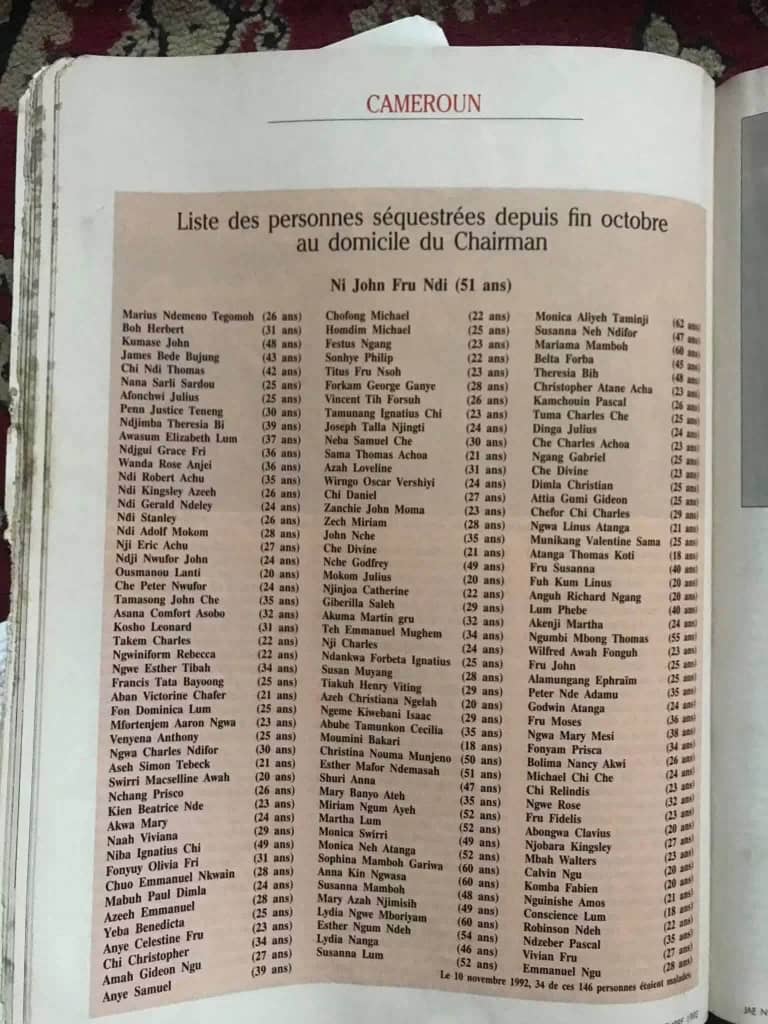
In 1992, following Cameroon’s disputed presidential election, John Fru Ndi declared that he had won the election. The Biya regime responded with a crackdown, and the threat of arrest against the SDF Chairman became a defining moment in the country’s struggle for democracy.
At his Ntarinkon residence in Bamenda, an estimated 200 SDF militants formed a human shield around their leader. They were prepared to risk their lives rather than allow him to be taken away without a fight.
But the militants were not alone. Hundreds of our mothers and grandmothers travelled from distant villages, formed long lines around the residence and slept in nearby houses, ready to put their bodies between Fru Ndi and any bullets the gendarmes might fire. Many residents living around Ntarinkon opened their homes to accommodate those who had come to protect the Chairman. Our parents were actively involved. We were not merely spectators; we were part of a community united by a common cause.
For many of us, that experience was more than a political confrontation. It was the birth of a spirit of activism, sacrifice and resistance—a determination to stand for what we believed was right, even when the price could be death.
Fru Ndi was eventually placed under house arrest at a guarded residence, while security forces maintained a siege around his Ntarinkon home for weeks. Throughout that difficult period, SDF militants maintained their protective cordon. Some reportedly slept on the same floor as their Chairman, determined to remain by his side in the face of danger.
Eventually, Fru Ndi chose to surrender, explaining that he wanted to prevent a bloodbath. Whatever one’s interpretation of that decision, the courage and sacrifices of the ordinary people who stood with him in 1992 deserve to be remembered.
But here is the painful question: What happened to that spirit of resistance? When the Ambazonia struggle for freedom, human rights and dignity intensified, many of us appealed to Ni John to take a firmer stand against the Biya regime. We expected the man whom thousands had risked their lives to protect to stand unequivocally with a people demanding justice and dignity. Yet, in the eyes of many who had once looked up to him, his later political posture fell short of those expectations.
Then came another painful irony. When Fru Ndi died, the same regime against which his supporters had once mobilised to protect him played a role in securing his funeral and burial.
What does this tell us about the final chapter of Ni John’s political journey? Did the man who once symbolised resistance become too constrained by the political system he had spent years challenging? Did political calculations gradually overshadow the ideals that inspired his supporters? Or did the realities of his later years lead him to make choices that his most devoted followers could neither understand nor accept? These are difficult questions, but history demands that we ask them.
The 200 militants, the mothers and grandmothers, the families who opened their homes, and the ordinary citizens who stood in solidarity with Fru Ndi did not make their sacrifices for one man alone. They believed they were defending democracy, justice and the right of the people to choose their leaders. Their sacrifices must not be reduced to a footnote in the history of Cameroon’s opposition politics.
A leader may eventually leave the political stage, but the people who risked everything for him have a right to ask whether he remained faithful to the ideals for which they stood. For those of us who witnessed those events, the memories remain vivid. The question is not simply what Ni John did in 1992. It is what his journey teaches us about leadership, courage, political compromise and the responsibility leaders owe to the people who place their trust in them. That is the debate his legacy leaves behind.
As Amazon associate this site earns from qualifying purchases
Buy your copies of books on the Ambazonian revolution by Martin Mungwa on Amazon
https://www.amazon.com/s?k=martin+mungwa&crid=3R7LZRNP7DOV0&sprefix=martin+mungwa%2Caps%2C1955&linkCode=ll2&tag=njokings-20&linkId=da9ac83468f5e26b504e1c835a24d0c5&language=en_US&ref_=as_li_ss_tl
Tsi Conrad for The Independentist News
Share This Post:
AMBAZONIA: A SETBACK IS NOT THE END — LEARN, ADAPT AND MOVE FORWARD
TRUMP AND THE GOVERNANCE CROSSROADS IN WEST AND CENTRAL AFRICA: Power, Sovereignty, and Accountability in an America First Era
Related Post
AMBAZONIA: A SETBACK IS NOT THE END — LEARN,
TRUMP AND THE GOVERNANCE CROSSROADS IN WEST AND CENTRAL
FOUR FORMER AMERICAN PRESIDENTS: ONE POWERFUL LESSON FOR AMBAZONIA,
ASTROTURFED: THE COMMUNITY IS IN PRISON AND IN THE
POLITICAL ECONOMY MADE SIMPLE: Why Nations Remain Poor—and How
THE CORPORATE CONSCIENCE: Why Corporate Integrity Must Be Engineered,