







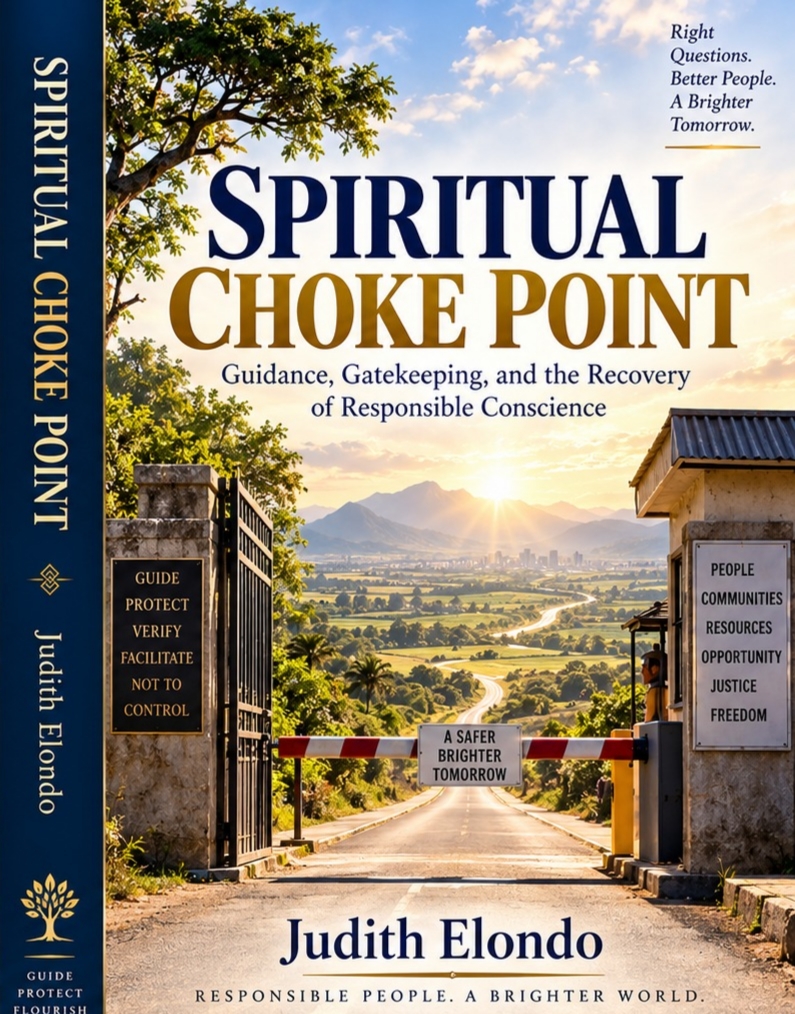
By Judith Elondo
Prepublication book Review By The Independentist News education desk
As Amazon associate this site earns from qualifying purchases
Get other publications by Judith Elondo on amazon
https://www.amazon.com/s?k=Book+by+Judith+Elondo&i=digital-text&crid=3T89K8IGVGT1D&sprefix=book+by+judith+elondo%2Cdigital-text%2C390&linkCode=ll2&tag=njokings-20&linkId=65b4d9ce1612be94c50a02f6883115d3&language=en_US&ref_=as_li_ss_tl
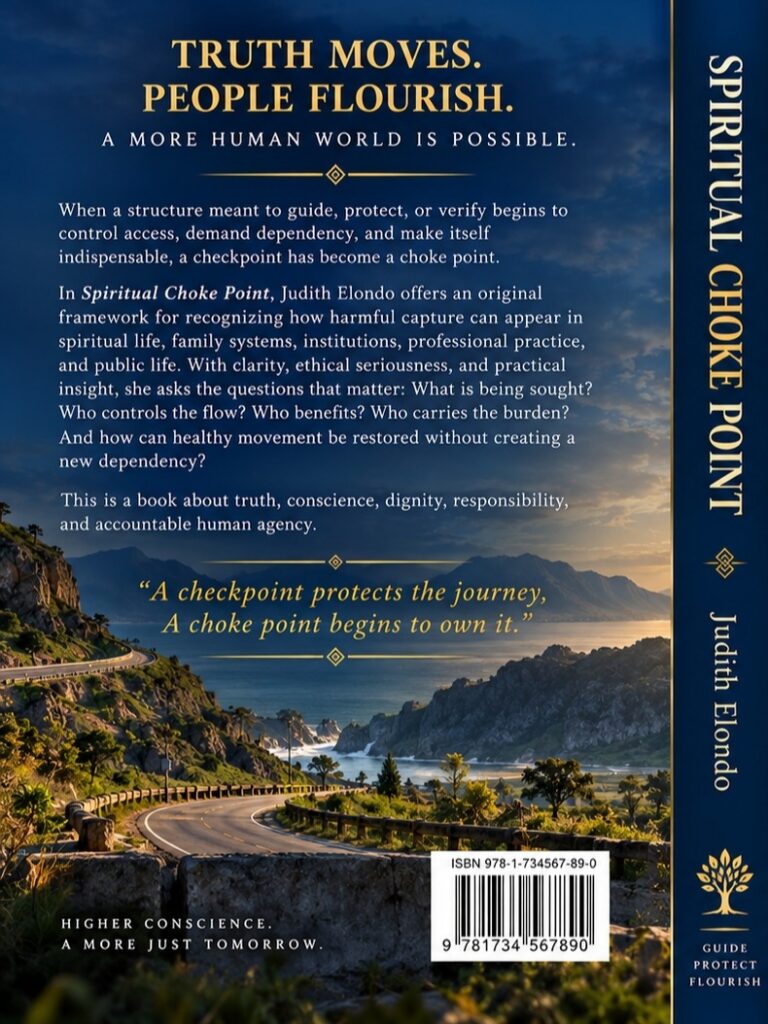
When does guidance stop helping us move and begin controlling whether we are allowed to move at all? That is the deceptively simple question at the heart of Judith Elondo’s Spiritual Choke Point, a thoughtful and unusually practical work of spiritual reflection, ethics, institutional analysis, and human responsibility.
Elondo begins with an idea familiar to engineers, clinicians, administrators, caregivers, and anyone who has ever worked inside a system: not every restriction is harmful. Some checkpoints exist for good reasons. They verify. They protect. They document. They correct. They safeguard the vulnerable. The problem begins when a checkpoint ceases to serve the purpose for which it was created and starts serving itself. That transformation—from checkpoint to choke point—provides the governing metaphor and analytical framework of the book.
A healthy checkpoint, in Elondo’s formulation, protects legitimate movement. A choke point narrows it. It controls information, permission, money, reputation, status, interpretation, or access until the intermediary becomes indispensable. The question is no longer simply whether authority exists, but what that authority produces.
Do people become more capable? More responsible? More discerning? Or more fearful, dependent, and unable to act without permission? That distinction gives Spiritual Choke Point much of its intellectual value.
A BOOK ABOUT ACCESS—BUT EVEN MORE ABOUT RESPONSIBILITY
At first glance, the book appears to be primarily about spiritual access to God. Elondo questions forms of religious dependence that persuade people they cannot hear, discern, decide, pray, repent, or act responsibly unless another person authorizes their movement. Yet the manuscript quickly becomes more demanding than a critique of religious gatekeeping.
Elondo does not argue that pastors, churches, elders, teachers, counsellors, professionals, or institutions are unnecessary. Quite the opposite. She repeatedly acknowledges that healthy authority can teach, protect, correct, verify, safeguard, and equip. Her objection is to monopolized access—the moment guidance becomes ownership.
This is a significant distinction. A pastor can counsel without controlling. A teacher can interpret without demanding intellectual dependency. A clinician can exercise professional authority without erasing human dignity. A safeguarding system can restrict action precisely because vulnerable people require protection. A public official can verify compliance without converting approval into private power.
Elondo’s framework therefore avoids the simplistic equation: authority = oppression. Instead, she asks a much more useful question: Does the authority help the person eventually stand more responsibly, or does it require permanent dependency to preserve its own importance? That is a stronger and more mature argument.
THE FOUR ETHICAL TESTS
The book is organised around four recurring ethical tests: Truth. Conscience. Righteousness. Justice.These words could easily have remained abstract moral vocabulary. Elondo makes them functional. Truth asks whether a claim, record, explanation, report, or interpretation can survive examination. Conscience asks whether a person retains meaningful moral agency rather than merely obeying pressure.
Righteousness asks whether conduct corresponds to the values publicly professed. Justice asks who receives protection, benefit, access, remedy, burden, and appeal. Together they move the book beyond private spirituality.
Elondo repeatedly carries the reader from prayer and spiritual authority into signatures, engineering certifications, public money, election records, church donations, caregiving, family mediation, professional duty, safeguarding, and institutional accountability. This may be the book’s greatest strength. It refuses to allow spirituality to remain respectable language detached from ordinary conduct.
THE SIGNATURE AS A MORAL EVENT
One of the book’s most powerful insights is that ethical breakdown often becomes visible at an ordinary decision point. A signature. A certification. A ballot record. An invoice. A medical observation. A financial approval. A statement made under pressure. The system may be enormous, but the moral choke point can become very small: the distance between what a person knows and what that person is willing to make official. This is especially effective in the engineering and public-administration cases. An engineer who knows that a road layer does not meet specification is not merely handling paperwork when asked to approve it. The signature transfers consequence into the physical world.
Likewise, an election officer asked to alter a record is not confronting an abstract political theory. She is being asked to convert something known to be false into an official statement. Elondo’s strength is in identifying these moments not as isolated moral failures but as points of narrowed flow: truth is present, conscience is active, authority applies pressure, risk is transferred, and the individual must decide whether to keep the passage open.
WHY THE CASE STUDIES MATTER
The book’s case studies significantly increase its usefulness. They include public works certification, election records, engineering standards, market conduct, church donors, family mediation, conflicting advisers, caregiving, healthy pastoral leadership, and safeguarding. Importantly, the manuscript identifies these as illustrative composites rather than accusations against specific individuals.
Each case asks essentially the same systems questions: What is being sought? Who is the intermediary? What legitimate purpose does the intermediary serve? What mechanism controls the flow? What dependency has formed? Who benefits? Who carries the burden? What happens if the gatekeeper is wrong? Can the decision be reviewed or appealed? What would restoration look like? This gives Spiritual Choke Point potential beyond ordinary reading. The framework could plausibly be used in leadership discussions, ethics seminars, faith communities, caregiving environments, professional education, and institutional review. That portability is one of the book’s strongest assets.
THE IMPORTANT DISTINCTION BETWEEN PROTECTION AND CONTROL
Perhaps the most intellectually responsible section of the book is the material on legitimate checkpoints. Many books about personal liberation eventually imply that every barrier should disappear. Elondo does not. Her caregiving and safeguarding material makes the opposite point: freedom is not the absence of every gate. There are situations in which documentation, clinical review, professional standards, legal procedures, appeals, and reporting requirements are not oppressive obstacles. They are protections.
The vulnerable person may have the least ability to defend themselves. In such circumstances, a checkpoint can be precisely what prevents neglect, intimidation, exploitation, or concealment. That leads to one of the book’s most useful ethical propositions: The task is not to abolish checkpoints. It is to determine which checkpoints protect life and which ones have begun protecting themselves. That distinction elevates the framework considerably.
RELIGION WITHOUT ANTI-RELIGIOUS POLEMICS
Religious authority is one of the manuscript’s most sensitive subjects, and Elondo handles it with greater balance than the provocative title might initially suggest. She explicitly recognizes the value of Scripture, church community, teaching, scholarship, pastoral care, Christian mediation through Christ, and accountable spiritual leadership. The critique is directed instead at mechanisms such as: fear, exclusive claims to revelation, money-dependent access, suppression of questions, unreviewable authority, and the substitution of religious performance for ethical accountability. The distinction is crucial.
A congregation receiving counsel from a pastor is not automatically experiencing a choke point. A choke point emerges when counsel becomes permission, permission becomes dependency, and dependency becomes fear of responsible judgment. This is where Elondo’s progression— counsel → permission → dependency —becomes particularly memorable.
The framework also turns back on the individual. Direct access does not mean that every internal impression is divine. Elondo repeatedly acknowledges that conscience can be mistaken, fear can resemble conviction, desire can masquerade as certainty, and professional expertise may still be necessary. That safeguard prevents the book from exchanging institutional infallibility for personal infallibility.
AFRICA WITHOUT REDUCING AFRICA TO A SINGLE STORY
The manuscript also attempts something important in its treatment of African spirituality, Christianity, public morality, and institutional life. Elondo avoids treating “Africa” as one undifferentiated spiritual or ethical culture. The book draws on scholars including John Mbiti, Kwame Bediako, Lamin Sanneh, Paul Gifford, and Mogobe Ramose to recognize both religious diversity and the importance of relational understandings of personhood and community.
This matters because the book addresses public corruption, religious authority, political pressure, and institutional weakness without claiming that those problems belong uniquely to Africa.Instead, Elondo uses African contexts as important sites of application while maintaining that choke-point dynamics can arise anywhere authority, dependency, information, money, status, or fear become concentrated. That is the right approach.
WHERE THE BOOK IS STRONGEST
Spiritual Choke Point is at its best when it does three things simultaneously: it identifies a mechanism, it shows the human being living inside that mechanism, and it asks what restoration would look like without merely reversing who holds the power. That final requirement is especially important.
A bad solution to a choke point can create another choke point. A person freed from one controlling adviser can become dependent on another. A church freed from one authoritarian structure can recreate authority around a new charismatic personality. A political reform can simply transfer control from one elite to another. A technological solution can remove human discretion only to place unreviewable power inside an algorithm. Elondo’s insistence that restoration must not create a new dependency gives the framework unusual resilience.
TECHNOLOGY AND THE NEXT GENERATION
The final movement into technology and the future is ambitious but justified. Artificial intelligence, digital platforms, automated decision-making, and information systems dramatically increase human capacity. They can also produce new forms of gatekeeping. Who controls the data? Who can question the output? Who understands the criteria? Who benefits from opacity? What happens when the system is wrong? Can the affected person appeal? Those are exactly the same questions the Spiritual Choke Point framework has already been asking.
The technology discussion therefore does not feel bolted onto the manuscript. It demonstrates the portability of the framework. And Elondo makes a valuable point: increasing technical capability does not automatically increase ethical maturity. The future therefore requires what she calls accountable human agency—power that expands capability without making responsibility, explanation, review, and remedy disappear.
A PARTICULARLY STRONG INTERGENERATIONAL INSIGHT
One of the quieter but most important ideas in the manuscript concerns children and institutional culture. Children do not learn ethics only from what adults write on classroom boards. They learn from what systems reward. A child may be taught honesty in school and then observe adults paying unofficial fees, praising influential donors despite unanswered questions, punishing whistleblowers, or rewarding people who manipulate the rules.
The formal lesson says: Be honest. The operating system says: Honesty is expensive. Influence works better. Elondo understands that the second lesson may be stronger. This moves the book beyond personal morality into institutional formation. If societies want ethical citizens, they cannot simply teach integrity; they must make integrity credible.
THE BOOK’S MAIN LIMITATION
The manuscript’s main challenge is breadth. Elondo moves from personal spirituality to Christianity, African religious history, conscience, caregiving, elections, engineering, public administration, church governance, corruption, technology, and human consciousness. The framework is strong enough to travel across those areas, but the range requires discipline. If every social problem is interpreted through the choke-point lens, the concept could become so expansive that it explains too much and therefore explains too little.
To the author’s credit, the manuscript repeatedly guards against that error. It states that corruption, poverty, infrastructure failure, illness, political instability, and institutional dysfunction have economic, technical, historical, legal, political, and organizational causes and should not be reduced to spirituality. That caution should remain prominent. The Spiritual Choke Point works best as a diagnostic lens within a larger analysis, not as a theory of everything.
THE SCHOLARLY FOUNDATION
The book also benefits from dialogue with established scholarship and spiritual writing. William James helps frame religious experience without reducing it to institutional authority. Paul Ricoeur offers resources for interpretation and responsible selfhood. Paulo Freire illuminates the relationship between consciousness, power, and agency. Lisa Oakley and Kathryn Kinmond provide important scholarship on spiritual abuse. Mbiti, Bediako, Sanneh, Gifford, Ramose, and others help situate African religion and Christianity without presenting the continent as spiritually uniform. Brother Lawrence, Thomas Merton, Henri Nouwen, Dallas Willard, A. W. Tozer, and Oswald Chambers contribute spiritual traditions emphasizing inward formation and attentiveness.The manuscript’s better passages use these figures as lenses, not substitute authors. That is exactly the right intellectual relationship.
THE CENTRAL CONTRIBUTION
The most valuable contribution of Spiritual Choke Point can be stated simply: A structure should be judged not merely by the authority it possesses, but by what happens to the people and purposes moving through it. Does it protect? Does it clarify? Does it verify? Does it equip? Does it eventually release responsibility? Or does it accumulate permission, information, money, status, fear, and dependency around the gatekeeper? That question is applicable to a church. A family. A government office. A school. A hospital. A profession. A corporation. A digital platform. An artificial-intelligence system. And sometimes to the internal structures through which individuals avoid taking responsibility for their own decisions. That breadth is why the concept has value.
PREPUBLICATION VERDICT
Spiritual Choke Point is not simply another book arguing that people should “trust themselves” or reject institutions. Its argument is more demanding. Seek counsel—but retain responsibility. Respect authority—but examine its function. Protect legitimate checkpoints—but expose captured ones. Listen to conscience—but do not mistake conscience for infallibility. Demand truth—but remain willing to be corrected by truth yourself. Remove unhealthy dependency—but do not create a new dependency in the name of liberation. That ethical balance gives the book substance.
Judith Elondo has developed a framework capable of moving between spirituality and systems thinking without requiring readers to choose between individual freedom and responsible community. The metaphor is simple enough to remember. The questions are practical enough to use. And the final standard is difficult enough to matter: Does the gate still serve the journey, or has the gate begun to own it?
Prepublication Rating: 4.8/5
Best suited for readers interested in: spirituality and conscience; Christian leadership; institutional ethics; spiritual abuse and healthy authority; professional responsibility; caregiving and safeguarding; public leadership; African religious thought; systems thinking; and the ethical challenges of emerging technology.
Bottom line
Spiritual Choke Point gives readers something more useful than an argument against authority. It gives them a framework for distinguishing authority that equips from authority that captures, protection from control, guidance from dependency, and legitimate checkpoints from choke points. And its most important lesson may be this: A checkpoint protects the journey. A choke point begins to own it. That is a distinction worth carrying far beyond the pages of this book.
As Amazon associate this site earns from qualifying purchases
Get othe publications by Judith Elondo on Amazon
The Independentist News education desk





Leave feedback about this