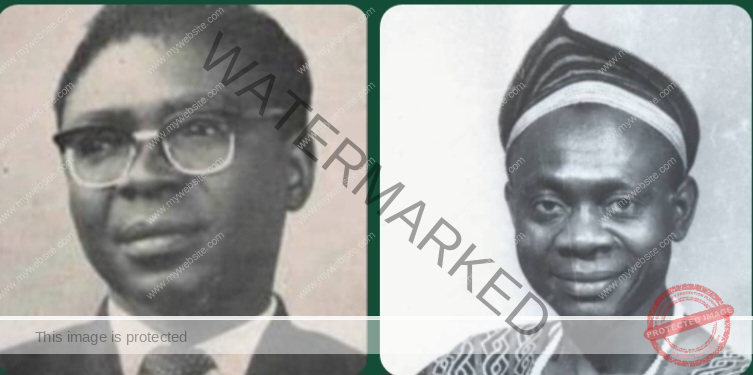


In the 1959 general elections, Dr. John Ngu Foncha’s KNDP defeated Dr. Endeley’s KNC. In an extraordinary moment for Africa, the transfer of power was peaceful, democratic, and transparent. The ceremony in Buea was attended by Dr. Kwame Nkrumah, who praised both men for setting an example that many newly independent African nations would later struggle to emulate. Southern Cameroons had proven that democracy could flourish in Africa without bloodshed.
By Timothy Enongene The Independentist historical desk.
Many young Ambazonians today do not know that their forebears once practiced one of Africa’s earliest experiments in democracy and peaceful transfer of power. In 1953, our leaders walked out of the Eastern House of Assembly in Enugu. Their reason was simple yet profound — their voices were not being heard, and their aspirations were being dismissed. Determined not to be drawn into the internal politics of Nigeria, they declared a position of “benevolent neutrality” and left the Assembly.
After a brief stop in Mamfe, they agreed to establish an instrument for self-government, which led to the election of Dr. E.M.L. Endeley as Leader of Government Business in 1954. Four years later, in 1958, that position evolved into the title of Prime Minister — a sign of growing political maturity and autonomy.
In the 1959 general elections, Dr. John Ngu Foncha’s KNDP defeated Dr. Endeley’s KNC. In an extraordinary moment for Africa, the transfer of power was peaceful, democratic, and transparent. The ceremony in Buea was attended by Dr. Kwame Nkrumah, who praised both men for setting an example that many newly independent African nations would later struggle to emulate. Southern Cameroons had proven that democracy could flourish in Africa without bloodshed.
The Beginning of Subjugation (1961–1968)
The spirit of that democracy began to fade after the 1961 plebiscite and the creation of the so-called Federal Republic of Cameroon, which violated UN Resolutions 1514 (1960) and 1608 (1961). Instead of a true federation of equals, the arrangement became a political trap. President Ahmadou Ahidjo appointed Prime Minister John Ngu Foncha as Vice President — a move that stripped Ambazonia (then West Cameroon) of genuine autonomy.
By 1965, when Ahidjo demanded that Foncha choose between remaining Prime Minister or serving as Vice President, Foncha chose the latter. It was then time for Ambazonians to elect a new Prime Minister — and they did. The people voted overwhelmingly for Bobe Augustine Ngom Jua, a principled man of integrity who could not be easily manipulated or corrupted.
Ahidjo, uncomfortable with Jua’s independence, rejected the results and demanded a second vote. Jua won again. Knowing that Jua would never support the full absorption of Ambazonia into La République du Cameroun, Ahidjo falsely accused him of planning to “dissolve the federation.” On January 12, 1968, Ahidjo dispatched his two trusted collaborators — Solomon Tandeng Muna and Emmanuel Tabi Egbe — to Buea. They overthrew Prime Minister Jua and imposed Muna in his place.
That day marked the death of Ambazonian democracy. From that moment, all subsequent “Anglophone leaders,” from Muna to Dion Ngute, were appointed, not elected. They were hand-picked proxies serving Yaoundé’s interests, not representatives of the Ambazonian people.
The Politics of Puppetry
Since 1968, every Ambazonian elevated to high office under Yaoundé has done so at the pleasure of the ruling regime. Whether it was Achidi Achu, Peter Mafany Musonge, or Atanga Nji, each played a role in perpetuating the policy of divide and rule.
Achidi Achu was used to weaken traditional authority; Musonge oversaw the decline of the Cameroon Development Corporation; Atanga Nji today acts as a political enforcer — a visible mask for invisible powers. Behind such figures lie the same architects of oppression: Ngoh Ngoh, Ferdinand Ayolo, and Chantal Biya, the courtiers of an aging autocracy.
When Ambazonians complain about the injustices imposed on them, Yaoundé cynically responds, “It is your own brothers causing your problems.” That is the oldest colonial strategy — to make the oppressed quarrel among themselves while the oppressor rules unchallenged.
The Erosion of a Democratic Legacy
Everything that once made Southern Cameroons a model of governance — free elections, rule of law, freedom of speech, and respect for traditional institutions — was gradually dismantled after 1968.
The stages of subjugation were carefully engineered:
1961: The illegal “federation” (West Cameroon and Cameroun Oriental) under Ahidjo’s control. 1972: The fraudulent “United Republic of Cameroon,” which erased Ambazonia’s federal status and renamed its regions as North-West and South-West provinces. 1984: The final act of secession — when Paul Biya dropped the word “United” and reverted to “La République du Cameroun”, the same name by which French Cameroun entered the United Nations in 1960. Through each stage, Ambazonia’s existence as a self-governing entity was erased — not by war, but by administrative deceit.
Restoration, Not Secession
Ambazonians are not secessionists, rebels, or separatists. They are restorationists — reclaiming a stolen sovereignty rooted in international law and history.
Our right to self-determination is affirmed by the League of Nations Mandate System after World War I, the Montevideo Convention on the Rights and Duties of States, and multiple UN resolutions recognizing the distinct status of the former British Southern Cameroons.
We are not asking for charity; we are demanding justice. The democracy that once inspired Kwame Nkrumah has been buried for over half a century — and our struggle is to restore it.
Timothy Enongene Tombel kupe manenguba county