







Commentary

We are home to news on Cameroon and the CEMAC region. We are dedicated to honest and reliable reporting. We are the voice of the Cameroonian people and their fight for freedom and democracy at a time when the Yaoundé government is silencing dissent and suppressing democratic voices.

The situation at the perimeter remains tense. Control is still asserted. But something less tangible has changed: the narrative is no longer singular. And once a narrative fractures, it rarely returns to its original form.
By Timothy Enongene – The Independentistnews Guest Editor-in-Chief, On Special Assignment in Bamenda Ambazonia
BAMENDA, 16 April 2026 – For years, the state has relied on choreography—protocol, symbolism, and controlled narratives—to shape perception. The sequence was predictable: receive the Holy Father in Yaoundé, frame the visit as a validation of the Republic, and contain the message within familiar diplomatic language. But that script did not fully hold. In Yaoundé, speaking in French—the administrative language of the state—the Pontiff delivered remarks that, while measured, carried unmistakable undertones: a warning against corruption, a rejection of vanity in power, and a call for leadership grounded in service rather than dominance. It was not an endorsement. It was a caution. Today, Bamenda presents a different atmosphere entirely.
THE SYMBOL THAT REFUSES ERASURE
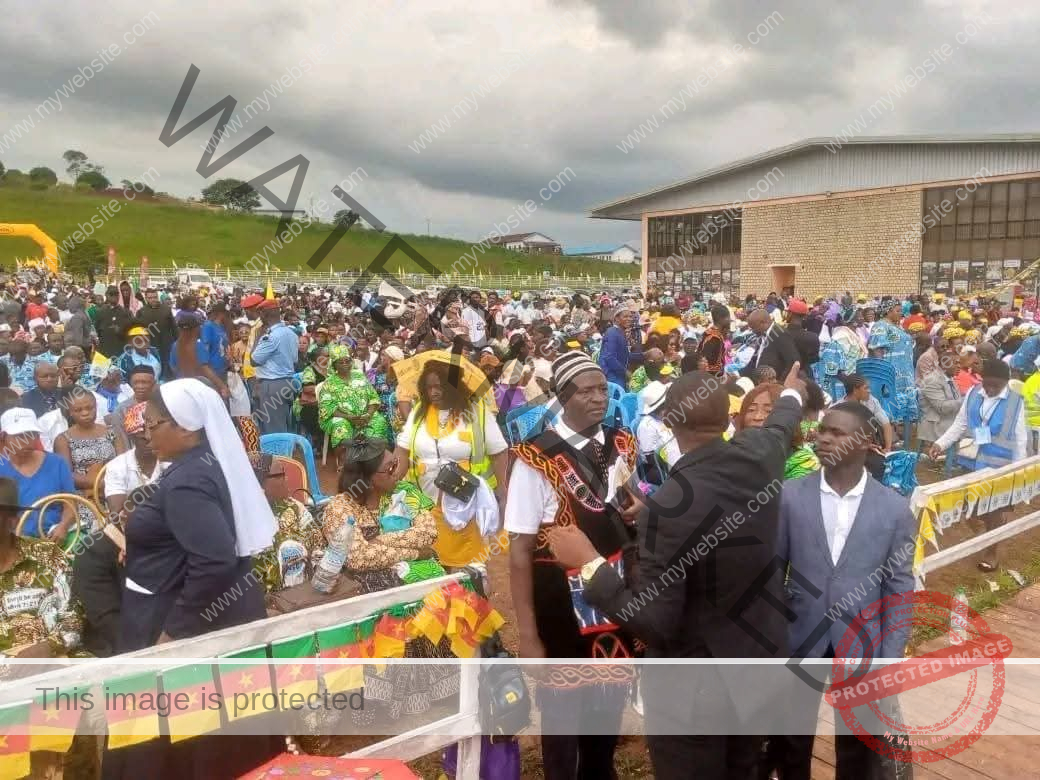
What stands out is not infrastructure or security arrangements—it is symbolism. Despite a visible military presence and tightly managed perimeters, expressions of identity remain present. The blue and white Ambazonian Flags appear discreetly but persistently—on balconies, in private spaces, and in the quiet resolve of those gathered. The message is not theatrical; it is enduring. Control of territory is one thing. Control of identity is another. Bamenda illustrates a point that has defined this conflict for years: authority can impose order, but it struggles to command legitimacy where it is fundamentally contested.
A MOMENT OF RECKONING FOR THE CLERGY
Attention inevitably turns to Andrew Nkea and the broader local clergy. The Pope’s approach—measured but direct—highlights a tension that has long existed within the Church’s role in the crisis. Neutrality, while often framed as prudence, can be perceived by affected populations as distance from lived reality. What is emerging from this visit is not confrontation, but a reframing: that moral authority is strongest when it is visibly aligned with truth, dignity, and the lived experiences of the people. For local religious leadership, this moment presents less a rebuke than an opportunity—to recalibrate, to listen more closely, and to speak with greater clarity.
THE WEIGHT OF HUMAN PRESENCE
Beyond symbolism and speeches lies the most important reality: people. Displaced families, returnees from hiding, and communities fractured by years of conflict are not gathering for ceremony. They are responding to a rare moment where their condition might be seen, acknowledged, and—critically—understood. Their expectation is not spectacle. It is recognition. If this visit carries strategic weight, it is here: in the possibility that moral visibility translates into political movement—toward dialogue that is credible, inclusive, and conducted in conditions perceived as fair.
A SHIFT, NOT A CONCLUSION
The anticipated English address in Bamenda carries significance beyond language. It is, symbolically, an engagement with a different historical and cultural reality—one that has often felt sidelined. But it is important to remain precise. This is not a resolution. It is not a declaration. It is a shift in tone, visibility, and framing. And in conflicts where narratives shape outcomes as much as force, such shifts matter.
The situation at the perimeter remains tense. Control is still asserted. But something less tangible has changed: the narrative is no longer singular. And once a narrative fractures, it rarely returns to its original form.
Timothy Enongene – The Independentistnews Guest Editor-in-Chief, On Special Assignment in Bamenda Ambazonia
Share This Post:
The Government of the Federal Republic of Ambazonia (in exile) takes note, and appreciates the Pope’s messages to the people of Ambazonia
THE DAY FIVE NEWSPAPERS DISAGREED—AND TOLD THE SAME TRUTH
Related Post
IS THE WORLD LISTENING: THREE DAYS FOUR FRONTLINES, ASA
SEPTEMBER 24, 1965, THIS DAY IN HISTORY: From Equal
AMBAZONIA’S WAR- IS BIGGER THAN YAOUNDÉ: BRITAIN, FRANCE AND
THE DAY SEPTEMBER 22 1961: — WHAT AMBAZONIA CAN
TRUMP’S “SUPER INTELLIGENCE” ERA: WHAT IT REALLY MEANS —
Why Is Ambazonia More Powerful Than many Imagine.