

Whether history ultimately judges Nzo Ekangaki as a statesman, a pragmatist, or a collaborator will depend largely on how future generations interpret the collapse of the federal experiment and the unresolved Southern Cameroons question. What remains beyond dispute is that he was not an ordinary politician.
By The Independentist News Editorial Desk
The Rise of a Brilliant Mind
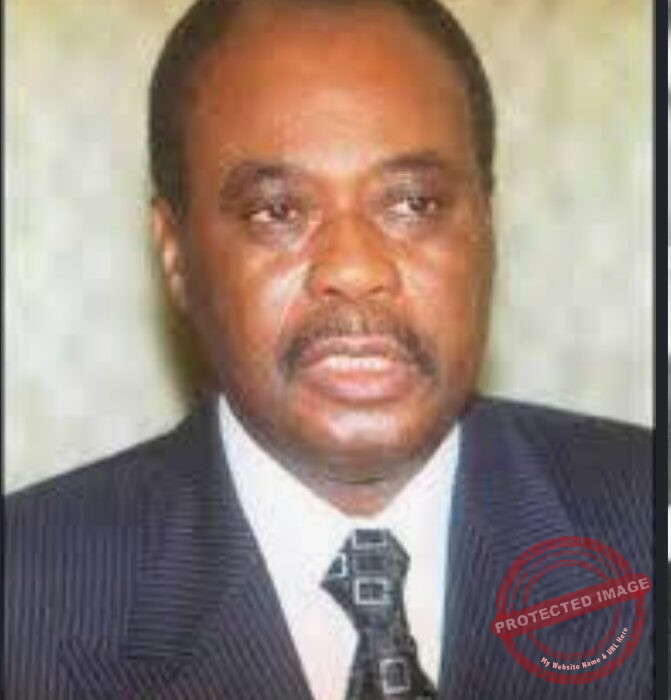
Nzo Ekangaki remains one of the most intellectually gifted and politically controversial figures ever produced by Southern Cameroons (Ambazonia). To some, he was a brilliant diplomat who navigated impossible political realities during the fragile post-colonial transition period. To others, he became one of the elite Anglophone collaborators who helped dismantle the federal protections that once safeguarded Southern Cameroons’ autonomy.
Born on March 22, 1934, in Nguti, he emerged early as a remarkably sharp intellectual and writer. Long before entering government, he authored publications such as An Introduction to Eastern Kamerun (1956) and To the Nigerian People (1958), reflecting an already sophisticated understanding of regional politics and identity.
Educated at University College Ibadan and later trained in diplomacy in Oxford and West Germany, Ekangaki represented a new generation of highly educated Southern Cameroonian elites entering politics during the final years of British colonial rule.
The Political Climb Inside the KNDP
His rapid political rise was closely tied to the KNDP government of John Ngu Foncha. Returning to Cameroon in 1959, Ekangaki quickly became deeply involved in the Kamerun National Democratic Party and eventually rose to become its Secretary-General. Following reunification in 1961, he entered the West Cameroon Legislative Assembly representing Mamfe and soon became one of the most visible Anglophone faces within the new federal system.
President Ahmadou Ahidjo appointed the young Ekangaki Deputy Minister of Foreign Affairs in 1962 at just 28 years old. He later served as Minister of Public Health and Minister of Labour and Social Welfare. On paper, these appointments appeared to symbolize balanced federal representation between East and West Cameroon. In reality, however, many Southern Cameroonians increasingly felt that Anglophone participation in government masked a deeper concentration of power in Yaoundé.
The Federal Dream Begins to Collapse
This contradiction defines Ekangaki’s legacy. Publicly, he accepted the dissolution of regional political structures and participated in the transition toward the centralized one-party state under the Cameroon National Union (CNU). He aligned himself with the political machinery that ultimately dismantled the Federal Republic and replaced it with the United Republic following the 1972 referendum. For many Southern Cameroonians today, this remains the unforgivable turning point.
Yet historical records also suggest a more complicated reality. Behind closed doors, Ekangaki reportedly expressed frustration with the marginalization of English-speaking West Cameroonians and the overwhelming dominance of East Cameroon within federal institutions. He appears to have understood the imbalance clearly, but chose political accommodation over confrontation.
Pragmatist or Collaborator?
That choice continues to divide opinion. To his defenders, Ekangaki was a pragmatist attempting to preserve whatever limited influence Southern Cameroonians still possessed inside an increasingly centralized state. To his critics, he symbolizes the educated elite who traded long-term constitutional protections for personal political survival and international prestige.
His life therefore raises one of the most difficult political questions in post-colonial African history: How should history judge leaders who recognized injustice, yet chose compromise over resistance?
The OAU Years and Continental Recognition
In June 1972, at the precise historical moment Cameroon transitioned into the United Republic, Ahidjo sponsored Ekangaki’s appointment as Secretary-General of the Organisation of African Unity (OAU). At only 38 years old, he became the youngest person ever to hold the position. It was the peak of his international career and proof of his diplomatic brilliance. For a brief moment, one of Southern Cameroons’ sons stood at the center of continental African diplomacy.
Fall from Power
But the triumph did not last. His independent diplomatic style and controversial decisions, particularly involving the multinational conglomerate Lonrho, generated backlash among African leaders. He resigned in 1974 under immense pressure, reportedly angering Ahidjo in the process. Upon his return to Cameroon, he was politically sidelined and relegated to a largely ceremonial advisory role — a dramatic fall for a man who had once stood at the pinnacle of African diplomacy. His political exile inside the very system he helped sustain remains one of the deepest ironies of his career.
The Broader Tragedy of Southern Cameroons
In many ways, Ekangaki’s life reflects the broader tragedy of post-colonial Cameroon itself. A brilliant generation emerged at independence believing coexistence between two inherited colonial systems could succeed through mutual respect and constitutional balance. Instead, federalism gradually gave way to centralization, assimilation, and deepening political distrust.
Men like Ekangaki found themselves trapped between loyalty to state power and loyalty to their regional identity. Some resisted openly. Others adapted quietly. Some rose politically while the federal foundations beneath them slowly disappeared.
History’s Final Judgment
Whether history ultimately judges Nzo Ekangaki as a statesman, a pragmatist, or a collaborator will depend largely on how future generations interpret the collapse of the federal experiment and the unresolved Southern Cameroons question. What remains beyond dispute is that he was not an ordinary politician.
He was one of the sharpest minds of his generation — a man whose ambitions rose to continental heights, but whose legacy remains permanently entangled in one of Africa’s most contested political unions.
Editorial Desk