









News commentary

We are home to news on Cameroon and the CEMAC region. We are dedicated to honest and reliable reporting. We are the voice of the Cameroonian people and their fight for freedom and democracy at a time when the Yaoundé government is silencing dissent and suppressing democratic voices.

The central question remains unanswered: who is responsible for the deaths in Ndzerem-Nyam? Until that question is resolved through credible, independent verification, all narratives remain incomplete.
By Carl Sanders
Guest Writer, The Independentist News | Soho, London
April 30, 2026
A Massacre Followed by Silence
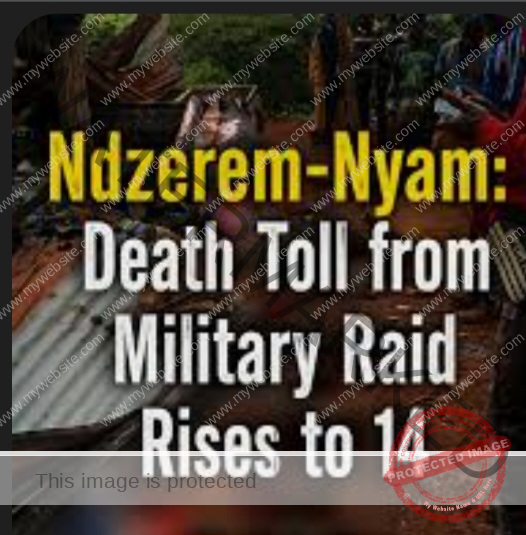
In the early hours of April 26, 2026, a cultural gathering in Ndzerem-Nyam was violently disrupted, leaving at least fourteen civilians dead. Among the victims were elderly members of a royal family, young attendees, and local residents who had gathered not for conflict, but for community.
What followed the killings may prove as consequential as the violence itself. There has been no clear, transparent, and verifiable account from authorities in Yaoundé. This silence is not merely an absence of communication. It is the opening move in a broader struggle—one that will determine whether accountability emerges, or dissolves into ambiguity.
Competing Narratives, Vanishing Responsibility
In the days following the incident, multiple explanations surfaced: a local cultural association attributed the violence to a traditional dispute involving neighboring communities; commentary linked to diaspora voices suggested the involvement of armed separatist elements; and government-aligned messaging circulated images purporting to show neutralized fighters. Each narrative differs in detail. Yet they share a critical feature: none establish responsibility through independently verifiable evidence. This fragmentation is not incidental. It creates a fog in which responsibility becomes difficult to assign—and easy to evade.8
From Incident to Pattern
Ndzerem-Nyam does not stand alone. Across Cameroon’s Anglophone regions, observers and analysts have repeatedly identified a troubling sequence: civilian-targeted violence, the immediate proliferation of competing or contradictory narratives, delayed or absent official clarification, and the gradual normalization of uncertainty. This pattern has surfaced in prior incidents, including disputes in Bambili–Nkwen and other contested areas. The result is not simply confusion. It is the systematic diffusion of accountability.
The Civilian Reality
At the center of the Ndzerem-Nyam tragedy are the victims themselves. Local accounts indicate that those killed included civilian participants at a cultural event, motorbike riders transporting attendees, and non-combatant residents, including an 18-year-old youth. In addition, reports describe the destruction of approximately 38 civilian motorbikes during early-morning operations—an action that raises serious concerns about proportionality and intent.
If these accounts are confirmed, they would point to potential violations of fundamental principles of international law, including the distinction between civilians and combatants, the prohibition of collective punishment, and the protection of civilian property. These are not abstract standards. They are the minimum protections afforded to populations in conflict zones.
Disinformation as a Second Front
The struggle over Ndzerem-Nyam is not confined to the physical space in which the violence occurred. It is also unfolding in the information domain. Images circulated online have been challenged by local families, who assert that those depicted were civilians rather than fighters. While independent verification remains essential, the speed and scale of such claims underscore a deeper reality: in modern conflict, the narrative can be as contested as the battlefield. Where information is fragmented, truth becomes negotiable—and accountability becomes elusive.
Why This Moment Matters
This is not merely a local tragedy. It is a test of whether, in contemporary conflicts, the fragmentation of truth can serve as a shield against responsibility. If violence can be followed by competing explanations, strategic silence, and the absence of verifiable fact, then accountability does not fail—it is prevented. And when accountability is prevented, repetition becomes not just possible, but likely.
A Call for Independent Verification
The events in Ndzerem-Nyam demand more than speculation or competing claims. They require independent investigation, preservation of physical and testimonial evidence, and transparent reporting accessible to both domestic and international audiences. Institutions such as the United Nations Human Rights Council and the International Criminal Court exist to address precisely such circumstances—where the establishment of truth is contested and accountability uncertain.
Beyond the Fog
The central question remains unanswered: who is responsible for the deaths in Ndzerem-Nyam? Until that question is resolved through credible, independent verification, all narratives remain incomplete. But one reality is already clear: Ndzerem-Nyam will not be defined only by what happened in the early hours of that morning—but by whether the world allows uncertainty to replace accountability.
“When truth is fragmented, responsibility dissolves. And when responsibility dissolves, violence does not end—it repeats.”
Carl Sanders
Guest Writer, The Independentist News
Share This Post:
The Vice Presidency Mirage: Symbolic Inclusion and the Reconfiguration of Power in Cameroon
The Classroom That Divides Two Futures – Why Cameroun Cannot Develop—and Why Ambazonia Must Be Built Differently
Related Post
IS THE WORLD LISTENING: THREE DAYS FOUR FRONTLINES, ASA
SEPTEMBER 24, 1965, THIS DAY IN HISTORY: From Equal
AMBAZONIA’S WAR- IS BIGGER THAN YAOUNDÉ: BRITAIN, FRANCE AND
THE DAY SEPTEMBER 22 1961: — WHAT AMBAZONIA CAN
TRUMP’S “SUPER INTELLIGENCE” ERA: WHAT IT REALLY MEANS —
Why Is Ambazonia More Powerful Than many Imagine.