

History does not repeat itself perfectly, and Cameroon in 2026 is not Europe in 1938. The actors, scale, institutions, history, and circumstances are different. That distinction must be respected. But history leaves warnings even when it does not provide exact templates. Munich should therefore not teach Ambazonia to reject diplomacy. It should teach Ambazonia to enter diplomacy with its eyes open. To negotiate seriously. To demand clarity. To insist on credible guarantees. To understand leverage. To distinguish temporary calm from durable settlement.
By Timothy Enongene
Associate Editor-in-Chief, The Independentist News
As Amazon associate this site earns from qualifying purchases
Shop from Amazon.Its back to school.
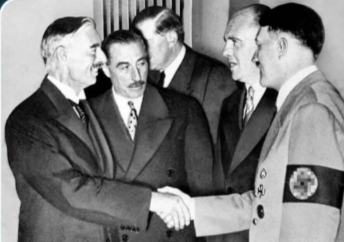
There are moments in history when the word peace becomes dangerously cheap. In 1938, British Prime Minister Neville Chamberlain returned from Munich convinced that he had helped secure peace with Adolf Hitler. Standing outside 10 Downing Street on September 30, he spoke of “peace with honour.” The Munich Agreement had transferred the Sudetenland to Nazi Germany in return for assurances that Hitler would make no further territorial demands. Those assurances did not hold. Within months, Germany occupied the remainder of Czechoslovakia, and Europe moved steadily toward the Second World War.
For Ambazonia, Munich should not be treated as a simplistic historical analogy. It should be studied as a warning about the difference between negotiation, appeasement, and an enforceable political settlement. The lesson of Munich is not that negotiations are useless. That would be the wrong conclusion. Negotiation remains one of the most important instruments available to societies trapped in prolonged conflict. The more difficult lesson is that negotiation without credible guarantees, consequences, leverage, monitoring, and a willingness to confront violations can become an instrument of delay rather than a pathway to peace.
That is where the Ambazonian question deserves serious reflection. Should Paul Biya be called another Hitler? No—not literally. Historical comparisons must be made with discipline. Hitler’s Nazi regime was responsible for genocidal racial persecution and a war of conquest across Europe on a scale that should not be casually equated with another government or conflict. Simply declaring that Paul Biya is “another Hitler” would flatten history and weaken rather than strengthen the argument.
But there is a legitimate analytical question behind the comparison: What happens when a government believes military pressure can ultimately force a population to abandon its political demands while negotiations are offered only within boundaries predetermined by that same government? That question is directly relevant to the Cameroon conflict.
The United Nations has repeatedly encouraged dialogue over the crisis. In 2019, the UN welcomed the National Dialogue announced by President Biya and called for an inclusive process capable of addressing underlying grievances. Yet the process faced a fundamental limitation: the question of separation was excluded from the negotiating framework. According to a UN Security Council briefing, Biya was prepared to discuss a wide range of issues, but not separation or secession. That distinction matters.
A government may refuse to accept an opposing party’s preferred outcome. That is normal in negotiation. But there is a difference between rejecting an outcome and refusing even to permit the central political dispute to be discussed.
If one party enters the room declaring in advance that the constitutional future of the territory cannot be reconsidered, then the process risks becoming consultation over the terms of an already determined result rather than negotiation over the dispute itself.
The 2019 National Dialogue produced recommendations, including a special status arrangement for the Northwest and Southwest Regions. But major separatist leaders were not participants, and independence was not genuinely placed on the negotiating table. That experience should matter enormously to anyone contemplating another process.
Dialogue Is Not the Same as Surrender
The Ambazonian position should not be, “Never negotiate with Biya.” That would be too simplistic and potentially self-defeating. The better principle is: Never enter negotiations without knowing what the negotiations are intended to achieve, what questions may be discussed, who will guarantee the process, and what happens when commitments are broken.
There is a profound difference between negotiating peace and negotiating the terms of submission. If Yaoundé invites Ambazonian representatives to another dialogue but arrives with a predetermined conclusion that the territory must remain permanently within La République du Cameroun, that independence cannot even be discussed, that fundamental constitutional restructuring is excluded, and that all decisive political questions have already been settled by one side, then the process may be called dialogue—but it is not necessarily negotiation between parties seeking a mutually acceptable settlement.
It becomes a process in which one party is being asked to discuss how it will accept a decision already made for it. That is the trap Ambazonian negotiators must avoid.
Munich’s Second Warning: Concessions Without Enforcement Can Encourage Further Demands
Munich also teaches a second lesson. Hitler interpreted the reluctance of Britain and France to confront German expansion as evidence that further pressure might succeed. British leaders, meanwhile, were themselves conscious that time mattered strategically and continued preparing for the possibility of war even as diplomacy continued. The lesson for Ambazonia is not to imitate war-making. It is to understand leverage.
Negotiation becomes meaningful when both parties have reasons to compromise. If one side believes that it can achieve everything it wants through military pressure while the other is expected to enter negotiations from desperation, the stronger party has little incentive to make meaningful concessions.
Ambazonian diplomacy therefore cannot be built around desperation. It must be built around political clarity, preparation, internal coherence, international engagement, civilian protection, credible guarantees, and a realistic understanding of leverage.
Never Confuse a Handshake With a Settlement
Images of diplomacy can be seductive. Leaders shake hands. Cameras flash. Communiqués are issued. Ceasefires are announced. Optimistic language fills the air. But a handshake is not peace. A communiqué is not peace. A ceasefire, although often essential to saving lives, is not by itself a political settlement. And a photograph of leaders smiling together is certainly not proof that the underlying conflict has been resolved.
Peace exists when the dispute that produced the conflict has been addressed through arrangements that the principal parties can accept, implement, monitor, and defend before the populations they claim to represent. That should be the standard applied to any future Ambazonian negotiation.
How, Then, Should Ambazonia Approach Yaoundé?
With negotiation—but not naïveté. With dialogue—but not predetermined surrender. With diplomacy—but not appeasement. With openness—but also clearly defined objectives and red lines. A credible future process should, at minimum, contain an agreed agenda, recognized representatives of the principal parties, credible international facilitation, civilian-protection measures, monitoring mechanisms, timelines, procedures for resolving violations, and meaningful freedom to discuss the political future of the territory without one party dictating the final answer before talks begin.
There must also be a mechanism for dealing with broken commitments. That is one of Munich’s enduring warnings. The failure was not simply that Chamberlain talked to Hitler. States must often negotiate with adversaries. The deeper failure was the inadequacy of the assumptions surrounding what Hitler’s assurances were worth and what consequences would follow if they were violated.
The lesson for Ambazonia is therefore not to reject talks with Yaoundé. It is to prevent talks from becoming a mechanism through which the government merely buys time, fragments the opposition, changes the subject, reduces international pressure, and then returns to the battlefield without addressing the fundamental political dispute.
History does not repeat itself perfectly, and Cameroon in 2026 is not Europe in 1938. The actors, scale, institutions, history, and circumstances are different. That distinction must be respected. But history leaves warnings even when it does not provide exact templates. Munich should therefore not teach Ambazonia to reject diplomacy. It should teach Ambazonia to enter diplomacy with its eyes open. To negotiate seriously. To demand clarity. To insist on credible guarantees. To understand leverage. To distinguish temporary calm from durable settlement.
And above all, to remember that when one party alone is allowed to define both the dispute and the acceptable meaning of peace, the word peace can become little more than a pause in conflict—or another name for surrender.
As Amazon associate this site earns from qualifying purchases
Shop from Amazon. Its back to school.
Timothy Enongene
Associate Editor-in-Chief
Independentist News