








Commentary

We are home to news on Cameroon and the CEMAC region. We are dedicated to honest and reliable reporting. We are the voice of the Cameroonian people and their fight for freedom and democracy at a time when the Yaoundé government is silencing dissent and suppressing democratic voices.

By Timothy Enongene
Associate Editor-in-Chief
The Independentist News
As Amazon associate this site earns from qualifying purchases
Buy your copy of Southern Cameroons 2050; Why America should care. By Martin Mungwa on Amazon
https://www.amazon.com/s?k=Southern+Cameroon+2050+by+Martin+mungwa&i=specialty-aps&srs=121082092011&crid=165NADKY1TYO0&sprefix=southern+cameroon+2050+by+martin+mungwa%2Cspecialty-aps%2C862&linkCode=ll2&tag=njokings-20&linkId=869031edbe3c55821adab9317208c171&language=en_US&ref_=as_li_ss_tl
BAMENDA – September 25, 2026 – Within the past three days, reports have circulated of Cameroonian security forces suffering casualties in Matouké-Kotto, Bafut, Buea and Ndop, with additional reports alleging the death of another soldier around Kumbo. These individual battlefield reports have not all been independently verified and should therefore be treated with appropriate caution.
What requires less speculation is the larger reality: nearly nine years into the armed conflict, fighting has not disappeared, and armed separatist forces continue to demonstrate a capacity to confront government security personnel in different parts of the former British Southern Cameroons.
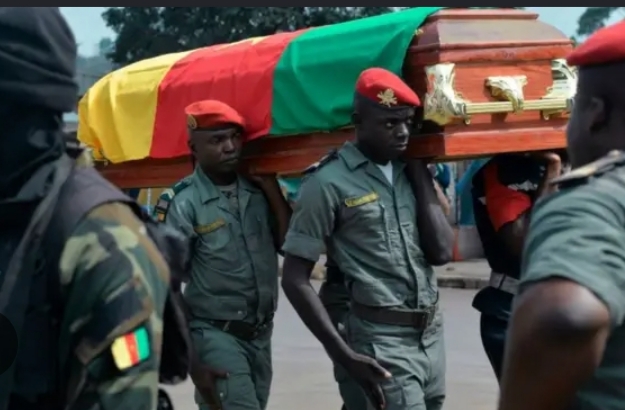
The reported killing of a gendarme identified as Hayatou in Molyko, Buea, on Thursday, if independently confirmed, would add another family to the thousands already touched by a conflict that has endured far longer than many expected. But these developments raise a larger question: Is the international community responding to the persistence of this conflict with the seriousness that nearly a decade of violence demands?
The world cannot reasonably claim ignorance. The United Kingdom has repeatedly acknowledged the conflict. As recently as June 2026, Britain told the United Nations Security Council that it remained concerned about violence in Cameroon and urged continued engagement toward a peaceful resolution of the Anglophone crisis through dialogue.
The United Nations likewise continues to document the consequences. In June, senior UN officials again told the Security Council that the ongoing crisis in Cameroon’s North-West and South-West regions was having a major humanitarian impact on civilians.
France’s current travel guidance provides another measure of the continuing insecurity. The French government formally advises against travel throughout the North-West and warns of serious insecurity in significant parts of the South-West. London knows. New York knows. Paris knows. The disagreement is therefore not principally about whether a conflict exists. It is about how that conflict is defined and what kind of political process is capable of resolving it.
International institutions generally describe the situation as the “Anglophone crisis” or the crisis in Cameroon’s North-West and South-West regions. Many Ambazonians reject that characterization as incomplete. They regard the conflict not simply as a regional governance dispute within Cameroon but as the unresolved consequence of a distinct political history and a continuing claim to separate political identity and sovereignty. That distinction matters.
A diplomatic process designed to resolve regional grievances will look very different from one designed to confront competing claims concerning constitutional authority, political identity, self-determination, and sovereignty. This is why repeated appeals for dialogue, although important, cannot by themselves constitute a settlement strategy.
What kind of dialogue? Between whom? About what? And with what political questions permitted at the table? Those are the questions that ultimately determine whether diplomacy is substantive or ceremonial. After nearly a decade, repeatedly calling for dialogue without establishing a sufficiently consequential process risks allowing diplomacy to become a ritual—something invoked after every escalation rather than employed as an instrument capable of confronting the dispute itself.
The recent battlefield reports will also inevitably generate discussion among Ambazonians about whether military momentum is shifting toward separatist forces, including the Ambazonian State Army and other armed groups operating under the independence cause.The available public evidence does not justify such a conclusion.
Individual attacks, even when confirmed, cannot establish strategic superiority. Nor can several days of casualties demonstrate that either side is approaching military victory. Reliable assessment would require information about territorial control, command structure, recruitment, logistics, casualties, operational tempo, civilian support, defections, force sustainability, and the ability of each side to achieve clearly defined political objectives.
The more defensible conclusion is narrower but still significant: armed resistance has endured. Almost nine years of military pressure have not eliminated separatist armed activity, just as armed resistance has not produced a negotiated political settlement or internationally recognized sovereign state. That reality should caution both sides against confusing battlefield endurance with political resolution.The central political question remains.
For many Ambazonians, the persistence of the independence movement demonstrates that political identity has survived military pressure, administrative control, and repeated declarations of Cameroon’s territorial integrity. But persistence alone is not enough. Ambazonians must also confront a question that becomes more important the longer the struggle continues:
What comes after resistance?
If sovereignty is the objective, then the ultimate test cannot be the ability to sustain an armed conflict indefinitely. It must be the ability to govern. Can institutions protect civilians? Can courts deliver justice? Can children remain in school? Can roads, electricity, water systems, hospitals, ports, telecommunications, and productive industries function? Can public money be accounted for? Can political disagreement occur without violence? Can institutions survive individual leaders? Can a future government earn the confidence of citizens, investors, neighboring states, and international partners?
These questions are not secondary to sovereignty. They determine whether sovereignty becomes meaningful. War can alter political possibilities. Only competent governance can turn sovereignty into a functioning country. That is why the future matters as much as the battlefield.
Supporters of Ambazonian independence trace their national argument through the political history surrounding the former British Southern Cameroons and the constitutional arrangements that followed 1961. They contend that decades of political and institutional pressure have failed to erase a separate identity.
If sovereign independence were eventually achieved through whatever lawful and political process ultimately determined the territory’s status, the defining question would immediately change. It would no longer be simply: Can Ambazonia survive? It would become: What can Ambazonians build when political, human, intellectual, and economic energy is redirected from conflict toward development? That is also where the international community has an interest.
A conflict that continues indefinitely serves neither civilians nor regional stability. Merely documenting casualties, issuing travel warnings, delivering humanitarian assistance, and repeating calls for dialogue may manage some consequences of the conflict, but they do not by themselves resolve its political foundations. London, New York, Paris, Yaoundé, and Ambazonian political actors therefore confront the same basic reality: There is no substitute for a political process capable of addressing the disagreement that actually exists.
Such a process would not predetermine its outcome. Nor would acknowledging competing political claims require the international community to endorse either side’s preferred settlement. It would simply mean confronting the dispute as it is rather than as diplomacy might prefer it to be.
After nearly a decade of violence, that distinction has become increasingly difficult to avoid. The question is no longer whether the conflict exists. The question is whether the political courage exists to confront what the conflict is actually about.
As Amazon associate this site earns from qualifying purchases
Buy your copy of Southern Cameroons 2050; why America should care . By Martin Mungwa, on Amazon
https://www.amazon.com/s?k=Southern+Cameroon+2050+by+Martin+mungwa&i=specialty-aps&srs=121082092011&crid=165NADKY1TYO0&sprefix=southern+cameroon+2050+by+martin+mungwa%2Cspecialty-aps%2C862&linkCode=ll2&tag=njokings-20&linkId=869031edbe3c55821adab9317208c171&language=en_US&ref_=as_li_ss_tl
Timothy Enongene
Associate Editor-in-Chief
The Independentist News
Share This Post:
SEPTEMBER 24, 1965, THIS DAY IN HISTORY: From Equal Rights to Equal Opportunity, What Ambazonia Can Learn from America’s Affirmative-Action Experiment
Related Post
SEPTEMBER 24, 1965, THIS DAY IN HISTORY: From Equal
AMBAZONIA’S WAR- IS BIGGER THAN YAOUNDÉ: BRITAIN, FRANCE AND
THE DAY SEPTEMBER 22 1961: — WHAT AMBAZONIA CAN
TRUMP’S “SUPER INTELLIGENCE” ERA: WHAT IT REALLY MEANS —
Why Is Ambazonia More Powerful Than many Imagine.
THIS DAY IN HISTORY SEPTEMBER 22, 2017: THE DAY