










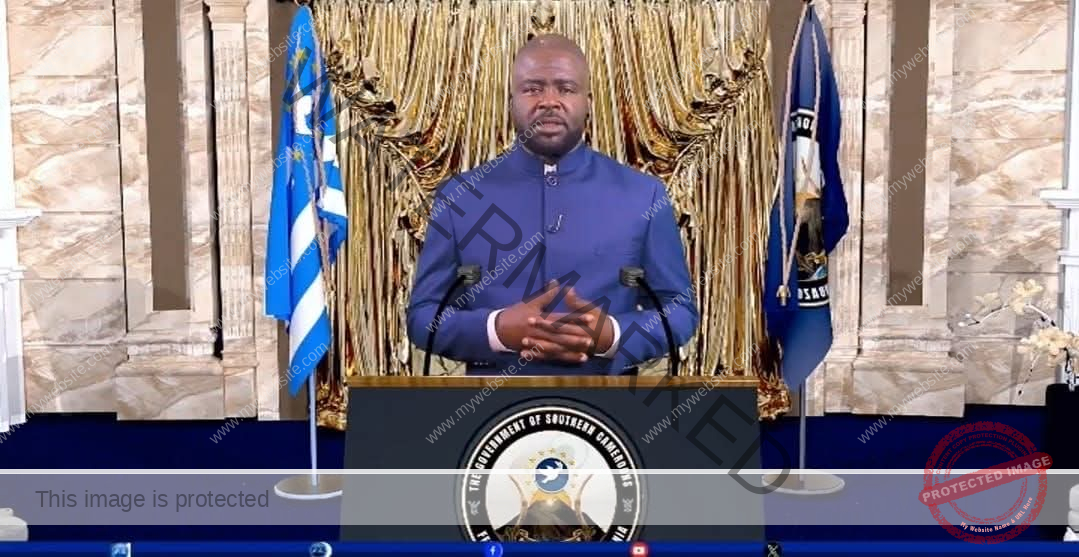
In a tone of total hope, in his address to his people in the end of year 2025, Dr. Samuel Ikome Sako, reveals a promising year for the freedom and Independence of the Ambazonian people in 2026,. Here is Dr. Sako’s full end of year address to the people of the former Bristish southern cameroons.
My dear Southern Cameroons citizens,
Fellow Ambazonians at home and in the diaspora,
As we enter the year two thousand twenty-six, I extend to you warm greetings of hope, resolve, and renewed commitment. We stand today at a decisive moment in our national journey. Despite the anguish of incarceration, torture, enforced disappearances, massacres, and the cries rising from refugee camps, villages, streets, and foreign courtrooms, the year just ended — two thousand twenty-five — will be remembered as a year of consolidation, clarity, and irreversible momentum in the struggle for the restoration and recognition of the Federal Republic of Ambazonia.
What was once denied is now debated.
What was once mocked as taboo is now acknowledged. What was once dismissed as imaginary is now studied.
Even those who condemned us yesterday — federalists, Southern Cameroons house slaves, blue-and-white Ambaroonians, and one-Cameroon presidential aspirants — now concede, in diverse ways, that Ambazonia was right. Some now secretly wish for our success. In doing so, they inadvertently confirm the discipline, vision, and leadership that have carried this struggle forward. This was not symbolic alone; it was a psychological victory, a clarifying moment, and a strategic gain for our end-game diplomacy.
Dear Ambazonians,
In two thousand twenty-five, our struggle crossed the point of inevitability. Ambazonia can no longer be wished away, crushed, erased, or ignored. Our cause has gone too deep into the bones of our people to be treated as a surface wound. It demands a fundamental resolution.
Years ago, I declared that if there is no Ambazonia, there will be no Cameroon as we know it. Today, that declaration is taking flesh. Even the architects and beneficiaries of the one-Cameroon construct are beginning to confront a reality they long avoided: separation is no longer only an Ambazonian necessity — it is increasingly a condition for regional survival.
Dear supporters of the Government of the Southern Cameroons, One of the defining milestones of two thousand twenty-five was the convening of the Ambazonia Strategic Constituent Assembly — the ASCA — in Washington, D.C. Like previous strategic conclaves, this was not a ceremonial gathering; it was a national audit of our struggle.
From that ASCA emerged clarity of purpose, strategic alignment, and renewed ownership by the people. Our movement remains anchored in a Constituent Assembly composed not of spectators, but of active government members and duly selected delegates. This safeguard has protected our revolution from opportunists, saboteurs, and merchants of confusion.
The unanimous renewal of my mandate was not a personal victory. It was a collective affirmation of continuity, discipline, and direction. Leadership in a liberation struggle is not about popularity or noise; it is about trust earned under trial and pressure. Accepting this responsibility is neither a trophy nor a privilege — it is a burden carried in service to the people and to generations yet unborn. If I could choose differently and still serve the same purpose, I would — but duty does not consult convenience.
As a major outcome of that strategic gathering, we undertook a decisive restructuring of the executive arm of our government — establishing commissions to replace departments. This was not cosmetic reform; it was strategic governance architecture.
The commission model strengthens coordination, professionalism, accountability, and institutional continuity. It ensures that no individual can hold the structure hostage through personal exit, sabotage, or ambition. Our painful lessons — lost treasuries, lost media assets, lost funds, lost networks, and lost institutions — guided this reform.
Rivalry has given way to collaboration.
Ego yields to selfless service. Fragmentation is being replaced by unity of purpose.
We now move forward as a system — working in teams, not as isolated sole proprietors. Our undertaking is truly a joint endeavor. Our responsibility is a collective enterprise.
Fellow Ambazonians,
In two thousand twenty-five, Ambazonia significantly expanded its media and communication footprint and strategy. Our voice broke through international outlets, policy platforms, and analytical spaces. At home and in the diaspora, misinformation receded as cohesion grew. Keyboard liars were confronted swiftly and decisively.
The propaganda machinery of La République du Cameroun and its proxies steadily lost ground. Truth, discipline, and consistency proved stronger than noise, money, and manufactured lies. Each time the noise increased, our voice grew louder. We refused to gift spoilers a monopoly over falsehoods without rebuttal, because diplomacy is inseparable from messaging and narrative control in the corridors of decision-making.
Dear diplomatic warriors,
Diplomacy is like the Earth — even when it is revolving at sixty-six thousand six hundred miles per hour, you cannot see it move with the naked eye. Much of our diplomatic work remains discreet, but progress has been steady and consequential.
The Ambazonian war of independence is no longer discussed in whispers; it is now recognized as a geopolitical reality. Within a shifting global landscape, we positioned Ambazonia not only as a moral and legal imperative, but as a stabilizing buffer in the Gulf of Guinea. We expanded our outreach and focused on peace through liberation. The mill grinds slowly, but steadily. It is our hope that this year, two thousand twenty-six, we shall witness visible fruits of hundreds of hours of labor in secret.
In two thousand twenty-five, we also established the Ambazonia Negotiation Commission, mandated to prepare for non-partisan negotiations of our destiny. The Commission has begun mobilizing Ambazonian expertise to develop the positional template and technical groundwork required for serious and credible negotiations when the moment arrives. We will not be ill-prepared or taken for granted, as Foncha’s delegation was in nineteen sixty-one. I call on well-meaning Ambazonians with expertise in international law, mediation, and negotiation to contact the Ambazonia Dialogue and Negotiation Commission.
Cameroon’s deepening crisis is not solely our doing, but our sustained resistance has raised the cost of occupation. Economic collapse, internal fractures, international isolation, and growing reliance on repression and non-traditional alliances now define the regime in Yaoundé.
When President Biya came to power in nineteen eighty-two, Cameroon had nearly one hundred eighty public enterprises. Today, fewer than thirty remain. Public services have deteriorated. Basic sanitation has collapsed. Even routine international obligations — such as assessed dues to continental institutions — have become a challenge.
Statistics are manufactured. Narratives are amplified by foreign interests. But reality has a way of surfacing. The bubble of illusion has burst. Cameroon stands on the brink of systemic failure.
Dear people of Southern Cameroons,
The morale of the Cameroon forces deployed in Ambazonia has significantly declined — not simply because they face a determined people, but due to neglect, the widening power vacuum, and pervasive uncertainty at the center of power in Yaoundé. This vacuum has given rise to powerful and competing factions, each seeking dominance as the old order collapses.
As authority weakens, impunity has become the new constitution of the Cameroonian state. Targeting of supposed enemies has increased dramatically — not just opponents of the regime, but friends, loyalists, and associates of rival factions. Eliminating a colleague has become a method of altering the balance of power.
This internal warfare is reflected on our soil. A growing number of colonial Divisional Officers died in Ambazonia last year under suspicious circumstances — deaths hastily blamed on Ambazonian forces, but more convincingly linked to internal factional purges and score-settling within the collapsing regime.
The consequences are stark: morale among Cameroonian forces is at its lowest,
deployments to Ambazonia are avoided when possible, corruption replaces command,
soldiers operate without discipline,
and atrocities multiply because there is no functioning chain of accountability.
This is not simply military weakness.
It is political implosion — and the world must take note.
Fellow Ambazonians,
Those who hesitated to help us yesterday because of misplaced faith in a cruel system promising stability have come to the same conclusion we reached long ago: if the mother is losing vital signs, perhaps we should focus on saving the baby.
The year two thousand twenty-six is therefore a year of hope for the Ambazonian dream — a year pointing to the inevitability of the collapse of the captured state, and the irreversible shift of global alliances reshaping Africa.
Let us shed hate, demagogy, infighting, sabotage, and self-destruction. Targeting one another and shooting ourselves in the foot is not a winning strategy. Facing the enemy as one people is.
The moment is too crucial to be distracted.
The treasure is too precious to risk for the trivial.
The duty is too urgent to be observed from a distance.
Our comrades in detention and prison were condemned by systems shaped by interest, not justice. But truth does not originate in courtrooms; it precedes them. Lesser laws cannot undo higher law.
Our land was given to us by God; no man can erase that. As long as we live, we will work to correct every human error that contradicts that divine order.
To our brothers in Kansas City, history knows who you are. Stand firm. Your story will not be written by your jailers, but by the generations whose future you defended.
Dear international community and stakeholders,
There are two Cameroons: the one that was yesterday a partner of Western interests, and the one today that has lost its essence — the Cameroon we all see now. The Cameroon of the past was a state that could, at least in name, pretend to democratic values. Today, the Cameroon we face is an undemocratic jungle, a ruthless autocracy, and a failing state wallowing in criminality, corruption, repression, and instability.
In this hopeless sea, without a coherent head, Cameroon is navigating steadily into the abyss of destruction at the hands of the very enemies of the free world. This is a call to deal with the Cameroon that exists — not the one that used to exist. That Cameroon of yesterday is no more.
This reality requires that you deliberately engage the vital forces of the endangered entity, or risk letting all slip into the hands of Russia and China. Engage the democratic opposition. Do not allow the country to collapse comfortably into the party-state that the CPDM tribal regime is determined to institutionalize. A free and democratic Cameroon can be a catalyst for meaningful dialogue, peace, and negotiations to end the war in Ambazonia.
Otherwise, going forward, Ambazonia is the most consequential party in the current geopolitical space to engage directly, in the absence of any legitimate leadership in Cameroon that you can compel to meet Ambazonia at the negotiation table. Ambazonia remains the home of approximately sixty percent of the GDP that Cameroon boasts of. The fight to take Yaoundé is technically a fight over Ambazonia. If Ambazonia is not separated from Cameroon, the Russian-leaning puppet regime in Yaoundé will pay their new masters with the wealth of Ambazonia and install them permanently in the Gulf of Guinea.
These realities inside Cameroon — deepening internal rivalries, competing factions, and the uncontrolled targeting of supposed enemies — are not just signs of political weakness; they are unmistakable symptoms of state collapse. Cameroon’s instability is no longer only a threat to Ambazonia; it is a regional time bomb. The international community must therefore recognize that stabilizing Ambazonia through an orderly resolution is not merely an act of justice — it is a necessary step to prevent the entire Gulf of Guinea from sliding into chaos under the weight of internal rivalries within the collapsing Cameroon regime.
As we step into two thousand twenty-six, we reiterate our call:
To Cameroon: release all Southern Cameroons political prisoners.
To the United Nations: deploy an independent fact-finding mission to the Southern Cameroons.
There were many reports in two thousand twenty-five — including claims from local communities and credible conflict observers — that incidents attributed to “unidentified gunmen or Ambazonian fighters” involved identified Cameroonian soldiers operating in ways that obscure their identity. These events, widely reported by diverse media sources, reinforce the need for a transparent investigation into all suspicious killings and attacks in the Southern Cameroons, so that the truth is established, accountability ensured, and the reign of impunity ends.
To the United Nations: remove Cameroon from the Human Rights Council, as it did Russia.
To the ICC: accelerate investigations into atrocity crimes.
To the Commonwealth: suspend Cameroon from its ranks.
To the Papacy: champion a genuine mediation process.
To Nigeria: stop collusion that forces Ambazonian refugees back to slaughter.
To the United States: facilitate structured dialogue addressing the root causes of war and displacement.
Ambazonian financial warriors,
Thank you for the success of the two-tier Draft exercise. To every financial warrior who carried the burden without excuse — thank you. We hereby designate this year’s exercise as the two thousand twenty-six Humanitarian Draft. Our interventions are charitable acts toward the defenseless and actions of collective self-defense — defending life, dignity, education, worship, and community. Self-defense is humanitarian.
Dear Ambazonia Armed Forces — heirs of our statehood,
You are the proud defenders of our patrimony. You are not merely gunmen with warrior titles. You are the army of a standing nation — the Ambazonia State Army. If Cameroon has the Cameroon Armed Forces but Ambazonia is described as merely militias, then equality is denied. Two states of equal status cannot be represented by unequal military institutions. Equal status means equal states, equal institutions — two equal military institutions. Call yourselves what you want the world to call you. If you call yourself inferior, the world will call you inferior. Ambazonians are the Ambazonia State Armed Forces of the restored State of the Southern Cameroons, Ambazonia.
Across our counties — from Donga Mantung to Fako, from Lebialem to Boyo, from Manyu to Mezam — you are one force. You are the restored army of the restored state. Names matter. Institutions matter. Strategy matters.
My dear people,
We are at a crucial phase. Ambazonia is not a cursed people destined to sabotage itself generation after generation. Distraction, rivalry, and internal targeting serve only the enemy.
Two thousand twenty-six is not a year for spectators — it is a year for contributors.
The road has been long, but the destination is now visible.
Ambazonia lives.
Ambazonia advances.
Ambazonia will be free.
Happy New Year two thousand twenty-six.
Long live the Federal Republic of Ambazonia.
God bless Ambazonia.
Dr. Samuel Ikome Sako (President)



Leave feedback about this