








Editorial commentary

We are home to news on Cameroon and the CEMAC region. We are dedicated to honest and reliable reporting. We are the voice of the Cameroonian people and their fight for freedom and democracy at a time when the Yaoundé government is silencing dissent and suppressing democratic voices.

Movements that seek to restore political identity and nationhood are rarely linear. They are often slow, contested, and uneven. But history shows that where a foundational question remains unresolved, time does not erase it—it sharpens it. The men and women of 1993 asked for restoration. The present generation is asking for resolution.
By Ali Dan Ismael
Editor-in-Chief, The Independentist News
History does not whisper. It records. And sometimes, it indicts. On April 7, 1993, the front page of the Cameroon Post carried a message so measured, so constitutional, and so unmistakably clear that even its critics could not dismiss it as extremism: “Anglophones Demand the Re-creation of the State of West Cameroon.” That was not a war cry. It was a warning—delivered through the All Anglophone Conference in Buea and codified in the Buea Declaration.
Those who gathered in Buea were not insurgents. They were lawyers, teachers, traditional authorities, and civil society leaders who still believed that the state could correct itself. They spoke the language of federalism, legality, and coexistence. They asked for restoration, not rupture. Reform, not rebellion. They were ignored.
Three decades later, the same structural tensions remain, but the language has evolved. Figures such as Simon Munzu and Felix Agbor Balla continue to advocate for dialogue, conferences, and negotiated frameworks. Their argument is familiar: that the crisis can still be resolved through structured engagement; that space exists for institutional compromise; that escalation can yet be reversed.
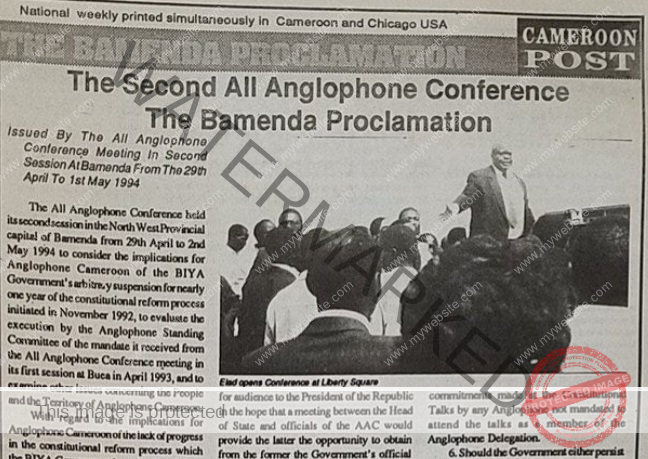
But history is an unforgiving examiner. These are not new prescriptions. They are echoes. Let us be precise. Dialogue is not the problem. Conferences are not the problem. Even compromise is not the problem. The problem is this: every major Anglophone dialogue initiative—from Buea to the present—has operated in a system where there is no cost for ignoring its outcomes. The Buea Declaration was ignored. The Bamenda Proclamation was diluted. Legal memoranda were shelved. Peaceful protests were met with force. What emerges is not a failure of ideas, but a failure of enforcement. Without enforcement, dialogue becomes performance.
There is a deeper tension that cannot be avoided. Moderation, in any political struggle, is both necessary and legitimate. But legitimacy alone is not enough. The question that now confronts every advocate of renewed dialogue is sharper than before: at what point does continued reliance on engagement without structural guarantees shift from prudence to prolongation? Because every cycle that resets the conversation without altering the underlying architecture risks doing one thing above all—it buys time for the status quo.
The evolution of language over the past three decades tells its own story. In 1993, the demand was for the “re-creation of West Cameroon.” In the years that followed, it shifted to calls for federal restructuring. Today, it is framed in terms of self-determination. This is not radicalization for its own sake. It is evolution under pressure. When constitutional appeals fail, demands escalate. When recognition is denied, identity hardens. When reform is blocked, rupture becomes thinkable.
The tragedy is not that the language changed. The tragedy is that it had to. What many contemporary moderates underestimate is not the value of dialogue, but the memory of its failures. Communities do not respond to proposals alone. They respond to patterns. And the pattern, from Buea to today, has been consistent: a conference is convened, reasonable demands are articulated, pressure is absorbed, and nothing fundamental changes. Over time, this cycle erodes trust—not only in institutions, but in the very idea of negotiated resolution.
It is against this historical record that current calls for an “All Anglophone Conference III” must be evaluated. To propose another conference, without addressing why previous ones failed, is not a strategy—it is a repetition. It reflects either a profound underestimation of the structural problem or a reluctance to confront it directly. The issue is not the absence of platforms for dialogue. The issue is the absence of mechanisms that compel outcomes.
Without enforcement, without guarantees, and without a clearly defined end-state, another conference risks becoming what its predecessors ultimately became: a well-structured conversation with no structural consequence. This is not a rejection of dialogue. It is a rejection of cyclical dialogue detached from results.
It is here that the deeper truth of the 1993 moment reveals itself. The issue was never simply constitutional. It was never merely administrative. It was, at its core, a question of political origin—one left unresolved at the end of the decolonization process.
Even external analytical circles, including Western intelligence assessments during the late Cold War period, repeatedly warned that unresolved structural tensions in Cameroon’s Anglophone regions carried long-term risks of fragmentation if left unaddressed. The implication was clear: a political arrangement built on imbalance, if not corrected, would eventually face rupture. That warning has matured into reality.
The demand for the re-creation of West Cameroon was, in effect, an early attempt to correct an incomplete transition from British trusteeship into a post-colonial arrangement whose terms were never fully settled. That question was deferred. And in being deferred, it transformed—from a federalist demand into a broader debate about identity, legitimacy, and self-determination. Today, that unresolved foundation remains the central fault line.
The contemporary position articulated by the Government of the Federal Republic of Ambazonia under Samuel Ikome Sako is built on a different framing—one that shifts the conversation from governance to origin. It asserts that the crisis is not merely a failure of administration, but the predictable outcome of an incomplete decolonization process. In this view, no amount of decentralization, dialogue, or reform can substitute for addressing the foundational question itself.
This reframing matters. It moves the discourse from policy adjustment to historical accountability. From dialogue as a process to resolution as an outcome. From managing symptoms to confronting cause.
The strategic significance of this position lies in its clarity. It defines the issue within a framework recognized in international law. It seeks to internationalize the conversation beyond domestic political containment. And it attempts to consolidate a narrative that is coherent, continuous, and anchored in a defined thesis.
A press posture aligned with this framing carries a precise intent: to clarify that the conflict is rooted in incomplete decolonization; to signal that superficial remedies cannot resolve a structural issue; to reaffirm a defined political position grounded in historical and legal arguments; to invite international engagement within a recognized framework; and to establish narrative coherence in a space too often defined by fragmentation.
Movements that seek to restore political identity and nationhood are rarely linear. They are often slow, contested, and uneven. But history shows that where a foundational question remains unresolved, time does not erase it—it sharpens it. The men and women of 1993 asked for restoration. The present generation is asking for resolution.
And today, the real test of leadership is not the ability to convene another conference, but the ability to learn from the last one. Until that lesson is fully absorbed, the path from Buea to the present does not end. It repeats—each time at a higher cost.
Ali Dan Ismael
Editor-in-Chief, The Independentist News
Share This Post:
THE AAC III TRAP: A CONFERENCE DESIGNED TO SAVE A REGIME, NOT A PEOPLE
THE ANGOLA CLARIFICATION: HOW THE VATICAN SHATTERED YAOUNDÉ’S LAST DIPLOMATIC ILLUSION
Related Post
IS THE WORLD LISTENING: THREE DAYS FOUR FRONTLINES, ASA
SEPTEMBER 24, 1965, THIS DAY IN HISTORY: From Equal
AMBAZONIA’S WAR- IS BIGGER THAN YAOUNDÉ: BRITAIN, FRANCE AND
THE DAY SEPTEMBER 22 1961: — WHAT AMBAZONIA CAN
TRUMP’S “SUPER INTELLIGENCE” ERA: WHAT IT REALLY MEANS —
Why Is Ambazonia More Powerful Than many Imagine.