

The ultimate proof of readiness will not be the number of declarations issued, factions denounced, or military rumors celebrated. It will be the existence of institutions capable of protecting the people, governing under law, transforming national resources into shared prosperity, and allowing citizens—not another indispensable ruler—to own the republic. That is the deeper meaning of Eritrea’s independence: sovereignty may be recognized in a moment, but it must be constructed over time.
By Ali Dan Ismael, Editor-in-chief The Independentist News
Introduction: Independence Was an Outcome, Not an Event
Eritrea’s independence from Ethiopia is often compressed into a simple story: Eritreans fought for thirty years, defeated the Ethiopian army, held a referendum, and became independent. That account is broadly true, but analytically incomplete. Eritrea did not emerge as a sovereign state through military struggle alone. Its independence resulted from the convergence of colonial territorial formation, the destruction of a federal constitutional settlement, the development of an organized national movement, the collapse of Ethiopia’s ruling regime, cooperation with other Ethiopian opposition forces, and an internationally verified act of popular consent.
The Eritrean experience therefore carries an important warning for national-liberation movements. Historical entitlement may establish the justice of a cause, but history does not implement sovereignty. Armed resistance may prevent forced assimilation, but warfare alone does not guarantee diplomatic recognition. A referendum can certify popular will, but only when political and international conditions permit it to occur. Independence is ultimately produced when historical legitimacy, territorial control, institutional capacity, diplomatic opportunity, and public consent converge. That is what happened in Eritrea.
Colonialism Created a Separate Territorial Reality
Modern Eritrea was shaped substantially by Italian colonial rule. Italy consolidated its Red Sea possessions into the colony of Eritrea in 1890 and governed the territory separately from Ethiopia. Colonialism was exploitative, authoritarian, and racially discriminatory, but it nevertheless created administrative boundaries, ports, roads, urban institutions, commercial networks, and a territorial political identity distinct from the Ethiopian imperial state.
The significance of this history is not that colonialism benevolently “created” an Eritrean people. Eritrea contained older communities, cultures, religious traditions, and regional identities predating European conquest. The important political consequence was that colonial administration placed those communities within a defined territorial framework that was internationally treated separately from Ethiopia.
After Italy’s defeat in East Africa during the Second World War, Eritrea came under British military administration in 1941. Its future then became the subject of international competition. Eritrean political organizations advocated different options, including independence, partition, and union with Ethiopia. Ethiopia demanded Eritrea partly because of historical claims, regional security considerations, and the strategic value of access to the Red Sea. Western powers also viewed Ethiopia and Eritrea through the strategic calculations of the emerging Cold War.
Eritrea’s future was therefore not determined exclusively by Eritreans. It was negotiated within an international system in which the interests of Ethiopia, Britain, the United States, and other powers carried enormous weight.
The Federal Compromise of 1952
In 1950, the United Nations General Assembly adopted Resolution 390 A(V), establishing Eritrea as an autonomous unit federated with Ethiopia under the Ethiopian Crown. The arrangement came into effect in 1952. Eritrea was supposed to retain substantial internal autonomy, including its own constitution, representative assembly, executive and judicial institutions, official languages, flag, and authority over domestic affairs. Ethiopia would control areas such as foreign affairs, defense, currency, and international commerce.
The arrangement attempted to balance Ethiopia’s demand for union with the desire of many Eritreans for national autonomy or independence. It was neither full Eritrean sovereignty nor simple Ethiopian annexation. It was a federal constitutional compromise carrying international legitimacy and specific protections for Eritrea’s internal political identity. United Nations Resolution 390 A(V)
The federation might have survived if both constituent entities had respected its constitutional boundaries. Instead, Emperor Haile Selassie’s government gradually weakened Eritrea’s autonomous institutions. Political parties and labor organizations were restricted, the Eritrean flag was removed, Amharic increasingly displaced local languages in public administration and education, and Ethiopian authority penetrated institutions reserved for Eritrean self-government.
In 1962, Eritrea’s assembly voted under intense political pressure to abolish the federation, after which Ethiopia incorporated the territory as a province. Even American government analysis later described this outcome as a “forced union” that terminated the UN-decreed federation. United States Office of the Historian
This was the decisive political rupture. Federalism had not failed because two peoples were inherently incapable of coexistence. It failed because the stronger party treated a negotiated federation as a transitional stage toward centralization and absorption.
Once constitutional autonomy became assimilation, resistance increasingly moved from reform to independence.
When Constitutional Erosion Produced Armed Resistance
The Eritrean armed struggle formally began in 1961, when Hamid Idris Awate and the Eritrean Liberation Front launched an insurgency against Ethiopian rule. At first, the movement drew much of its strength from Muslim lowland communities. Over time, resistance expanded across religious, ethnic, and regional lines.
The Eritrean movement was never perfectly united. The Eritrean Liberation Front experienced ideological, organizational, regional, and personal divisions. The Eritrean People’s Liberation Front eventually emerged from these divisions and became the dominant force. Rival Eritrean organizations sometimes fought one another—a sobering reminder that a just national cause does not automatically produce disciplined leadership or internal unity.
The EPLF’s eventual strength came not only from its military organization but also from its capacity to construct institutions in areas under its influence. It established administrative structures, medical services, educational programs, systems of production, political education, and mechanisms for mobilizing women and rural populations. These institutions were imperfect and often subordinated to the demands of war, but they demonstrated that the liberation movement was attempting to organize society rather than merely conduct attacks.
That distinction was critical. An armed organization can disrupt a state without becoming capable of replacing it. A national-liberation movement approaches sovereign capacity only when it can protect civilians, administer territory, mobilize resources, resolve internal disputes, provide essential services, communicate a political program, and maintain disciplined relations with the population.
Eritrea’s struggle lasted thirty years because Ethiopia possessed a much larger army and received substantial external assistance. Under Emperor Haile Selassie, Ethiopia benefited from close Western support. After the 1974 revolution, the Marxist Derg regime under Mengistu Haile Mariam became a major Soviet ally. The source of foreign backing changed, but the central government’s commitment to retaining Eritrea did not.
This teaches an important lesson: the replacement of one ruler or ideology does not necessarily resolve a territorial question. Imperial Ethiopia and revolutionary Ethiopia differed radically in political language, yet both defended centralized control over Eritrea.
Victory Came Through a Wider Collapse of Power
By the late 1980s, the strategic balance had changed. The Derg faced economic crisis, declining Soviet support, internal rebellion, military exhaustion, and insurgencies across Ethiopia. Eritrean forces secured major battlefield victories, including the defeat of Ethiopian forces at Afabet in 1988 and the capture of the port of Massawa in 1990.
Yet Eritrea did not win in isolation. The EPLF developed a consequential relationship with the Tigray People’s Liberation Front, which became the leading force within the Ethiopian People’s Revolutionary Democratic Front. While the EPLF advanced in Eritrea, the EPRDF advanced toward Addis Ababa.
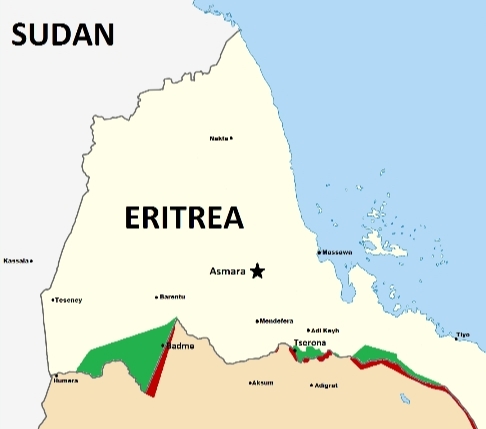
In May 1991, Mengistu fled Ethiopia. The Derg collapsed, the EPLF entered Asmara, and the EPRDF took Addis Ababa. Eritrea achieved de facto separation because Ethiopian forces had been defeated and the incoming Ethiopian government accepted Eritrea’s right to determine its political status through a referendum.
This was the indispensable political opening. The battlefield altered the balance of power, but regime change in Ethiopia created the negotiating counterpart willing to recognize a referendum. Without that change in Addis Ababa, Eritrean forces might have controlled their territory while remaining diplomatically isolated or facing continuing war.
The lesson is profound: liberation movements must study the political order confronting them, the forces capable of succeeding it, and the conditions under which a successor government might accept negotiations. The weakening of a centralized regime does not automatically produce independence. It produces a window of uncertainty. Only movements with coherent institutions, territorial organization, diplomatic relationships, and a credible transition plan can convert such a window into a durable political outcome.
The Referendum Converted Victory Into Legitimate Sovereignty
Eritrea exercised de facto self-government from 1991, but formal independence was deferred pending a referendum. The Provisional Government of Eritrea requested United Nations participation, leading to the establishment of the United Nations Observer Mission to Verify the Referendum in Eritrea.
Voting took place from April 23 to 25, 1993. More than 99 percent of participating voters supported independence, and the United Nations concluded that the process had been free and fair. Eritreans outside the territory were also permitted to participate. United Nations report on Eritrean independence
The referendum did not create Eritrean national consciousness. It did not produce the liberation movement’s military victory or its control of the territory. Its essential function was to convert a political and military reality into an internationally verifiable expression of popular consent.
Ethiopia recognized Eritrea’s sovereignty, and Eritrea declared formal independence on May 24, 1993. The United Nations Security Council recommended its admission through Resolution 828, and on May 28, 1993, the General Assembly admitted Eritrea as a member of the United Nations. UN Security Council Resolution 828 United Nations membership record
Eritrea’s emergence therefore contained four complementary forms of legitimacy: historical territorial identity, effective control, consent from the new Ethiopian government, and an internationally verified referendum. Recognition became possible because these elements reinforced one another.
What the Eritrean Case Does—and Does Not—Prove for Ambazonia
The comparison between Eritrea and Ambazonia is instructive, but it must not be exaggerated. Both cases involve territories shaped by separate colonial administrations that later entered political unions with neighboring states. Both experienced federal arrangements that were progressively centralized. Both developed resistance after local institutions, cultural protections, and constitutional expectations were weakened. Both demonstrate how forced assimilation can transform demands for reform into movements for sovereign separation.
There are nevertheless important differences. Eritrea had been administered as a separate Italian colony before British military administration and was later federated with Ethiopia through a specific United Nations arrangement. Ambazonia—the Former British Southern Cameroons—was a United Nations Trust Territory under British administration that achieved independence by joining La République du Cameroun following the 1961 plebiscite. Eritrea’s final referendum occurred with the approval of Ethiopia’s transitional government after a complete change of regime. No equivalent consent from Yaoundé or internationally authorized status referendum presently exists for Ambazonia.
Eritrea is therefore not an automatic legal precedent guaranteeing Ambazonian recognition. It is a strategic and historical comparison demonstrating that Africa’s inherited borders have not always prevented the restoration or emergence of a separate state when a political union collapses, a distinct people sustains its claim, effective governing capacity develops, and international conditions change.
The first Ambazonian lesson is that memory must be organized into institutions. Repeating historical grievances cannot substitute for transparent finance, constitutional succession, civilian protection, disciplined security, diplomatic engagement, and administrative readiness.
The second lesson is that fragmentation carries an enormous price. Eritrean organizations experienced serious internal conflict before the EPLF became dominant. Ambazonia should not imitate a process in which unity is achieved through coercive elimination. It must instead build constitutional unity: common rules, civilian authority, financial accountability, enforceable standards of conduct, representative decision-making, and peaceful mechanisms for resolving disagreement.
The third lesson is that territorial control must be accompanied by protection and service. A liberation movement cannot credibly claim sovereignty while civilians under its influence face kidnapping, extortion, arbitrary punishment, attacks on education, or unaccountable armed authority. The ability to discipline one’s own forces is a more convincing demonstration of governing capacity than the ability to issue declarations against an adversary.
The fourth lesson is that diplomacy follows preparedness. The United Nations did not arrive in Eritrea in 1993 to create a liberation movement from nothing. It arrived to verify public consent after a territorial, military, administrative, and political transformation had already occurred. Ambazonian diplomacy must therefore present not only the historical case against an imposed constitutional order, but also measurable evidence that a successor state can protect its population, honor international obligations, maintain lawful commerce, secure its borders, safeguard minorities, and cooperate peacefully with its neighbors.
The fifth lesson is that Ambazonia 2050 & Beyond can perform an essential function if it is treated as a governing architecture rather than merely a visionary publication. A credible sovereignty project must explain how political freedom will be converted into education, infrastructure, productive agriculture, financial sovereignty, technological innovation, human security, accountable government, territorial balance, and shared prosperity.
A flag establishes political identity. A developmental ecosystem gives that identity material meaning.
The Warning Eritrea Also Gives
Eritrea’s history cannot be used responsibly without examining what followed independence. The organizational discipline that helped sustain the liberation struggle later contributed to an intensely centralized political order. Eritrea has not established the open, competitive democratic system many supporters expected at independence. Human-rights organizations continue to document severe restrictions on political expression, religious freedom, independent organization, and movement, as well as indefinite national service. Human Rights Watch, World Report 2025: Eritrea
Eritrea and Ethiopia also fought a devastating border war from 1998 to 2000, demonstrating that recognition does not automatically settle borders, trade, citizenship, security, or access to resources.
These outcomes do not invalidate Eritrea’s right to independence. They reveal a different truth: a movement can succeed in liberating a territory and still fail to liberate the citizen from arbitrary power.
Ambazonia must therefore learn from both Eritrean achievement and Eritrean disappointment. Structures created for secrecy, wartime discipline, and centralized command cannot be allowed to become permanent instruments of government. Independence must bring constitutional limits, civilian control, independent courts, political competition, transparent public finance, freedom of expression, and lawful succession.
The objective cannot be merely to transfer coercive power from Yaoundé to Buea. It must be to transform the relationship between power and the citizen.
Conclusion: Sovereignty Had to Be Built Before It Was Recognized
Eritrea became independent because its people preserved a separate national claim after the collapse of federation, sustained resistance through changing Ethiopian regimes, constructed an organization capable of territorial administration, benefited from the fall of the Derg, secured acceptance of a referendum from Ethiopia’s transitional authorities, demonstrated overwhelming popular consent, and obtained international recognition.
No single factor was sufficient.
Colonial history established territorial distinctiveness but did not deliver independence. Armed struggle prevented assimilation but imposed enormous human costs. Battlefield success created effective control but did not automatically produce international legitimacy. Regime change opened a political door but did not determine what Eritrea would do with it. The referendum converted a hard-won reality into an internationally recognized act of self-determination.
For Ambazonia, the central lesson is not that independence inevitably follows prolonged conflict. History offers no such guarantee. The lesson is that a people seeking sovereignty must prepare simultaneously for resistance, diplomacy, governance, political transition, civilian protection, and development.
Eritrea did not become independent merely because Ethiopia became weak. It became independent because Eritrean institutions were sufficiently organized to act when Ethiopian power changed.
Ambazonia’s future will likewise not be determined only by the weaknesses, succession struggles, or political failures of La République du Cameroun. It will be determined by whether Ambazonians can demonstrate a more legitimate, disciplined, humane, and productive political order.
The ultimate proof of readiness will not be the number of declarations issued, factions denounced, or military rumors celebrated. It will be the existence of institutions capable of protecting the people, governing under law, transforming national resources into shared prosperity, and allowing citizens—not another indispensable ruler—to own the republic. That is the deeper meaning of Eritrea’s independence: sovereignty may be recognized in a moment, but it must be constructed over time.