









News commentary

We are home to news on Cameroon and the CEMAC region. We are dedicated to honest and reliable reporting. We are the voice of the Cameroonian people and their fight for freedom and democracy at a time when the Yaoundé government is silencing dissent and suppressing democratic voices.

The central question before the Norwegian court is not whether the people of Southern Cameroons have a cause. It is whether the prosecution can establish, beyond reasonable doubt, that Dr. Cho Ayaba bears individual criminal responsibility for the specific offenses charged.That is the distinction his defense must understand, the distinction the media must respect, and the distinction the international community must not lose sight of.
By Tarh Paddy King, as Contributor The Independentist News
As Amazon associate this site earns from qualifying purchases
Get your copies of publications on the Ambazonian revolution By Martin Mungwa on Amazon
https://www.amazon.com/s?k=Martin+mungwa&crid=2VVLXEC4N2U8S&sprefix=trump+and+the+gov+martin+mungwa%2Caps%2C1837&linkCode=ll2&tag=njokings-20&linkId=2049db11a324e38ad627ed6a8db8b574&language=en_US&ref_=as_li_ss_tl
Dr. Cho Ayaba and his legal team must appreciate one fundamental distinction: his arrest, prolonged detention, and subsequent indictment before the Norwegian judicial authorities do not, in themselves, constitute an indictment of the Ambazonian Liberation Movement, nor do they invalidate the historical and legal arguments underpinning the Southern Cameroons people’s struggle for self-determination. These are two fundamentally different questions that must not be deliberately conflated.
The Norwegian judicial proceedings are not a referendum on the historical legitimacy of the Southern Cameroons question. Neither is the court being called upon to determine whether the people of Southern Cameroons possess legitimate political grievances or an arguable claim to self-determination under international law.
Rather, the proceedings concern allegations of individual criminal responsibility arising from conduct associated with the armed conflict in Southern Cameroons.
At the time of his arrest in September 2024, Norwegian authorities investigated Dr. Ayaba on suspicion of incitement to crimes against humanity. The subsequent prosecutorial developments reported in November 2026 concern alleged complicity in war crimes and terrorist acts, while the earlier crimes-against-humanity allegation has been discontinued.
This distinction is not a matter of political interpretation. It goes to the very substance of the criminal proceedings.
It is therefore essential that Dr. Ayaba and his defense team remain focused on the actual allegations, the evidentiary standards governing the prosecution, and the legal elements that must be established before any criminal responsibility can be attributed to him.
I recognize that certain media narratives, particularly those perceived as sympathetic to the Franco-Cameroun hegemonic establishment (CNA of Nfor Hanson, Mimi Mefo infos…), may seek to portray these proceedings as a judicial repudiation of the entire Ambazonian struggle. Such an interpretation would be legally misleading and politically opportunistic.
An individual’s prosecution cannot automatically extinguish a people’s historical grievances, nor can it serve as a definitive judicial determination of their collective political aspirations.
However, the manipulation of public opinion by political adversaries and Yaounde-sponsored proxies cannot become a substitute for a credible legal defense.
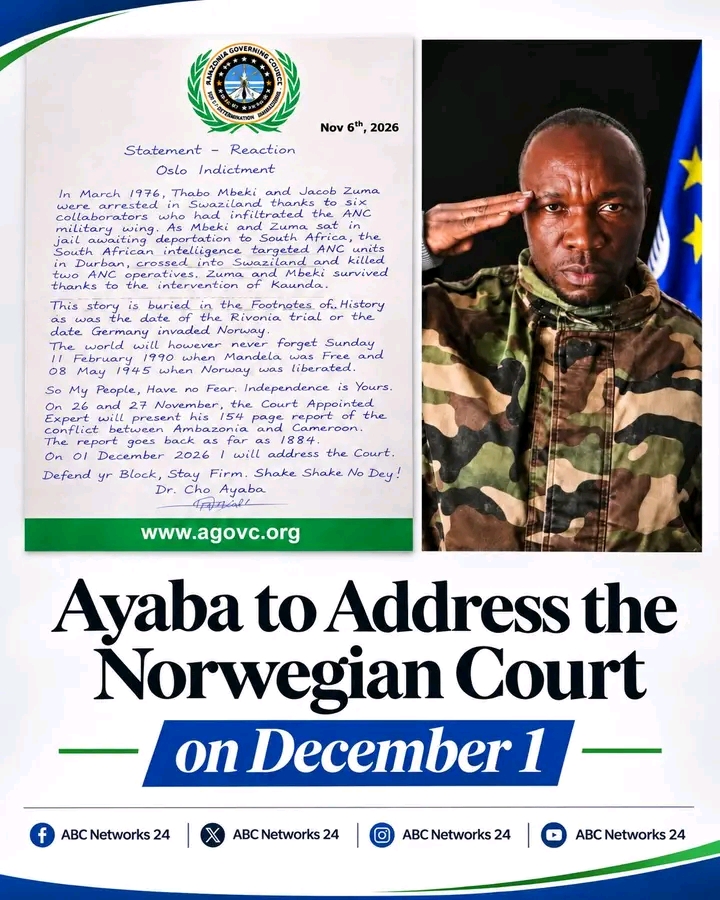
This is precisely where I find Dr. Ayaba’s recent handwritten statement concerning the Oslo indictment troubling.
Historical comparisons involving anti-apartheid leaders (Zuma, Mbeki), colonial struggles, or resistance movements may carry political symbolism. But political symbolism and historical analogies, however emotionally compelling, do not answer specific allegations of criminal conduct.
At this critical stage, his defense must confront the substance of the prosecution’s case rather than appear to redirect public attention toward questions that are not, in themselves, determinative of his individual criminal liability.
There is another distinction that deserves particular emphasis.
Armed conflict is not, by its mere existence, synonymous with a war crime. However, the conduct of hostilities is governed by binding principles of international humanitarian law.
The principles of distinction, proportionality, precaution, and the protection of civilians are not optional political considerations. They constitute essential legal obligations applicable to parties to an armed conflict.
A movement may advance a historically grounded claim to self-determination while its members or commanders remain individually accountable for violations of the laws of war. The legitimacy claimed for a political objective does not confer immunity from criminal responsibility for unlawful methods used in its pursuit.
Equally, allegations of unlawful conduct must be proved through admissible evidence and the applicable legal standards. Political leadership, public declarations, or association with an armed movement cannot automatically establish responsibility for every act committed by individuals claiming allegiance to that movement.
There have been publicly circulated statements and recordings attributed to Dr. Ayaba that raise questions concerning his relationship with armed operations and the extent of his authority or influence. Any such material relied upon by the prosecution must be rigorously examined for authenticity, context, legal significance, and its connection to the specific offenses alleged.
It would be premature to treat such recordings as conclusive proof of criminal guilt. It would be equally imprudent for a serious defense to dismiss potentially relevant evidence without confronting its substance.
The burden of proving criminal liability remains with the prosecution, and Dr. Ayaba is entitled to the presumption of innocence and all guarantees of due process.
My position is therefore neither an endorsement of the prosecution nor a prejudgment of his guilt. It is an insistence on intellectual honesty, legal clarity, and political responsibility.
The Southern Cameroons question has its own historical, constitutional, and international dimensions. Those questions deserve serious consideration independently of the criminal proceedings against any individual.
But the defense of an individual’s conduct and the defense of a people’s political aspirations must not be confused.
Dr. Cho Ayaba and his legal advisers would be better served by addressing the precise allegations, interrogating the evidence, challenging any deficiencies in the prosecution’s legal theory, and establishing the relevant facts concerning his personal involvement or non-involvement in the acts under examination.
The Ambazonian cause must not be reduced to the fate of one individual. Equally, the cause of self-determination must not be invoked as a blanket defense against allegations of violations of international humanitarian law.
Ultimately, justice requires that political grievances be acknowledged without excusing unlawful conduct, and that criminal allegations be examined without criminalizing an entire people’s aspirations.
The central question before the Norwegian court is not whether the people of Southern Cameroons have a cause. It is whether the prosecution can establish, beyond reasonable doubt, that Dr. Cho Ayaba bears individual criminal responsibility for the specific offenses charged.
That is the distinction his defense must understand, the distinction the media must respect, and the distinction the international community must not lose sight of.
As Amazon associate this site earns from qualifying purchases
Get your copies of publications on the Ambazonian revolution By Martin Mungwa on Amazon
https://www.amazon.com/s?k=Martin+mungwa&crid=2VVLXEC4N2U8S&sprefix=trump+and+the+gov+martin+mungwa%2Caps%2C1837&linkCode=ll2&tag=njokings-20&linkId=2049db11a324e38ad627ed6a8db8b574&language=en_US&ref_=as_li_ss_tl
©️ Tarh Paddy King, as contributor The Independentist New
Share This Post:
Beyond the Assembly Line: Rethinking Management and the Future of Work .THE INDEPENDENTIST NEWS | BOOK REVIEW
THE DIVIDE-AND-RULE TRAP: ATANGA NJI, TAMBE TIKU AND THE DANGEROUS POLITICS OF FRAGMENTING AMBAZONIA
Related Post
Beyond the Assembly Line: Rethinking Management and the Future
THE DIVIDE-AND-RULE TRAP: ATANGA NJI, TAMBE TIKU AND THE
GROW YOUR BUSINESS WITH DIASPORA PROSPERITY NETWORK (DPN)! Put
THE NEW DEAL EXPIRED! 44 YEARS OF BIYA: A
DAVID MAKONGO, AGBOR GILBERT AND THE POLITICS OF PRISON
A patriot from home front, writes to the Independentist