











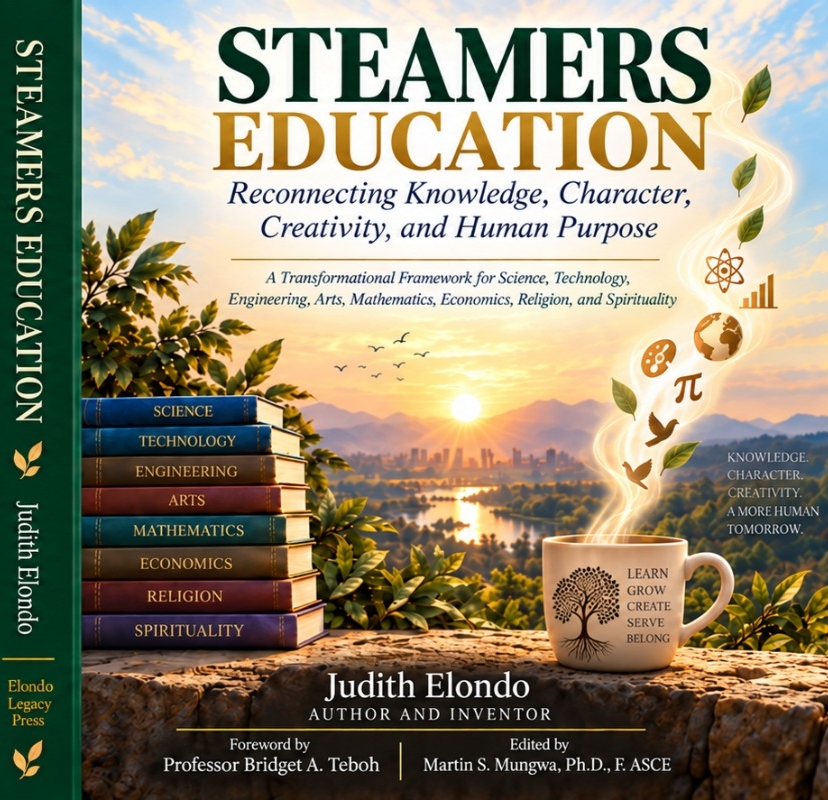
The Independentist News Education desk, Book Review
Author and Inventor: Judith Elondo
Foreword: Professor Bridget A. Teboh
Editor: Martin S. Mungwa, Ph.D., F. ASCE
Current Pre-Press Length: approximately 239 pages
Chapters: 10, followed by a Final Open Horizon
Publisher: Elondo Legacy Press
As Amazon associate this site earns from qualifying purchases
Its back to school. Shop from Amazon
https://www.amazon.com/s?k=back+to+school&i=specialty-aps&srs=217248077011&crid=2UB3ZEVCOPJI7&sprefix=Back%2Cspecialty-aps%2C404&linkCode=ll2&tag=njokings-20&linkId=f4bb16a5b028f2a684ecb08c7b6f3953&language=en_US&ref_=as_li_ss_tl
What should remain in a learner after the examination has been passed, the certificate awarded, the classroom left behind, and even the technology used for learning has become obsolete? That question sits at the heart of STEAMERS EDUCATION: Reconnecting Knowledge, Character, Creativity, and Human Purpose, a 239-page educational work by Judith Elondo that proposes an ambitious expansion of the familiar STEM and STEAM models.
Elondo’s framework brings together eight distinct but interconnected pillars: Science, Technology, Engineering, Arts, Mathematics, Economics, Religion, and Spirituality. Her argument is not that schools need eight unrelated subjects competing for additional classroom time. Rather, she proposes that learners be taught to connect different forms of knowledge when confronting real human problems.
The result is a book concerned not simply with what students know, but with what they can do, how they judge, how they create, how they understand value and consequences, how they relate to others, and what kind of human beings education is helping them become.
The book is particularly careful in its treatment of Religion and Spirituality. Elondo treats them as separate but related pillars and repeatedly protects freedom of conscience. The framework does not require learners to accept the author’s Christian beliefs. Instead, belief, meaning, conscience, culture, evidence, and human responsibility are placed within an educational conversation that leaves room for religious, differently religious, and nonreligious learners.
The Ten-Chapter Journey
The book’s ten chapters move deliberately from philosophy to classroom practice, institutional readiness, evidence, and finally society.
Chapter 1 — “The Kettle, the Water, and the Source” introduces Elondo’s central water-heater metaphor. The learner is not an empty container simply waiting to be filled. Education creates conditions for transformation.
Chapter 2 — “The Journey Behind STEAMERS” traces the personal, educational, caregiving, religious, and spiritual experiences that helped shape Elondo’s educational thinking. Importantly, the chapter distinguishes personal experience from scientific evidence.
Chapter 3 — “What Should Education Produce?” moves beyond information and examination scores toward understanding, application, judgment, responsibility, and contribution. It also introduces four ethical questions built around Truth, Conscience, Righteousness, and Justice.
Chapter 4 — “The Eight Pillars” explains the intellectual architecture of STEAMERS and the distinctive contribution of each discipline. Economics brings production, ownership, incentives, and value into the classroom conversation; Religion addresses organized systems of meaning; Spirituality considers inner awareness and purpose.
Chapter 5 — “From Subjects to Problems” takes the framework into the classroom. Problems such as clean water, solar energy, waste, food production, artificial intelligence, shelter, and community needs become opportunities for interdisciplinary learning without abandoning the rigor of individual subjects.
Chapter 6 — “The STEAMERS Learner” puts the whole learner at the center. It examines curiosity, creativity, character, disability, neurodiversity, poverty, migration, language, culture, technology access, family responsibility, dignity, and the possibility that capability can be hidden behind circumstance.
Chapter 7 — “The Teacher and the School” recognizes an important reality: a good teacher cannot carry an unprepared institution alone. Governance, administrative capacity, learner protection, resources, partnerships, assessment, technology, and teacher workload must all be considered before an educational innovation is scaled.
Chapter 8 — “Who Signs? Who Pays? Who Owns It?” may be one of the book’s most unusual contributions to educational reform literature. It asks questions frequently left until too late: Who owns the curriculum? Who controls revisions? Who pays for equipment and replacement? What happens when a donor leaves, electricity fails, a platform disappears, or the only trained teacher departs? Education, Elondo argues, must be designed to survive.
Chapter 9 — “From Idea to Evidence” provides a necessary restraint on educational enthusiasm. The chapter insists that originality is not proof of effectiveness. Concept, prototype, pilot, baseline, implementation, observation, measurement, evaluation, revision, and scale are treated as different stages. STEAMERS, the book argues, should be willing to be tested—and corrected by evidence.
Chapter 10 — “From the Classroom to Society” asks what the STEAMERS graduate should ultimately carry into adulthood: the capacity to understand evidence, use technology without surrendering judgment, design solutions, create, calculate, understand economics and value, engage respectfully with belief and culture, exercise conscience, question manipulation, communicate, cooperate, and accept responsibility for consequences.
The book closes with a Final Open Horizon, “When Education Begins to Rise,” returning to the kettle metaphor with which the journey began: Education creates conditions. The learner transforms. The teacher guides. The institution supports. Evidence corrects. Conscience directs.
Capability rises.
An African Framework with a Wider Question
Although deeply conscious of African educational realities, STEAMERS EDUCATION does not present itself as a universal cure. That restraint strengthens the book.
Its African significance lies in its refusal to assume that education should merely prepare young people to participate in systems designed elsewhere. Economics, ownership, production, technology, institutional capability, creativity, and responsibility all enter the educational equation. But its central question is broader than Africa. In an age of artificial intelligence and rapidly changing technology, what becomes uniquely important when machines can produce information, calculations, summaries, images, and increasingly sophisticated answers?
Elondo’s answer is that education must continue developing judgment, conscience, creativity, responsibility, human relationship, evidence literacy, and the ability to determine what technology should be used for in the first place. That makes STEAMERS less an argument against STEM than an argument about what STEM—and education generally—must ultimately serve.
The book has a Foreword by Professor Bridget A. Teboh and has been edited by Martin S. Mungwa, Ph.D., F. ASCE, whose systems and implementation lens is particularly visible in the later chapters dealing with institutional readiness, ownership, resilience, evidence, and scaling.
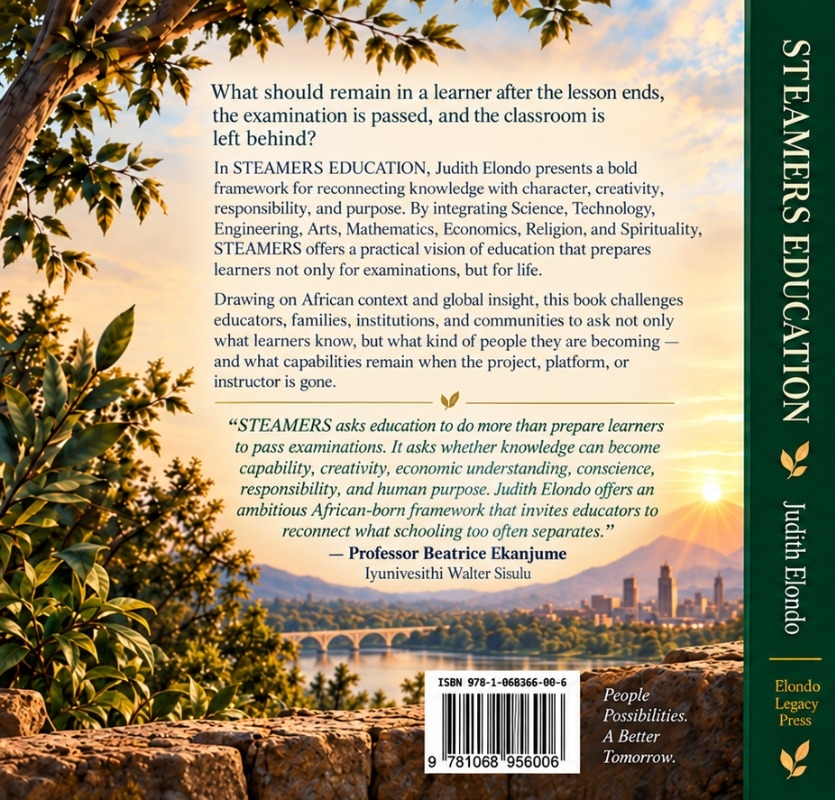
An endorsement attributed for the book to Professor Beatrice Ekanjume, Iyunivesithi Walter Sisulu, captures the ambition of the project: “STEAMERS asks education to do more than prepare learners to pass examinations. It asks whether knowledge can become capability, creativity, economic understanding, conscience, responsibility, and human purpose.” ability That is also the clearest way to understand this book.
STEAMERS EDUCATION is ultimately not about adding more letters to an educational acronym. It is about reconnecting knowledge with the human being who must eventually decide what to do with that knowledge.
For educators, parents, curriculum designers, school leaders, policymakers, and anyone concerned about what education should produce in the age of artificial intelligence, Judith Elondo has opened a conversation worth having.
The Independentist News Rating: 9.5/10
Editorial note: The reviewed pre-press manuscript runs approximately 239 pages. Final pagination may change slightly during final typesetting and press preparation.
As Amazon associate this site earns from qualifying purchases
Its back to school. Shop from Amazon
https://www.amazon.com/s?k=back+to+school&i=specialty-aps&srs=217248077011&crid=2UB3ZEVCOPJI7&sprefix=Back%2Cspecialty-aps%2C404&linkCode=ll2&tag=njokings-20&linkId=f4bb16a5b028f2a684ecb08c7b6f3953&language=en_US&ref_=as_li_ss_tl
The Independentist News education desk







Leave feedback about this