

Who accepted the completed system? Who benefits when it succeeds? Who pays when it fails? Until those questions are answered publicly, the €274 million obligation should be understood not merely as money owed to foreign companies but as a warning that Cameroon’s infrastructure, diplomacy, and postcolonial economic arrangements have converged into a national debt chokepoint.
By Martin S. Mungwa, PhD, P.E., F.ASCE, Contributor The Independentist News
As Amazon associate this site earns from qualifying purchases
Get your back to school stuff via Amazon
A January 2026 investigation by Africa Intelligence reported that the Cameroonian government owed approximately €274 million—about CFA 180 billion—to several French-controlled or French-associated companies operating in the country. The reported creditors include Nachtigal Hydro Power Company, Tollcam, and TotalEnergies. According to the report, the unpaid obligations were increasing and had become a matter of concern in Paris.¹
The immediate temptation is to treat this as another story about Cameroon’s growing public debt. That would miss its deeper significance. Governments routinely borrow, purchase fuel, commission infrastructure, enter public-private partnerships, and accumulate legitimate contractual obligations. The more consequential question is why a resource-rich country repeatedly develops strategic infrastructure through arrangements that leave the state unable to meet its obligations, foreign operators demanding payment, and Cameroonian citizens carrying the ultimate burden.
This is not simply a debt story. It is a structural test of sovereignty, public financial management, infrastructure governance, and productive capacity. The €274 million obligation must also be examined within the historical economic architecture established during Cameroon’s transition from French colonial administration to formal independence. That architecture included Franco-Cameroonian cooperation agreements covering monetary, financial, military, technical, cultural, and administrative relations. It later became protected by an authoritarian domestic system and normalized internationally through organizations that proclaimed democracy and human rights while imposing few meaningful consequences for Cameroon’s deteriorating governance.
The Amount Is Manageable, but the Pattern Is Dangerous.
Cameroon’s total public-sector debt was reported at approximately CFA 15.6 trillion by June 2026. On that scale, CFA 180 billion represents only a little more than one percent of the total debt stock. It is not, by itself, sufficient to bankrupt the country.
But percentages can conceal institutional danger. These obligations reportedly involve companies operating in electricity, toll roads, fuel, and other essential sectors. Payment arrears connected to strategic infrastructure are more consequential than their nominal share of public debt might suggest. They can delay maintenance, disrupt investment, trigger contractual penalties, weaken essential services, increase future financing costs, and strengthen the negotiating power of foreign creditors.
The International Monetary Fund continues to classify Cameroon as facing a high risk of debt distress. Its assessments have identified payment delays, supplier arrears, public-enterprise liabilities, contingent obligations, insufficient transparency, and weaknesses in public financial management.²
The real warning is therefore not simply that one obligation has become large. It is that arrears are becoming a recurring method of financing government activity. When a state awards contracts, accepts delivery, consumes services, and postpones payment, it is effectively borrowing from suppliers without always presenting that borrowing transparently to Parliament or the public.
The Cooperation Accords and the Architecture of Dependency
The roots of Cameroon’s present economic vulnerability extend beyond the Biya administration. They reach back to the cooperation agreements concluded with France around independence. On 13 November 1960, France and Cameroon signed a series of agreements addressing economic, monetary, and financial cooperation; relations between the Cameroonian and French treasuries; technical military assistance; the role of the French military mission; civil aviation; and technical personnel. These instruments are recorded in the United Nations Treaty Series.³
The agreements did not mean that France made every subsequent Cameroonian decision. Nor do they absolve Cameroon’s governments of responsibility for corruption, mismanagement, excessive borrowing, and the failure to protect national assets. They did, however, establish an asymmetric starting point.
France entered the post-independence relationship with capital, corporations, technical personnel, military relationships, diplomatic influence, monetary leverage, and access to the commanding heights of the economy. Cameroon entered it with internationally recognized sovereignty but limited control over many of the systems through which that sovereignty had to operate. This was not complete economic decolonization. The flag changed faster than the institutional architecture.
The cooperation arrangements reinforced the assumption that Cameroon’s monetary stability, technical administration, security capacity, education, and major infrastructure projects required continuing French supervision or partnership. External assistance was not consistently structured as a temporary bridge toward domestic capability. It became a durable feature of governance.
The consequence was cumulative. Where local technical capacity was not deliberately developed, Cameroon remained dependent on foreign consultants. Where domestic capital was not sufficiently mobilized, strategic projects depended on external lenders. Where public institutions remained weak, foreign corporations negotiated with a state whose legal, financial, and technical capabilities were often less developed than their own.
The cooperation agreements should therefore be judged not only by their formal language but by their results. Did they transfer technical and managerial capability? Did they create autonomous Cameroonian institutions? Did they develop competitive domestic industries? Did they enable Cameroon to finance, operate, maintain, and reproduce its productive systems? More than six decades after independence, the continuing inability of the state to manage strategic infrastructure without accumulating substantial obligations to foreign companies suggests that the results have been deeply unsatisfactory.
The CFA Franc: Stability Without Transformation
The monetary dimension remains important. Cameroon uses the Central African CFA franc through the Central African Economic and Monetary Community. The currency is pegged to the euro and supported through a monetary-cooperation framework involving France. Supporters argue that this arrangement provides exchange-rate stability, currency convertibility, and inflation discipline. Those advantages should not be dismissed. Monetary stability has real value.
But stability is not the same as productive transformation. A monetary system must also be evaluated by its effects on industrial development, domestic credit, employment, export competitiveness, agricultural processing, infrastructure maintenance, and the circulation of capital within the local economy.
Cameroon can possess a relatively stable currency while operating an unstable productive system. The country exports raw materials, imports processed goods, borrows for infrastructure, and then struggles to produce the domestic revenue required to service its obligations. Capital enters through loans and foreign investment but leaves through imported equipment, consulting contracts, debt service, dividends, management charges, and external procurement. The central question is therefore not merely whether the currency is stable. It is whether the monetary and financial architecture helps Cameroon build a nation of producers and owners.
Nachtigal and the Broken Infrastructure Chain
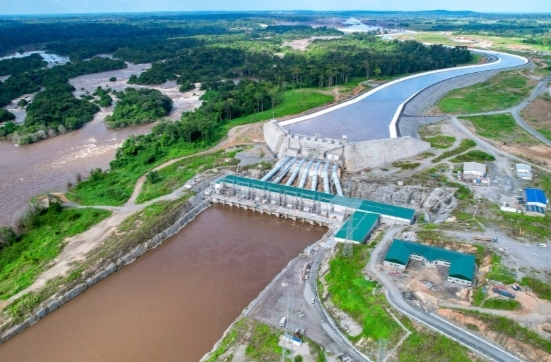
The Nachtigal hydroelectric project illustrates the structural problem. Cameroon urgently needs reliable electricity, and hydropower should be one of its strongest comparative advantages. Nachtigal has an installed capacity of approximately 420 megawatts and is owned through a partnership involving the Cameroonian state, Électricité de France, and international development-finance interests.⁴
Yet electricity generation alone is not development. A functional power system requires an integrated chain: generation, transmission, distribution, metering, collection, maintenance, productive use, and reinvestment. If one link fails, the economic value of the entire system declines.
Nachtigal can generate electricity, but inadequate transmission and distribution capacity can prevent that electricity from reaching consumers reliably. The state may therefore incur obligations for generation while failing to complete or maintain the network necessary to sell the power efficiently and generate the revenue required to meet those obligations. That is not simply a financial failure. It is an engineering and institutional failure. The productive asset exists, but the supporting system does not reliably convert its output into public value.
The correct question is not merely, “How many megawatts were installed?” It is, “How many usable megawatt-hours reached households and productive enterprises? How much revenue was collected? Who controlled that revenue? How much was reinvested in the network?”
If generation expands while transmission remains constrained, consumers can continue experiencing shortages even as the country accumulates debt. Cameroon then pays twice: first through the original contractual obligation and again through lost production, damaged businesses, emergency generation, and unreliable service. A power station without adequate transmission is like a structurally sound bridge that does not connect to a functioning road. The component may exist, but the system has failed.
The Missing Acceptance Test
In engineering and major-project management, an asset is not considered successful merely because construction has been completed. It must be inspected, tested, commissioned, accepted, operated, and evaluated against its design requirements. Someone must certify that the system performs as intended. The same discipline should apply to public infrastructure.
Who verified that the promised capacity was delivered? Who confirmed that the connected transmission or road network was ready? Who measured actual performance against the financial assumptions used to justify the project? Who accepted the system on behalf of the Cameroonian public? Who remains professionally accountable when projected revenues fail to materialize?
Political inauguration is not technical acceptance. A ribbon-cutting ceremony cannot replace system testing, transparent performance data, or financial verification. When governments confuse project completion with project success, they can accept long-term payment obligations before confirming that the underlying asset produces its expected public and economic value.
Who Signed, Who Pays, and Who Carries the Risk?
Every major public-private infrastructure agreement should answer five questions. Who signed the contract? Who guaranteed payment? Who controls the productive asset? Who collects the revenue? Who carries the loss when performance or payment fails? These questions matter because the language of partnership can conceal an unequal distribution of risk. A foreign investor may provide capital, technology, management, and access to international finance. The Cameroonian state may provide land, sovereign guarantees, tax concessions, regulatory approvals, natural resources, and a protected market. Cameroonian citizens then provide the consumer base and ultimately absorb higher tariffs, increased taxes, reduced public expenditure, or deteriorating services.
If the project succeeds, dividends and management income may leave the country. If it fails, the state may still be required to honor its guarantees. Gains become transferable while losses become public. This does not establish wrongdoing by every foreign company. A company that performs under a valid contract has a legitimate expectation of payment. France is not responsible for every fiscal decision made in Yaoundé. Cameroon’s leaders cannot blame colonial history for contracts they negotiated, signed, guaranteed, and failed to manage.
But contractual legality should not end the analysis. A contract can be legally enforceable while remaining economically unbalanced, inadequately disclosed, poorly supervised, or inconsistent with long-term national development. Cameroon should pay verified and legitimate obligations. It should not do so without establishing whether the underlying assets performed as promised and whether the contracts distributed risk fairly.
From Cooperation to Corporate Extraction
It would be careless to describe every foreign company operating in Cameroon as a looter. Foreign investment can provide capital, employment, technology, professional skills, and access to international markets. Cameroon requires productive international partnerships. The stronger argument concerns the system that permits disproportionate extraction without adequate domestic accountability. Foreign corporations have benefited from concessions, purchasing arrangements, resource contracts, public guarantees, tax treatment, and political relationships cultivated within an historically unequal order.
Extraction should therefore be defined structurally rather than used merely as a slogan. It occurs when national resources produce private value without proportionate public benefit, transparent accounting, environmental restoration, domestic reinvestment, capability transfer, or meaningful public consent. It occurs when profits are externalized while losses are transferred to the state and its citizens.
Under this definition, the question is not whether every company violated the law. The question is whether the legal, political, and contractual order helped sustain an opaque economy in which foreign companies could extract disproportionate value while weak domestic institutions transferred substantial commercial and fiscal risks to the Cameroonian public. That formulation is more defensible than alleging that every foreign investor participated in criminal looting. It directs attention toward ownership, revenue, risk, transparency, and measurable public benefit.
The Commonwealth and La Francophonie: Principles Without Consequences
Cameroon occupies an unusual international position as a member of both the Commonwealth and the Organisation internationale de la Francophonie. In principle, this dual membership should expose the country to two communities committed to democracy, constitutional government, human rights, linguistic pluralism, and the rule of law.
Cameroon joined the Commonwealth in 1995. The Commonwealth Charter affirms democracy, human rights, separation of powers, rule of law, good governance, freedom of expression, and sustainable development.⁵ La Francophonie similarly declares its commitment to democratic government, credible elections, human rights, political freedom, and the rule of law through the Bamako Declaration and related programs.⁶
In practice, Cameroon has benefited from the prestige and diplomatic recognition of membership while facing limited institutional consequences for its governance record. President Paul Biya has governed since 1982. Constitutional changes removed presidential term limits, elections have repeatedly been disputed, civil and political freedoms remain constrained, and serious abuses have been documented in the conflict affecting the English-speaking regions. Independent assessments continue to describe Cameroon as authoritarian and affected by corruption, patronage, restrictions on opposition, and weak accountability.⁷
Neither the Commonwealth nor La Francophonie created the Biya regime. Both have occasionally promoted dialogue, electoral support, institutional reform, and human rights. But continuing engagement without measurable accountability can become a form of diplomatic insulation. The protective shield does not require an explicit agreement to defend the regime. It operates through recognition, summit invitations, carefully worded communiqués, continued programming, cautious election observation, and the prioritization of stability over institutional consequences.
The Commonwealth allows Yaoundé to cite membership as evidence of Anglophone inclusion, even while the constitutional and political grievances of the former British Southern Cameroons remain unresolved. La Francophonie reinforces Cameroon’s position within a French-centered diplomatic community whose geopolitical and commercial interests favor continuity.
The regime receives legitimacy from both linguistic communities without being held fully accountable by either. Principles are proclaimed, programs are administered, and relationships continue. The absence of consequences gradually converts institutional membership into political protection.
How Diplomatic Tolerance Enables Predatory Economics
Neither the Commonwealth nor La Francophonie instructs foreign companies to exploit Cameroon. The relationship is indirect but important. Diplomatic tolerance helps preserve an unaccountable political order. That order controls concessions, licenses, sovereign guarantees, procurement contracts, tax exemptions, and access to natural resources. Foreign companies seeking commercial advantage adapt to the system they encounter.
The cycle becomes mutually reinforcing. The regime offers access, continuity, and centralized decision-making. Foreign interests provide capital, revenue, corporate relationships, and the appearance of international confidence. International organizations preserve diplomatic normalcy. Citizens remain unable to inspect many of the contracts that govern national assets.
Foreign companies are not automatically responsible for the regime’s survival, but they can benefit from the predictability of an administration that centralizes power and limits scrutiny. International organizations may not intend to protect authoritarian government, but their reluctance to impose consequences can reduce the external cost of domestic repression and economic opacity.
The problem is therefore not only what is illegal. It is what has been normalized. A foreign company may lawfully receive a concession negotiated behind closed doors. A government may lawfully guarantee a project without publishing the full risk. An international organization may lawfully continue engaging a government with a deeply contested record. Yet the combination of these individually defensible actions can produce an economically destructive and politically self-protecting system.
The Productive-Sovereignty Test
Cameroon should evaluate every strategic infrastructure project through a productive-sovereignty test. The test is not whether a project was inaugurated, whether a foreign delegation attended the ceremony, or whether officials announced its theoretical capacity. It is whether the investment strengthens the country’s ability to own, operate, maintain, finance, and reproduce productive capacity.
A successful project creates a reinforcing chain: National resources support production. Production creates reliable services. Services generate domestic revenue. Revenue pays legitimate obligations. The remaining value is reinvested in maintenance, professional skills, expansion, and locally owned enterprise. A failed structure moves in the opposite direction:
The state provides resources and guarantees. Foreign capital builds or operates the asset. Institutional weakness reduces performance. Revenue becomes insufficient. Arrears accumulate. Refinancing increases external leverage. Citizens inherit the cost without acquiring the ability to reproduce the system. The difference is not ideology. It is system design.
Cameroon should not reject capital because it is foreign. It should reject structures that consume national resources without producing durable national capability. The proper question is whether capital circulates through the domestic economy or enters through sovereign guarantees and exits through debt service, imported expertise, management fees, dividends, and external procurement.
Transparency Must Precede Payment or Restructuring
Before Cameroon pays or restructures the reported €274 million, the government should publish a verified creditor schedule. The public deserves to know how much is owed to each company, what goods or services created the obligation, when payments became due, what penalties are accumulating, what guarantees were issued, and whether any portion is disputed.
The government should disclose whether the obligations were included in approved budgets. If they were not, officials should identify who authorized them and under what legal authority. Parliament should review the contracts and contingent liabilities. Independent auditors should verify whether performance milestones were achieved before invoices became payable.
Cameroon must distinguish legitimate contractual obligations from disputed charges, unverified claims, cost overruns, compensation demands, and commitments created without sufficient budget authorization. Paying blindly is not accountability. Refusing legitimate payment is not sovereignty. The responsible path is verification, disclosure, lawful negotiation, and institutional correction.
Cameroon should establish a public register of major public-private partnerships, concessions, and sovereign guarantees. Each project should identify its ownership structure, capital cost, expected revenue, public contribution, repayment obligations, performance milestones, dispute-resolution mechanism, and ultimate risk bearer.
The government should also undertake a transparent legal and economic review of the continuing effects of the Franco-Cameroonian cooperation framework. Provisions or institutional practices inconsistent with reciprocal benefit, democratic accountability, economic sovereignty, and domestic capability should be renegotiated through lawful processes.
The Cost to Ordinary Cameroonians
Debt is often discussed as though it exists only on government balance sheets. In reality, unpaid obligations eventually reach ordinary people. They appear through unreliable electricity, higher tariffs, delayed road maintenance, increased taxes, reduced public investment, unpaid local contractors, and diminished funding for health, education, water, and municipal services. They appear through lost employment when domestic businesses cannot operate because electricity is unreliable or transportation costs are excessive. Foreign companies may use contractual, diplomatic, or arbitral channels to recover their claims. Cameroonian contractors, workers, municipalities, pensioners, and small businesses rarely possess comparable leverage.
This creates a hierarchy of payment in which the best-connected creditors are eventually protected while ordinary citizens absorb the adjustment. The debt must therefore be evaluated as a question of distributive justice. Who receives payment first? Who waits? Who earns penalties and interest? Who loses employment? Who pays higher tariffs? Who sacrifices essential services so that arrears can be cleared?
A Warning About the Architecture of the State
The €274 million obligation is worth examining because it exposes more than a temporary shortage of cash. It reveals a state struggling to connect infrastructure planning, budgeting, contracting, service delivery, revenue collection, and debt repayment into one accountable system.
Cameroon possesses water, energy resources, agricultural capacity, ports, minerals, forests, labor, and a large regional market. Yet possession of resources does not automatically create productive sovereignty. Sovereignty exists when institutions can convert national assets into reliable services, retained revenue, domestic capability, and broadly shared prosperity.
The cooperation accords established an unequal foundation. Successive governments failed to replace that foundation with transparent and capable national institutions. The Biya regime deepened the weakness through centralized power, limited accountability, opaque contracting, and inadequate oversight. Foreign enterprises learned how to profit within that system. The Commonwealth and La Francophonie continued extending diplomatic recognition without consistently attaching consequences proportionate to their declared democratic principles.
The result is not proof that every foreign company looted Cameroon or that every international partner deliberately protected the regime. It is evidence of an opaque political economy in which external interests could extract considerable value while domestic institutions transferred risk and loss to the public.
The decisive questions remain unanswered: Who signed? Who guaranteed payment? Who verified performance? Who collected the revenue? Who accepted the completed system? Who benefits when it succeeds? Who pays when it fails? Until those questions are answered publicly, the €274 million obligation should be understood not merely as money owed to foreign companies but as a warning that Cameroon’s infrastructure, diplomacy, and postcolonial economic arrangements have converged into a national debt chokepoint.
A country that cannot connect its productive assets to accountable revenue will continue borrowing against its future while others negotiate over the value of its present.
Endnotes
“Yaoundé’s €274m Debt to French Firms Increasingly Problematic in Paris,” Africa Intelligence, January 21, 2026, article page.
International Monetary Fund, Cameroon: Staff Report for the 2026 Article IV Consultation (Washington, DC: International Monetary Fund, 2026), IMF report.
United Nations, Treaty Series, vol. 741, agreements nos. 10637–10643, including “Agreement on Co-operation in Economic, Monetary and Financial Matters,” “Convention concerning Relations between the Cameroonian Treasury and the French Treasury,” and agreements covering technical military assistance, civil aviation, and technical personnel, signed at Yaoundé, November 13, 1960, UN Treaty Series.
Nachtigal Hydro Power Company, “Project History,” describing the project’s development and ownership involving the State of Cameroon, Électricité de France, and international financial partners, NHPC project history.
Commonwealth Secretariat, Charter of the Commonwealth, affirming democracy, human rights, good governance, separation of powers, rule of law, freedom of expression, and sustainable development.
Organisation internationale de la Francophonie, “Affaires politiques et gouvernance démocratique,” setting out commitments to the rule of law, credible and transparent elections, democratic political life, and human rights under the Bamako framework, OIF governance commitments.
Freedom House, “Cameroon: Freedom in the World 2024,” describing restrictions on political competition, opposition activity, civil society, press freedom, and due process, Freedom House report.
Bertelsmann Stiftung, BTI 2026 Country Report—Cameroon, addressing authoritarian governance, corruption, patronage, institutional weakness, and economic-management challenges, BTI Cameroon report.
Emmanuel Frogameni, “Cameroon, the Commonwealth, and Crisis,” The Round Table (2025), examining the Commonwealth’s role and the crisis affecting Cameroon’s English-speaking regions, journal article.
France, Ministry for Europe and Foreign Affairs, “Franc Zone,” describing France’s continuing monetary-cooperation arrangements with African monetary areas, including the Central African monetary union to which Cameroon belongs, French Foreign Ministry.
Martin S. Mungwa, PhD, P.E., F.ASCE, Contributor The Independentist News
As Amazon associate this site earns from qualifying purchases
Get your back to school stuff via Amazon