










FIFA has shown the world what happens when talent meets opportunity. Black athletes are not succeeding because of racial magic. They are succeeding because football gives them a visible path, measurable performance, disciplined training, and a stage on which the gatekeeper cannot easily hide the result.
By Ali Dan Ismael Editor-in-chief The Independentist News
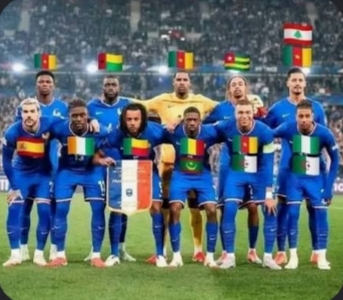
Today, the game of football has become one of the clearest stages on which Black excellence is visible. Across Europe’s most powerful national teams, Black athletes are not marginal participants. They are often central to success. France, England, Portugal, Belgium, Switzerland, the Netherlands, and other European teams rely heavily on players of African and Caribbean heritage. These athletes score the goals, control the midfield, defend the badge, carry national expectations, and rescue countries whose societies do not always treat them with equal dignity. This is one of the great contradictions of modern Europe.
On the field, Black athletes are celebrated as national heroes. In the communities where many of them live, or where their families once struggled as immigrants, Black people are too often looked down upon, stereotyped, policed, excluded, or treated as conditional citizens. They are praised when they win trophies, but questioned when they demand equality. They are embraced when they score goals, but insulted when they remind Europe of racism.
The stadium applauds them. The street may still suspect them. The flag claims them in victory. The nation questions them in discomfort. That contradiction is at the heart of the modern pigmentation war.
Talent Is Not Race; Talent Is Opportunity
Some people may look at the dominance of Black athletes in football and conclude that Black people are naturally more talented, more physical, or stronger than white people. That is a dangerous and simplistic conclusion. It reduces human excellence to biology and repeats the same racial thinking that has long been used to classify, limit, and stereotype Black people. The better explanation is opportunity.
Football is one of the few arenas where the gatekeeper cannot easily hide talent. A player either runs, passes, tackles, scores, creates, defends, and performs under pressure, or he does not. The ball exposes ability. The scoreboard records performance. The crowd witnesses the result. A racist may insult the player, but he cannot deny the goal once the ball enters the net. That is why sports can reveal what other institutions conceal.
In many fields, the gatekeeper controls the door. In education, the gatekeeper can decide who enters elite schools. In science, the gatekeeper can decide whose work receives funding, publication, recognition, patents, and promotion. In business, the gatekeeper can decide who receives capital. In politics, the gatekeeper can decide who is considered “electable.” In diplomacy, the gatekeeper can decide who is treated as legitimate. In media, the gatekeeper can decide whose story is told and whose name disappears. But in football, once the whistle blows, performance becomes harder to suppress.
This does not mean football is free of racism. It is not. Racism follows Black athletes onto the field, into the stands, onto social media, and into political commentary. But football still gives talent a visible battlefield. A racist fan may abuse a Black player, but he cannot erase the assist. A politician may question a player’s belonging, but he cannot remove the score from the record. A commentator may complain about the African presence in a European team, but he cannot deny that the team depends on the very excellence he resents. That is the power of opportunity.
When Black Excellence Becomes Useful
Europe’s relationship with Black footballers reveals an uncomfortable truth. Black excellence is celebrated when it is useful to national glory, but resisted when it demands equality beyond the stadium. The Black athlete is embraced when he scores. The Black citizen is questioned when he speaks. The Black player becomes national property when he wins. The Black person becomes foreign again when he challenges racism.
This double standard is visible across European football. France has depended on players of African heritage for some of its greatest footballing achievements. England has relied on Black British players to carry the hopes of a nation that still struggles with race, immigration, policing, and belonging. Portugal, Belgium, Switzerland, the Netherlands, and other European teams have also benefited from athletes whose family histories reach into Africa, the Caribbean, and the wider postcolonial world.
When they win, they are national heroes. When they lose, their identity is often questioned. When they score, the flag embraces them. When they protest, the old hierarchy returns. That is not patriotism. That is conditional belonging.
Mbappé, England, and the Insult Behind the Goal
The recent racist hostility directed at Kylian Mbappé revealed this contradiction once again. Mbappé is one of the most brilliant footballers of his generation. He is French, but his ancestry reaches into Cameroon and Algeria. When he scores, France celebrates. When opponents are humiliated by his brilliance, some cannot resist turning to race.
The insult is not only against the player. It is against what the player represents. A Black man of African heritage can dominate the stage, decide the match, carry a European nation, and expose the weakness of those who still believe power, intelligence, discipline, and excellence belong to one race.
That is why racist abuse after defeat is so revealing. It is the cry of wounded hierarchy. It is the rage of those who cannot accept that the person they were taught to see as inferior has become the one who decides their fate.
The same symbolism appears when England is rescued by Black excellence. When a Black English player scores decisive goals for England, the country celebrates. But the deeper question remains: does England love the Black player only when he wins, or does it respect the Black citizen when he demands dignity?
This is not a small question. It goes to the heart of modern Western identity. Many non-African countries may now quietly wonder how they can bring more Black talent into their squads. But the deeper question is not how to recruit Black bodies for national glory. The deeper question is whether those countries are prepared to respect Black dignity beyond the stadium.
A society has no moral right to celebrate Black goals while despising Black people.It has no moral right to use Black excellence while denying Black equality. It has no moral right to wave the flag when Black athletes win, then question their belonging when they speak.
The Gatekeepers Outside Sports
The lesson of football reaches far beyond football. Education was once treated as the privilege of the white man. If Black people were denied access to schools, laboratories, libraries, universities, capital, and professional recognition, then the world could pretend there were no Black physicists, engineers, inventors, scientists, judges, diplomats, financiers, or statesmen. But that absence was not proof of incapacity. It was evidence of exclusion.
When the door is closed, talent does not disappear. It is simply trapped outside. Even under exclusion, Black innovators still emerged. In the United States and elsewhere, Black inventors, engineers, scientists, and technicians contributed to traffic-signal technology, home-security systems, heating systems, communications technology, transportation safety, agriculture, medicine, computing, and modern infrastructure. Yet many names were pushed to the margins, ignored, minimized, or removed from popular memory. Their contributions were often treated as exceptions rather than evidence of suppressed possibility.
The world was then told a lie. It was told that Black people had not contributed because they lacked capacity. In truth, many were denied the platform, the patent protection, the capital, the school, the laboratory, the publisher, the archive, and the recognition.
That is why the football field matters. It gives the world a visible lesson in opportunity. When Black people are allowed to compete under rules that reward performance, they excel. When they are given access to training, nutrition, coaching, discipline, infrastructure, and professional pathways, they become world-class. The same would happen in science, engineering, diplomacy, business, education, governance, invention, finance, and national leadership if the gates were opened with equal seriousness. Football has shown the world what happens when the gate opens. The question is why so many other gates remain guarded.
The Myth of Black Physicality
One of the dangers of celebrating Black athletic success is that it can become another form of stereotyping. Some people praise Black athletes while reducing them to bodies. They speak of speed, power, strength, and physicality, but avoid speaking of intelligence, discipline, tactical awareness, leadership, sacrifice, emotional control, and strategic thinking. That is another insult disguised as praise.
A great footballer is not merely a body in motion. He is a thinker under pressure. He reads space. He anticipates movement. He calculates risk. He manages fear. He understands timing. He disciplines his instincts. He studies opponents. He makes decisions in fractions of a second before millions of eyes.
To reduce Black excellence to physical strength is to miss the intelligence inside performance. The same false reduction has been used historically in other fields. When Black people succeed in sport, racists say it is physical. When Black people succeed in music, they say it is natural rhythm. When Black people succeed in leadership, they say it is charisma. When Black people invent, discover, design, or build, their names are often forgotten or minimized.
The pattern is clear: Black excellence is praised only when it can be separated from intellect. That must be rejected. Black football excellence is not proof of biological superiority. It is proof of human capacity released through opportunity, discipline, competition, and belief.
Europe’s Postcolonial Mirror
European football is now a mirror of empire. The children of Africa, the Caribbean, and the former colonies now wear the jerseys of countries that once ruled, exploited, or marginalized their ancestral lands. They sing national anthems in languages their grandparents may have encountered through colonization. They carry flags whose histories include conquest. They win matches for nations that still struggle to fully accept them. That is the strange poetry of history.
The empire went out into the world.
Now the world has returned through the empire’s own teams. France cannot tell its football story without Africa. England cannot tell its football story without the Caribbean and Africa. Portugal cannot tell its football story without Lusophone Africa and Brazil. Belgium cannot tell its football story without Congo and the African diaspora. Switzerland, the Netherlands, Spain, Germany, and others cannot tell their modern football stories without migration, diaspora, and postcolonial movement.
The World Cup has become a postcolonial courtroom. Every match reveals histories that official diplomacy tries to soften. Every Black goal for a European nation asks a silent question: will you celebrate my talent while denying the history that brought my family here?
What Ambazonia Must Learn
For Ambazonia, the lesson is direct and urgent. Talent is everywhere, but opportunity is not. A nation that opens the gates of education, engineering, science, sports, enterprise, technology, and leadership will discover excellence among its own people. A nation that closes those gates will produce frustration, dependency, corruption, migration, and wasted genius.
Ambazonia must therefore reject every system that makes opportunity the privilege of a few. It must reject the colonial habit of believing that some people are born to lead and others are born to serve. It must reject ethnic gatekeeping, political gatekeeping, educational gatekeeping, gender gatekeeping, class gatekeeping, and party gatekeeping.
The future Ambazonia must be designed around open opportunity. The child in Wum must have a path. The child in Mamfe must have a path. The child in Kumba must have a path. The child in Ndop must have a path. The child in Kumbo must have a path. The child in Buea must have a path. The child in Victoria must have a path. The child in every village, town, and city must know that excellence is not reserved for those with access to power. That is how nations are built. Not by slogans. Not by favoritism. Not by closed doors. But by systems that allow talent to rise.
Conclusion: Open the Gates
FIFA has shown the world what happens when talent meets opportunity. Black athletes are not succeeding because of racial magic. They are succeeding because football gives them a visible path, measurable performance, disciplined training, and a stage on which the gatekeeper cannot easily hide the result.
The lesson must now move beyond football. Open the gates in education. Open the gates in science.Open the gates in engineering.Open the gates in business. Open the gates in diplomacy. Open the gates in invention. Open the gates in national leadership. Open the gates in Ambazonia. A people cannot become great while wasting its own talent. A nation cannot become prosperous while allowing gatekeepers to suffocate genius. A republic cannot become free while reproducing the same hierarchies that once oppressed it.
The world celebrates Black excellence on the football field because the result is visible. Now let the world see what African excellence can do when every field is opened. The ball has already told the truth. Opportunity, not race, is the real difference. Ambazonia must build a nation where the gates do not have to be forced open. They must be designed open from the beginning.
Ali Dan Ismael. Editor-in-chief The Independentist News




Leave feedback about this