







Commentary

We are home to news on Cameroon and the CEMAC region. We are dedicated to honest and reliable reporting. We are the voice of the Cameroonian people and their fight for freedom and democracy at a time when the Yaoundé government is silencing dissent and suppressing democratic voices.

For those who identify with the Ambazonian vision, the name represents a belief that their story, culture, and political aspirations deserve recognition. For others, the debate continues. What remains certain is that the discussion about identity, history, and self-determination will continue to shape the political landscape of the region for years to come
By Timothy Enongene, Guest Editor-in-Chief, The Independentistnews
BUEA – 6 March 2026 – In the life of every oppressed people, there comes a moment when the chains of the mind must be broken before the chains on the land can be shattered. For many in our community, that moment is captured in a single word: Ambazonia. For supporters of the sovereignty movement, the name represents more than a label. It has come to symbolize identity, political aspiration, and a claim to self-determination.
The Etymology of a Name: The Origin of Ambazonia
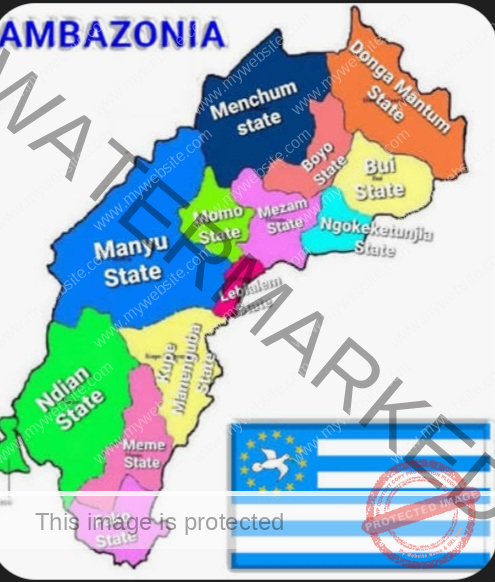
To understand the meaning of the name, one must look to the geography and history of the territory once administered as British Southern Cameroons. The term Ambazonia is commonly linked to Ambas Bay, the body of water in the Gulf of Guinea where British missionary and administrative presence developed in the nineteenth century.
The territory historically associated with Southern Cameroons lies between approximately latitude 3°57′ and 7°10′ N and longitude 8°42′ and 11°11′ E, bordered by Nigeria to the west and the Mungo River, often regarded historically as a boundary with La République du Cameroun (LRC).
The name Ambazonia was introduced in 1984 by Fon Fongum Gorji Dinka, a Cameroonian jurist and former president of the Cameroon Bar Association. His argument emerged after President Paul Biya’s 1984 decree changed the country’s name from the United Republic of Cameroon back to La République du Cameroun. Some Southern Cameroons activists interpreted this change as evidence that the federal union established in 1961 had effectively been dissolved. In that context, the name Ambazonia was proposed as a way to describe the distinct political identity of the territory.
Why the Name Ambazonia Matters to Many
For many advocates of the sovereignty movement, the adoption of the name Ambazonia serves several purposes.
First, it seeks to avoid confusion associated with administrative labels historically used within Cameroon. Terms such as “West Cameroon” or “North West and South West Regions” are seen by some activists as designations imposed during political restructuring in the 1970s and later decentralization reforms.
Second, the name attempts to affirm a distinct historical trajectory. Supporters argue that the former Southern Cameroons Trust Territory followed a different colonial and administrative path from that of French Cameroon.
Third, the use of a new name reflects a broader effort to assert identity in the face of perceived cultural and political assimilation.
Public Sentiment and the CiDi Survey
Debates over terminology continue within the broader community. Some prefer the historical name Southern Cameroons, while others favor Ambazonia as a symbol of a future political project.
A survey conducted by the Civil Initiative for Development with Integrity (CiDi) suggested that a significant portion of respondents favored the name Ambazonia when given the choice between the two terms. While interpretations of such surveys vary, the results indicate that the terminology debate resonates strongly among people concerned with the region’s political future.
The Legal Dimension
For many advocates, the dispute is not only political but also legal. Two international references are often cited in discussions about the status of Southern Cameroons.
UN General Assembly Resolution 1608 (XV), adopted in 1961, addressed the future of the British-administered territory following a UN-organized plebiscite. Supporters of the sovereignty argument contend that the implementation of this resolution did not result in a formally registered treaty of union between Southern Cameroons and the Republic of Cameroon.
Another frequently referenced document is Communication 266/2003 of the African Commission on Human and Peoples’ Rights, which acknowledged the existence of the people of Southern Cameroons as a “people” under the African Charter and affirmed their rights under international law, including the principle of self-determination.
Different political actors interpret these legal references in different ways, but they remain central to ongoing debates about the region’s status.
A Question of Identity
The current conflict has intensified discussions about identity, governance, and the future of the territory historically known as Southern Cameroons. For many supporters of the Ambazonian movement, the name represents the culmination of decades of political frustration and cultural assertion.
Across the world, similar processes have accompanied periods of political transformation. Countries such as Malawi, Zambia, Zimbabwe, Burkina Faso, and Eswatini all adopted new national names at pivotal moments in their histories, reflecting shifts in identity and political direction.
A Message to the Community
For many people in the homeland and the diaspora, the debate over names ultimately reflects a deeper search for dignity, recognition, and peace. Regardless of political positions, most share the hope that the region will move toward a future marked by justice, stability, and meaningful dialogue.
History shows that identity questions rarely disappear. They evolve, adapt, and often become part of broader negotiations about governance, coexistence, and the rights of communities.
For those who identify with the Ambazonian vision, the name represents a belief that their story, culture, and political aspirations deserve recognition. For others, the debate continues. What remains certain is that the discussion about identity, history, and self-determination will continue to shape the political landscape of the region for years to come.
Timothy Enongene, Guest Editor-in-Chief, The Independentistnews
Share This Post:
CAUTION: The Self-Defense Fighters in Bui and Momo – A Call for Reflection and Responsibility
False Flags and Counter-Insurgency: When Wars Are Fought in the Shadows
Related Post
IS THE WORLD LISTENING: THREE DAYS FOUR FRONTLINES, ASA
SEPTEMBER 24, 1965, THIS DAY IN HISTORY: From Equal
AMBAZONIA’S WAR- IS BIGGER THAN YAOUNDÉ: BRITAIN, FRANCE AND
THE DAY SEPTEMBER 22 1961: — WHAT AMBAZONIA CAN
TRUMP’S “SUPER INTELLIGENCE” ERA: WHAT IT REALLY MEANS —
Why Is Ambazonia More Powerful Than many Imagine.