



A Fon should be a custodian of ancestral authority, not an ambassador of political expediency. Let traditional rulers preserve their dignity. Let political representatives discharge their political responsibilities. Let the people exercise their right to determine their future.
By Lester Maddox
Guest Contributor
The Independentist News
Oakland, California
As Amazon associate this site earns from qualifying purchases
Buy your copies of books on the Ambazonian revolution by Martin Mungwa on Amazon
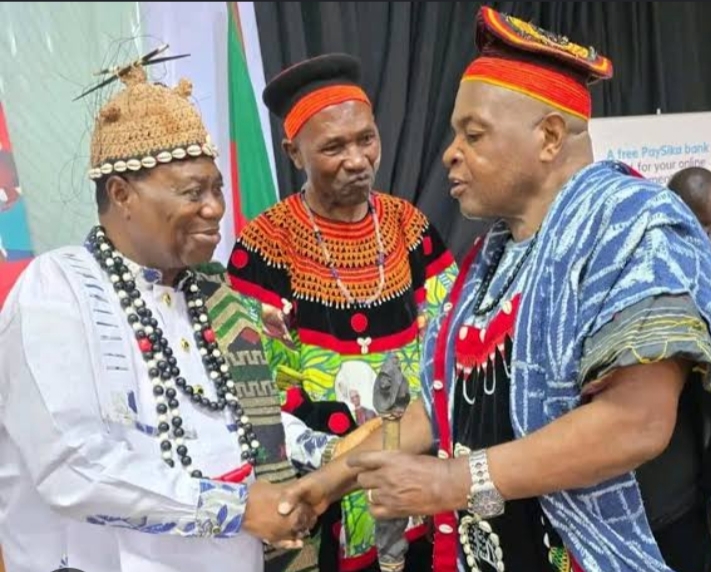
BUEA – 26 October 2026 – The controversy surrounding the Fon of Nso and the proposed community dialogue in Douala raises a fundamental question that every traditional ruler in Ambazonia must confront: Where does traditional authority end, and where does political interference begin?
A Fon or Chief derives his customary authority from his ancestral homeland, the traditions of his people, and the institutions that sustain his throne. He is not a national political representative merely by virtue of his traditional office. His legitimacy is rooted in a particular community, and his responsibilities must remain accountable to that community.
The throne is not a travelling political embassy. Neither is it an instrument that a government can summon whenever it wishes to manufacture the appearance of popular consent. Ancestral shrines, sacred forests, royal burial grounds, and other institutions of traditional authority are inseparable from the history and customs of the communities to which they belong. They cannot simply be relocated for political convenience.
A Fon may travel, seek refuge, or represent the welfare of his people beyond his homeland. But physical relocation does not automatically transfer the spiritual foundations, customary jurisdiction, or legitimacy of his throne to another territory. This distinction is particularly important in the case of the Fon of Nso.
At a time when the people of Nso continue to endure the devastating consequences of war, the Fon’s presence in Douala, within French Cameroun, raises uncomfortable questions about traditional responsibility, political accountability, and the moral obligations of leadership.
If a Fon is enthroned to serve his people, what happens when he is separated from them during their greatest suffering? How should the customary institutions of Nso respond to prolonged absence? And what authority does a ruler exercising his office away from his ancestral homeland possess to participate in a government-sponsored political dialogue concerning the future of Ambazonia? These are not questions of personal hostility. They go to the very foundations of traditional leadership.
Where circumstances prevent a Fon from exercising his customary responsibilities, the appropriate response must be determined by the traditions and legitimate institutions of his people, including any recognised arrangements for a regency.
The broader lesson, however, extends beyond Nso. Every Ambazonian Fon and Chief must understand that the throne belongs to the people and their ancestral institutions—not to the political authorities in Yaoundé.
TRADITIONAL RULERS MUST REMAIN IMPARTIAL
Traditional rulers are custodians of culture, history, ancestral institutions, and customary law. Their responsibilities transcend electoral cycles, political administrations, and the ambitions of individual politicians.
A Fon is expected to preserve the dignity of his throne, protect the welfare of his subjects, promote reconciliation, and uphold the traditions inherited from generations of ancestors. These responsibilities require impartiality.
When a traditional ruler allows himself to become visibly associated with a particular political agenda, he risks transforming an institution meant to unite his people into an instrument of division. The consequences can be particularly serious in a society experiencing armed conflict.
Families may hold different political views. Some may support independence, others may favour alternative political arrangements, while still others may be concerned primarily with security, survival, and the restoration of ordinary life. A legitimate traditional institution must remain capable of serving all these families without discrimination.
Impartiality, however, must never be confused with indifference. A Fon should speak when his people are killed, displaced, intimidated, or deprived of their livelihoods. A Chief should defend the safety of his community, the protection of ancestral lands, and the restoration of conditions in which families can live without fear.
But defending the welfare of the people is fundamentally different from lending the authority of the throne to a political programme designed by outside interests. A traditional ruler must be the guardian of his people, not the political messenger of a government. The dignity of the throne depends on that distinction.
THE FON OF NSO: WHEN ABSENCE BECOMES A QUESTION OF LEADERSHIP
The controversy involving the Fon of Nso must be examined within the realities of the ongoing war. The people of Nso have experienced displacement, insecurity, destruction, and profound disruptions to community life. Traditional leadership is therefore not merely a ceremonial matter. It carries a moral responsibility to remain connected to the suffering and aspirations of the people.
No reasonable observer should deny that a traditional ruler may face genuine threats to his personal safety. Seeking refuge during armed conflict is not, by itself, proof of cowardice or abandonment. Nevertheless, refuge cannot become an unquestionable substitute for responsibility.
The critical question is not simply where the Fon resides. It is whether he continues to discharge his customary duties, maintain the confidence of his people, and preserve the political independence of his traditional office. His participation in a proposed dialogue in Douala creates an additional concern.
If the Fon has left the homeland entrusted to his care because of the insecurity associated with the conflict, what makes a government-sponsored gathering outside that homeland an appropriate platform for resolving the grievances of the people he represents? Who authorised his participation? Whose interests will he defend?Can he independently challenge the authorities organising the dialogue?
And will his presence be portrayed as evidence that the people of Nso have accepted a political settlement they have never expressly authorised? These questions deserve answers before the dignity of the Nso throne is associated with any political initiative.
Leadership is not measured by proximity to government officials. It is measured by accountability to the people, especially when those people are suffering. A throne must never become more accessible to political authorities than to the community whose traditions give it legitimacy.
COMMUNITY DIALOGUE MUST NOT BECOME ANOTHER POLITICAL TRAP
The armed conflict between La République du Cameroun (LRC) and the Ambazonian independence movement cannot be reduced to a collection of disagreements among villages, clans, or traditional communities. The underlying dispute concerns the political status, historical identity, governance, and future of the former British Southern Cameroons.
Nso is not at war with Bafut. Bakweri is not at war with Meta. Bali is not fighting Kom. Nor is the central political dispute a quarrel among the traditional institutions of Ambazonia. It is a political conflict whose resolution requires confronting the questions that gave rise to it.
The 2019 Major National Dialogue did not produce an accepted settlement of the fundamental dispute. Consequently, any new initiative promoted as community dialogue must be examined with considerable caution. The mere presence of Fons, Chiefs, elders, religious leaders, and community representatives does not establish that a credible political process is underway.
A government can assemble traditional dignitaries in a conference hall, display photographs of their participation, issue declarations about reconciliation, and still leave the central causes of a conflict untouched. That is the danger. A meeting may be presented as a peace initiative while functioning politically to create an impression of consultation, legitimacy, or agreement.
Traditional rulers should therefore ask difficult questions before accepting invitations to such gatherings: Who designed the dialogue, and who controls its agenda? Are the affected communities genuinely represented? Can participants freely challenge the underlying government policies? Will the central political dispute be addressed? What guarantees exist that participation will not be misrepresented as political consent? Who has the authority to negotiate and accept any resulting political settlement?
Without credible answers, the participation of traditional rulers risks becoming a ceremonial endorsement of a predetermined agenda. Peace cannot be manufactured through photographs of traditional rulers seated around a conference table. A meaningful peace process requires legitimate representation, substantive negotiations, accountability, and a willingness to confront the causes of the conflict.
FONS AND CHIEFS HAVE CUSTOMARY AUTHORITY, NOT AN UNRESTRICTED NATIONAL MANDATE
Every traditional ruler must respect the distinction between customary jurisdiction and national political representation. A Fon of Nso exercises traditional authority according to Nso customs. A Fon of Bafut derives his customary legitimacy from Bafut institutions. The same principle applies to the traditional rulers of Kom, Bali, Bakweri, Manyu, and other Ambazonian communities.
Their respective authority cannot simply be expanded into a collective national political mandate because an external government has invited them to a meeting. Traditional rulers may consult one another, cooperate across customary boundaries, advocate for humanitarian protection, and contribute to reconciliation.
But none of these activities automatically confers authority to determine the political future of the entire Ambazonian people. National political questions require legitimate political representation and a credible process through which the population can exercise its right to determine its future. Traditional institutions should contribute to the protection and healing of society without being converted into substitutes for political representation. This distinction must remain clear.
A government seeking a national political settlement should engage the relevant political parties and representatives through an appropriately mandated process. It should not assume that assembling traditional rulers amounts to securing the consent of the population.
A Fon may speak for the customary interests of his community within the authority recognised by its traditions. He cannot automatically surrender the political rights of an entire people. That is a boundary every traditional ruler must respect.
TO ALL AMBAZONIAN FONS AND CHIEFS: PROTECT YOUR THRONES
The message to Ambazonian traditional rulers is straightforward. Remain faithful to the ancestral institutions from which your authority originates. Respect the territorial and customary limits of your office. Protect your communities from political manipulation. Do not allow ceremonial recognition, government invitations, financial inducements, or promises of influence to compromise the independence of your throne.
Traditional institutions existed before many of today’s political arrangements. Their legitimacy should not be sacrificed to satisfy the temporary objectives of those holding governmental power. The responsibility of a Fon or Chief is especially demanding during war. When people are displaced, advocate for their safe return.
When ancestral lands are threatened, defend the customary rights of the community. When families are divided, promote reconciliation. When civilians face abuse, demand their protection. When political authorities seek to use traditional institutions for partisan purposes, insist on transparency, independence, and accountability. Above all, remember that the community is the foundation of traditional authority.
A ruler who loses the confidence of his people cannot recover it merely through recognition from distant political offices. The throne must never be treated as a political appointment whose loyalty can be transferred from the ancestral community to the government of the day. Traditional authority survives through the confidence of the people, not the approval of political patrons.
BUEA REPRESENTS THE RESTORATION OF SELF-GOVERNMENT
For Ambazonians committed to independence, Buea is more than a city. It represents the historical institutions of Southern Cameroons self-government and the continuing aspiration to determine the territory’s political future. That historical and political question cannot be settled through isolated community meetings organised outside the territory while the underlying dispute remains unresolved.
The aspiration for self-government is not a disagreement among traditional rulers. Neither can it be reduced to a dispute over chieftaincy, customary jurisdiction, or local community relationships. It concerns the political future of a people. Whether the final resolution emerges through negotiations, internationally supported mechanisms, or another credible political process, it must rest on legitimate representation and meaningful respect for the aspirations of the affected population.
Traditional rulers have an important contribution to make. They can help restore trust, protect cultural institutions, support displaced families, and facilitate reconciliation among communities affected by the war. But they must not confuse these responsibilities with authority to determine national political status.
For those who identify Buea with the restoration of Ambazonian self-government, that aspiration cannot be extinguished by presenting a collection of community dialogues as a substitute for a political settlement. The road to a lasting peace must address the political dispute itself—not merely create the appearance that traditional communities have reconciled.
CONCLUSION: PROTECT THE THRONE, PROTECT THE PEOPLE
To every Ambazonian Fon and Chief, the warning is clear: Stay within the boundaries of your customary authority, and keep your throne out of partisan political manipulation. Your ancestral homeland is the foundation of your traditional legitimacy. Your people are the source of your responsibility. Your customs and institutions define the authority entrusted to you. Do not mistake invitations from political officials for mandates from your communities.
Do not allow participation in government-sponsored gatherings to be presented as the consent of people who have never authorised you to negotiate their political future. And do not permit the dignity of centuries-old institutions to be reduced to ceremonial decoration for contemporary political agendas.
The controversy surrounding the Fon of Nso offers an important lesson. A traditional ruler separated from his ancestral homeland may face extraordinary challenges. Those circumstances deserve understanding. But they also demand accountability, transparency, and an unwavering commitment to the people whose throne he occupies.
Seeking safety is understandable. Allowing political authorities to exploit the dignity of a traditional institution is another matter entirely. The people need traditional rulers who will protect their communities, defend their heritage, and stand above partisan interests. They do not need thrones transformed into extensions of the political machinery responsible for organising the next dialogue.
A Fon should be a custodian of ancestral authority, not an ambassador of political expediency. Let traditional rulers preserve their dignity. Let political representatives discharge their political responsibilities. Let the people exercise their right to determine their future.
And let no one confuse the presence of a Fon in Douala with the political consent of Ambazonia.The throne belongs to the people and their ancestral institutions. It must never become a bargaining chip in the hands of those who seek political convenience at the expense of a lasting and legitimate peace.
As Amazon associate this site earns from qualifying purchases
Buy your copies of books on the Ambazonian revolution by Martin Mungwa on Amazon
Lester Maddox
Guest Contributor
The Independentist News