











THE INDEPENDENTIST NEWS BOOK REVIEW | POLITICS, HISTORY & CONFLICT RESOLUTION 18 November 2026
Forward: By Ali Dan Ismael senior Editor-in-chief The Independentist News
As Amazon associate this site earns from qualifying purchases
Follow the Amazon link below to get your copies of the many publications on the Ambazonian revolution By Martin Mungwa
History has repeatedly demonstrated that political conflicts cannot be resolved by deliberately avoiding the fundamental questions that produced them. The Southern Cameroons–Ambazonia conflict is no exception.
For years, conferences, consultations, political declarations, and competing peace initiatives have attempted to address the crisis. Yet one question remains central to any meaningful discussion of peace: Who declared war on whom, and who therefore bears responsibility for entering negotiations capable of ending it?
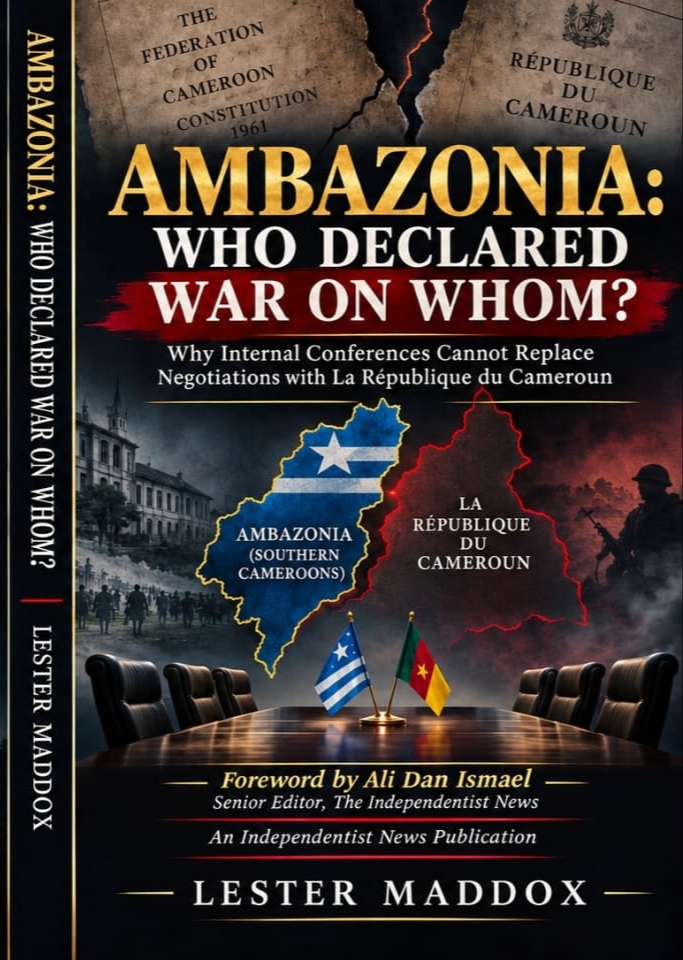
This is the question Lester Maddox places at the heart of his new book, Ambazonia: Who Declared War on Whom? The significance of this work lies not merely in its forceful language but in its insistence that the architecture of peace must correspond to the actual structure of the conflict.
A conference among Ambazonians may help reconcile political differences, establish representative institutions, or formulate a common negotiating position. But internal agreement alone cannot produce a binding political settlement with the government of La République du Cameroun. That distinction is fundamental.
The people of Southern Cameroons have experienced decades of constitutional controversy, political marginalization, and disputes concerning the legitimacy of their relationship with the Republic of Cameroon. These issues cannot simply be reduced to disagreements among Anglophone political personalities.
Nor can they be satisfactorily addressed through ceremonies of national dialogue in which the underlying political questions remain unresolved.
Maddox challenges readers to distinguish political participation from meaningful negotiation, consultation from consent, and declarations of peace from enforceable agreements.
His argument carries a wider lesson for African conflict resolution: sustainable peace requires the identification of legitimate negotiating parties, recognition of disputed political grievances, credible mediation, and mechanisms through which agreements can be implemented and verified.
As Senior Editor of The Independentist News, I believe serious political writing should challenge established assumptions, invite critical examination, and contribute to informed public debate.
This book deserves attention because it asks readers to evaluate peace initiatives not by the number of conferences convened or communiqués issued, but by whether they address the parties, causes, and conditions necessary for a durable settlement.
Whether readers agree with every conclusion or not, the central questions raised by Lester Maddox should not be avoided. Peace cannot become a substitute for justice, and dialogue cannot become a substitute for negotiation.
Ali Dan Ismael
BOOK REVIEW
A War That Cannot Be Negotiated Away Through Internal Conferences.
At a time when the Southern Cameroons–Ambazonia conflict continues to generate competing political initiatives, Lester Maddox presents a sharply argued intervention in one of the most consequential debates surrounding its future.
His new book, Ambazonia: Who Declared War on Whom?, challenges an assumption that has influenced numerous efforts to address the conflict: that internal conferences among Ambazonians can somehow substitute for negotiations between the principal adversarial parties.
The book’s defining proposition is direct: “Ambazonians can prepare for negotiations, but they cannot negotiate a settlement with themselves.”
This statement, prominently featured on the back cover, captures the political reasoning behind the work. Maddox does not dismiss internal political organization or the importance of consensus. Instead, he questions whether such activities can accomplish what requires the participation of the opposing party to the conflict. It is this distinction that gives the book its immediate political relevance.
Returning to the Question of Responsibility
- One of the book’s strongest conceptual features is its decision to return the debate to the question of political responsibility.
On 30 November 2017, President Paul Biya publicly announced a military response to separatist fighters following escalating violence in the Anglophone regions. For Maddox, this development raises an important question about the nature of subsequent peace initiatives.
If an armed confrontation involves identifiable adversaries, can the conflict realistically be settled by convening consultations that do not provide a negotiating role for those adversaries? The question is politically uncomfortable, but its relevance is difficult to dismiss.
At the same time, historical accuracy requires distinguishing the November 2017 declaration from the earlier origins of the Anglophone crisis and the violence that preceded it. The broader conflict involves a complex sequence of political decisions, protests, repression, armed mobilization, and actions by multiple actors.
The strength of Maddox’s approach is that it encourages examination of responsibility rather than allowing the chronology of the conflict to disappear beneath competing political narratives.
- The Constitutional Foundations of the Conflict
Another important dimension of the book is its attention to the constitutional and historical foundations of the Southern Cameroons question. The dispute cannot be understood exclusively through developments after 2016.
Its historical foundations extend to the 1961 political arrangements, the federation established between the former Southern Cameroons and the Republic of Cameroon, the constitutional changes of 1972, and subsequent disputes concerning the character of the state.
Maddox’s treatment, as described in the book’s presentation, places these developments within the broader question of political legitimacy. This is essential because a durable settlement requires more than an agreement to stop fighting.
It requires a credible process for addressing the constitutional, institutional, and political grievances that helped produce the conflict.
The historical arguments surrounding the 1961 federation and its later transformation remain contested. A rigorous evaluation must distinguish documented constitutional developments from differing interpretations of their legal significance.
Nevertheless, the decision to locate the present crisis within its historical setting strengthens the book’s analytical framework.
- The Limitations of Internal Political Conferences
Perhaps the book’s most politically consequential argument concerns the proliferation of conferences and consultations organized among Ambazonians.
Maddox challenges the tendency to present such meetings as substitutes for negotiations with the government of Cameroon. His position is not that internal dialogue lacks value.
Indeed, political movements facing fragmentation can benefit from internal consultations aimed at improving coordination, identifying representatives, establishing negotiating priorities, and reducing internal mistrust. It cannot, acting alone, secure the other party’s acceptance of those demands.
An internal conference may establish a delegation. It cannot, acting alone, guarantee that the opposing government will recognize that delegation. An internal conference may adopt a peace resolution. It cannot, acting alone, establish mutually accepted and enforceable arrangements for ending hostilities.
This distinction is among the most persuasive arguments presented in the book’s description. Internal political coordination may be necessary for effective negotiation, but it is not equivalent to negotiation itself.
- Political Representation and the Problem of Legitimacy
The question of representation remains one of the most difficult challenges confronting the Southern Cameroons–Ambazonia political movement. Who speaks for the population? Who possesses a legitimate mandate? How should political organizations, civil society, traditional institutions, affected communities, and armed actors participate in a credible peace process? These are questions that cannot be answered simply by convening another conference.
Maddox’s emphasis on credible representation is therefore particularly important. Political legitimacy cannot be established exclusively through declarations of authority. It requires recognizable procedures, public accountability, and sufficient confidence among those whose interests negotiators claim to represent.
Any credible negotiation framework must also consider the views of civilians, displaced populations, victims of violence, and communities whose political aspirations may differ.
The principle is straightforward: a peace process should not confuse the loudest political voices with the full range of people affected by the conflict. A more representative process would improve the prospects for an agreement that possesses both political credibility and public acceptance.
- The Case for Independent Mediation
The book’s argument for credible, independently mediated negotiations addresses another central challenge. When political adversaries possess incompatible understandings of the conflict, direct negotiations can become difficult to initiate and sustain.
Independent mediation may provide a framework for establishing procedures, defining negotiating issues, improving communication, and monitoring compliance with agreed commitments. However, mediation must be more than a diplomatic label.
Its credibility depends on the acceptance of the parties, transparency concerning its mandate, and the existence of practical mechanisms through which agreements can be implemented.
A meaningful settlement process would need to consider civilian protection, humanitarian access, security arrangements, political and constitutional questions, and the verification of commitments. Maddox’s insistence on an independently mediated process therefore raises an important question for every institution claiming to promote peace:
Is the proposed initiative designed to produce a negotiated political settlement, or merely to create the appearance of political engagement? This is a legitimate question that policymakers, mediators, civil society organizations, and international observers should examine seriously.
- Beyond Political Rhetoric: What Makes a Settlement Durable?
An important implication of Maddox’s argument is that a ceasefire, a political conference, and a durable settlement are not interchangeable. A ceasefire may reduce immediate violence. A conference may facilitate discussion. A negotiated agreement may establish political commitments. ;But durable peace requires institutions and procedures capable of sustaining those commitments beyond the initial announcement.
The broader peacebuilding literature repeatedly emphasizes implementation, monitoring, public legitimacy, and mechanisms for resolving disputes that arise after an agreement has been signed. A political settlement that lacks credible enforcement or verification mechanisms may fail even when the parties publicly endorse it.
This makes Maddox’s focus on the structure of negotiations especially relevant. It shifts attention from the symbolism of dialogue to the conditions under which political agreements can become operational.
- The Book’s Intellectual Contribution
The principal contribution of Ambazonia: Who Declared War on Whom? is its distinction between internal political preparation and external conflict settlement. This distinction deserves greater attention within discussions of the Southern Cameroons crisis.
The book also challenges a broader tendency in political discourse to measure progress through meetings, declarations, diplomatic visits, and public ceremonies rather than through demonstrable changes in the conditions producing conflict. Its accessible language makes it relevant beyond academic audiences.
Political leaders, journalists, civil society advocates, students of African politics, diaspora communities, and conflict-resolution practitioners may all find value in the questions it raises. The book’s advocacy-oriented framing is also a limitation readers should recognize. Its central thesis is forceful, but the full persuasive weight of the argument depends on the evidence, treatment of competing interpretations, and practical negotiating proposals developed within the chapters.
A comprehensive scholarly judgment would therefore require examination of the complete manuscript and its sources. Nevertheless, the central proposition presented in the book is sufficiently important to merit serious public discussion.
- Why This Book Matters Now
The Southern Cameroons–Ambazonia conflict has produced extensive human suffering, displacement, educational disruption, economic hardship, and political uncertainty. Yet the search for a credible settlement remains deeply contested. It is within this context that Maddox’s book enters the public debate.
Its message is that political conferences should be judged according to their actual function. If their purpose is reconciliation among political organizations, they should be assessed on whether they improve internal cooperation.
If their purpose is preparation for negotiations, they should be assessed on whether they establish credible representation and coherent negotiating positions.
But if they claim to settle a conflict without the meaningful participation of the parties whose actions and political decisions sustain it, their limitations must be acknowledged.This is the central challenge the book presents.
THE INDEPENDENTIST NEWS VERDICT
Ambazonia: Who Declared War on Whom? is a provocative and timely contribution to the political debate surrounding the Southern Cameroons–Ambazonia conflict.
Its greatest strength is the clarity of its central argument: a political community may organize internally, but it cannot unilaterally negotiate a binding settlement with an absent adversary.
By placing responsibility, constitutional history, political representation, and credible mediation at the center of the discussion, Lester Maddox advances a framework that deserves examination by policymakers, political organizations, researchers, and international mediators.
The book does not need to command universal agreement to make a meaningful contribution. Its value lies in compelling readers to confront questions too often obscured by political rhetoric and competing declarations of legitimacy.
The fundamental lesson is that preparing for peace and negotiating peace are different political undertakings. Both may be necessary, but neither should be confused with the other.
Final Editorial Assessment
A compelling political intervention with a clear central thesis, considerable contemporary relevance, and the potential to stimulate a more substantive debate on conflict resolution.
Its eventual scholarly standing will depend on the depth of historical evidence, engagement with alternative interpretations, and practical proposals contained in the complete manuscript.
Editorial note: This preliminary review is based on the book’s publicly presented description, cover, and central argument. It should not be represented as an independent evaluation of the complete manuscript.
Ali Dan Ismael
Senior Editor
The Independentist News
18 November 2026




Leave feedback about this