












Ambazonia’s future must not be planned in separate rooms. It must be conceived, financed, engineered, regulated, and governed as one integrated national system. Political freedom may open the door to nationhood. Only disciplined, integrated, sustainable, and people-centered development will enable a nation to walk successfully through it.
By Martin S. Mungwa, PhD, MBA, P.E., F.ASCE
Architectural/Civil/Structural Engineer and Fellow of the American Society of Civil Engineers
The views expressed in this article constitute a national-development proposal derived from the framework presented in Ambazonia 2050 & Beyond. They should not be interpreted as formally adopted government policy.
Part I established that housing, transportation, healthcare, energy, education, industry, land use, environmental resilience, and public finance cannot be governed successfully as disconnected sectors. Part II applies that principle to Bamenda and identifies some of the regulatory, financial, and institutional structures Ambazonia will require to convert integrated planning from an aspiration into an operating system of government.
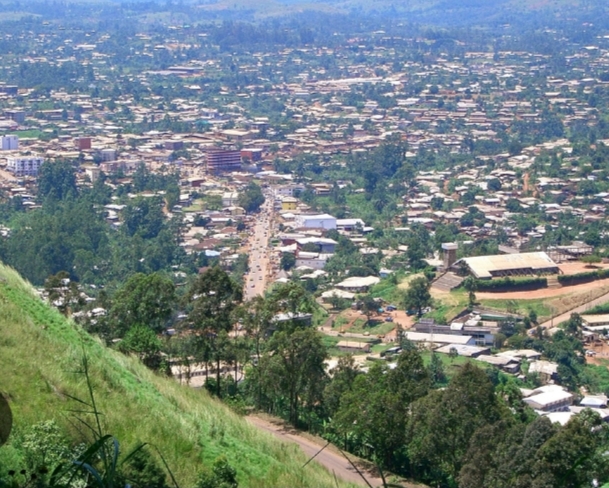
Bamenda provides a compelling demonstration of why Ambazonia cannot plan reconstruction, infrastructure, housing, land, public health, education, energy, enterprise, security, and finance in separate rooms.
Historically an important commercial, agricultural, educational, and transportation center, Bamenda and its surrounding economy have been severely weakened by prolonged conflict, insecurity, deteriorating infrastructure, disrupted trade, declining investment, and the displacement of people and enterprises.
Its revival cannot be achieved through isolated projects. Reconstructing a few roads without restoring markets, energy, housing, security, healthcare, education, finance, and regional trade might improve appearances, but it would not rebuild the economic system.
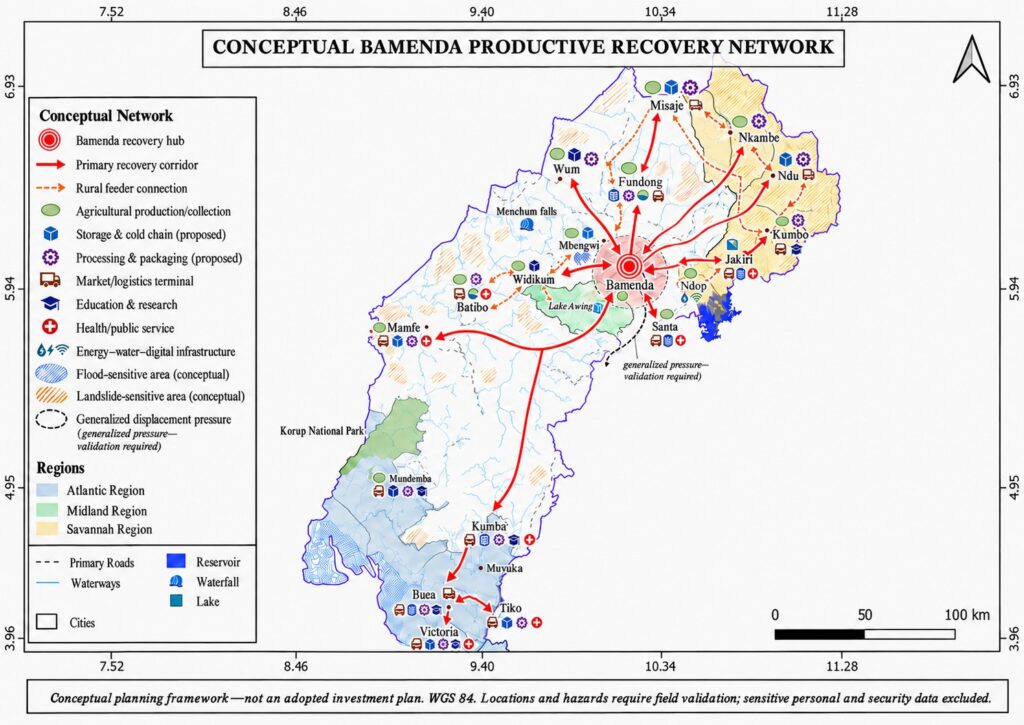
Bamenda requires an integrated recovery strategy connecting its productive hinterland, institutions, businesses, human capital, and commercial networks to national and international markets.
Reconnecting Agriculture, Transportation, and Markets
Transportation must be coordinated with agriculture and commerce. Rehabilitated roads should connect farmers in surrounding counties and LGAs to collection centers, storage facilities, food-processing industries, markets, and national distribution corridors.
Better mobility would reduce post-harvest losses, lower transportation costs, stabilize food supplies, expand rural incomes, and restore Bamenda’s role as an important center of agricultural trade.
A road becomes economically valuable not simply because vehicles can travel upon it, but because it reduces the distance between production and opportunity. It must connect farms to storage, storage to processing, processing to markets, and markets to consumers.
Transportation planning should therefore be accompanied by agricultural extension, rural finance, crop insurance, digital market information, cold storage, processing capacity, dependable energy, and quality-control systems. Otherwise, new roads may simply accelerate the movement of unprocessed commodities without creating sufficient local value.
The objective should not be merely to move agricultural products out of rural communities. It should be to build value chains that retain a greater share of processing, employment, enterprise ownership, and commercial wealth within Ambazonia.
Bamenda can become the organizing center of an integrated agricultural ecosystem connecting rural production, research institutions, financial services, transportation, logistics, storage, processing, packaging, distribution, and export markets.
Rebuilding Communities, Not Merely Houses
Housing reconstruction must be planned together with water, sanitation, drainage, healthcare, schools, security, transportation, digital connectivity, employment, and public space.
Families returning to damaged or rapidly expanding communities should not be placed in settlements disconnected from jobs and essential services. New and rehabilitated neighborhoods must become healthy, accessible, secure, and productive communities—not dormitories of unemployment and deprivation.
Housing is also health infrastructure. A home without clean water, adequate sanitation, ventilation, drainage, waste management, structural safety, and protection from extreme weather is not merely inadequate housing. It is a public-health risk.
Bamenda’s reconstruction must therefore improve the entire community ecosystem rather than merely replace individual structures.
Public spaces, local markets, walkable streets, drainage, public transportation, schools, healthcare facilities, recreation, digital connectivity, and small-business locations should be planned as integral parts of every major settlement.
Reconstruction should also create opportunities for local contractors, artisans, engineers, architects, construction workers, suppliers, and small enterprises. Housing investment should build national technical capacity and circulate money through local productive networks rather than relying excessively upon imported systems that create little domestic competence.
Ambazonia Must Adopt a Comprehensive National Building Code
Integrated development requires a coherent, modern, and enforceable construction code. Ambazonia should not enter nationhood with fragmented colonial regulations, improvised municipal rules, inconsistent enforcement, or technical standards that address structural calculations without establishing a complete building-regulation system.
Ambazonia should adopt and localize the International Building Code, together with the appropriate companion International Codes, as the foundation of an Ambazonian national building-regulatory framework.
The principal advantage of the IBC is not merely its technical treatment of structural safety, fire protection, occupancy classifications, accessibility, means of egress, materials, and building systems. It also provides a model for administering and enforcing those requirements.
Its administrative framework addresses the authority and responsibilities of building officials, review of construction documents, permits, inspections, approvals, certificates of occupancy, violations, stop-work orders, appeals, and alternative materials and methods.
These provisions connect engineering requirements to public accountability. A technical standard has limited public value if no institution is authorized to review designs, issue permits, inspect construction, prevent unsafe occupancy, correct violations, and determine responsibility when failures occur.
A building code must answer several fundamental questions:
Who is legally qualified to prepare and approve construction documents? Who reviews those documents? Who issues permits? Who inspects construction? Who can stop unsafe work? When may a completed building be occupied? What happens when owners, contractors, or professionals violate the code? How may administrative decisions be appealed? Without clear answers, technical standards remain largely voluntary.
Why the Eurocodes Alone Are Insufficient
The Eurocodes are internationally respected and technically sophisticated standards for structural and geotechnical design. They provide valuable methods for evaluating structural safety, serviceability, durability, and reliability. They may therefore remain useful technical references where properly adapted.
However, the Eurocodes alone do not constitute a complete national building-administration system. They are principally structural-design standards rather than an integrated framework governing planning approval, building permits, professional responsibility, inspections, occupancy, enforcement, appeals, alterations, maintenance, and demolition.
The choice should not be presented as a rejection of European structural-engineering knowledge. It is a question of regulatory completeness and national suitability.
Ambazonia needs more than calculations showing whether structural members can resist specified loads. It requires a complete building-regulatory system that connects planning, design, professional responsibility, permitting, construction, inspection, fire safety, accessibility, occupancy, alteration, maintenance, enforcement, and—where necessary—demolition.
For this reason, a localized IBC-based framework would provide a more appropriate primary foundation for Ambazonia than reliance upon the Eurocodes alone.
The International Building Code should not be treated as an untouchable foreign document. It should provide the organizational and administrative foundation from which Ambazonia develops a code suited to its climate, economy, institutions, construction practices, and constitutional structure.
Localization Is Essential
Adopting the IBC should not mean copying a foreign model without adaptation. Ambazonia should establish an Ambazonia National Building Code Commission to review, localize, publish, administer, and periodically update the code.
The localized framework must respond to national conditions, including tropical rainfall, flooding, landslide exposure, coastal corrosion, strong winds, seismic hazards, soil conditions, fire-service capacity, construction skills, locally available materials, traditional building practices, housing affordability, incremental construction, and county and LGA administrative capacity.
It should establish uniform minimum national requirements while allowing counties and LGAs to adopt stronger provisions where documented local hazards justify them.
The national framework should provide for: Licensing and accountability standards for architects, engineers, contractors, inspectors, developers, and other construction professionals. Independent plan review and inspection for major, complex, high-occupancy, or high-risk structures. Transparent digital permitting systems with clearly published requirements, fees, responsibilities, and approval timelines. Mandatory inspections at critical stages of construction. Certificates of occupancy before completed buildings enter public use. Enforcement against unauthorized construction, unsafe alterations, professional negligence, corruption, and the use of substandard materials.
Appropriate provisions for existing buildings, informal settlements, heritage structures, affordable housing, and incremental construction. Procedures for approving safe alternative materials, innovative technologies, and locally developed construction methods.
Accessible appeal procedures protecting citizens and professionals from arbitrary administrative decisions. Periodic review so the code evolves with technology, climate risk, national experience, and advances in construction knowledge.
National adoption must also be legally precise. Administrative provisions cannot simply be assumed. Ambazonia must enact the necessary clauses expressly, define the authority of each level of government, and establish how enforcement responsibilities will be financed.
A national building code is not merely an engineering manual. It is an instrument of public health, disaster prevention, economic development, professional accountability, environmental resilience, property protection, and confidence in government.
Ambazonia must not only determine how buildings should be designed. It must establish who approves them, who inspects them, who may occupy them, who answers when standards are violated, and how citizens can appeal administrative decisions.
Governing Land Transparently
Land-use planning must protect agricultural land while identifying appropriate areas for housing, commerce, industry, logistics, education, recreation, transportation, and environmental conservation.
Uncontrolled development would reproduce congestion, flooding, land disputes, unsafe construction, displacement, and inequality. Transparent planning, lawful land administration, public consultation, and protection of customary rights must guide Bamenda’s expansion and national development.
Integrated planning must never become an excuse for arbitrary land acquisition, forced displacement, cultural erasure, or the marginalization of host communities.
Major projects should require transparent land records, meaningful public consultation, fair and timely compensation, independent appeals, protection of legitimate customary rights, and community participation in the benefits created by development.
Traditional institutions should participate in matters involving customary land, sacred sites, cultural heritage, and community identity. Their participation must operate within the Constitution, transparent procedures, and the equal rights of all citizens.
Infrastructure should connect communities to prosperity—not remove communities from their inheritance without justice.
Powering Production and Innovation
Reliable energy must support more than household lighting. It should power cold-storage facilities, workshops, hospitals, universities, food-processing plants, markets, digital enterprises, transportation systems, and small industries. Bamenda’s young and educated population cannot participate fully in a modern economy without dependable electricity and digital connectivity.
Universities, technical colleges, vocational centers, research institutions, financial organizations, and industries should form an innovation and skills ecosystem. Young people should be educated not merely to obtain certificates, but to solve practical problems in agriculture, construction, energy, healthcare, manufacturing, technology, transportation, and public administration. Education becomes more valuable when it produces competence, enterprise, invention, employment, and public problem-solving capacity.
The revival of Bamenda should therefore include a deliberate relationship between educational institutions and the productive economy. Training programs should respond to identified national and regional needs. Students should gain practical experience through industry partnerships, applied research, apprenticeships, public projects, and enterprise development.
A university should not operate as an island surrounded by unemployment. It should become an engine connecting knowledge to production and young people to opportunity.
Climate Ambition Requires Financial Architecture
Climate adaptation cannot remain a collection of aspirations written separately from fiscal policy. Flood control, coastal protection, resilient agriculture, forest conservation, drainage, emergency preparedness, water security, heat management, and stronger construction standards require sustained financing. They also create long-term operation, inspection, insurance, maintenance, and renewal obligations.
A government that promises resilience without identifying how construction, operation, monitoring, maintenance, and replacement will be financed has not produced a climate strategy. It has produced an unfunded declaration. Ambazonia must integrate climate risk into taxation, budgeting, infrastructure design, insurance, land valuation, municipal finance, capital programming, and national debt management.
Every major public project should identify its financing source, lifecycle cost, maintenance responsibility, climate-resilience requirements, implementation authority, anticipated economic return, and measurable public benefit. A responsible national investment principle should therefore be established:
No major public project should enter the national investment program without an identified funding source, lifecycle-cost assessment, maintenance plan, resilience review, implementation responsibility, and measurable public benefit.
Climate adaptation is not a separate environmental concern. It is a matter of national security, food security, fiscal stability, public health, infrastructure protection, and intergenerational justice.
Financing the Entire Lifecycle
Too many governments celebrate the construction of infrastructure while neglecting its operation and maintenance. Political credit is obtained when a project is commissioned, while future administrations and citizens inherit the cost of deterioration. Ambazonia must reject this culture.
Every major investment should be evaluated across its entire lifecycle: planning, land acquisition, design, financing, construction, commissioning, operation, inspection, maintenance, rehabilitation, and eventual replacement.
A project that cannot be maintained is not affordable merely because its initial construction cost can be financed. Public authorities should publish lifecycle-cost assessments and identify the agency legally and financially responsible for maintaining each asset. Maintenance funds should be protected from routine political diversion, and performance information should be available to citizens. Public investment must produce durable value, not ceremonial openings followed by institutional abandonment.
Federalism Must Define Who Does What
Integrated planning must not become excessive centralization. Ambazonia’s federal architecture should distribute responsibility clearly while requiring coordination across every level of government.
The federal government should establish national standards, strategic corridors, financing frameworks, major infrastructure priorities, building-code requirements, national security standards, and systems extending across county boundaries.
County governments should coordinate regional development, inter-LGA transportation, healthcare networks, environmental management, economic clusters, code-administration support, and projects covering multiple local jurisdictions.
LGAs should oversee local land use, development control, markets, community roads, sanitation, neighborhood services, building permits, inspections, and locally accountable implementation—subject to national standards and professional-capacity requirements.
Traditional institutions should participate in customary-land matters, heritage protection, community consultation, and cultural preservation within the Constitution and the equal rights of citizens.
This distribution of authority would permit national integration without erasing local government. Federalism would become an operating system for coordinated development—not merely a political formula for distributing offices.
Where an LGA lacks sufficient technical capacity to administer complex building permits or infrastructure programs, county or federal institutions should provide professional assistance. Decentralization must not become abandonment, and national standards must not become an excuse for unnecessary central control.
From Separate Ministries to National Missions
Integrated planning requires a transformation in the culture of government. Ministries must not become isolated bureaucratic kingdoms defending their budgets and institutional territory. They must function as coordinated instruments of national missions.
A national housing program should involve transportation, health, water, sanitation, energy, education, finance, employment, building regulation, local government, and environmental planning.
An agricultural strategy should incorporate roads, storage, processing, insurance, research, trade, land tenure, water, finance, energy, and digital services.
A national climate program should involve public finance, engineering, national security, agriculture, healthcare, housing, insurance, construction regulation, and emergency management.
This approach does not eliminate institutional specialization. It gives specialization a common purpose.
Architects, engineers, economists, physicians, planners, environmental scientists, educators, investors, traditional authorities, entrepreneurs, and community representatives must work within a shared national framework.
Budgets should therefore be aligned around measurable national missions rather than developed solely through isolated ministerial requests. Agencies participating in the same mission should share targets, timelines, data, and accountability.
A National Development and Systems Planning Council
To translate this philosophy into practice, Ambazonia should consider establishing a professionally led and constitutionally accountable National Development and Systems Planning Council.
The council would not replace elected institutions, ministries, counties, or LGAs. Its responsibility would be to coordinate long-term planning across them.
It could align national, county, and LGA development plans; evaluate major infrastructure proposals; coordinate capital budgeting and project sequencing; assess lifecycle costs and climate risks; mobilize diaspora expertise and investment; and publish measurable performance standards.
Its membership should reflect competence, integrity, territorial diversity, professional knowledge, community participation, and constitutional accountability. Its major plans and evaluations should be publicly available so citizens can distinguish genuine national investment from politically convenient announcements.
The proposed National Building Code Commission could work within or alongside this broader framework while retaining the specialized professional authority required to regulate construction.
Neither institution should become an unelected government or a shelter for political patronage. Elected authorities must retain constitutional decision-making power. The purpose of professional planning institutions is to ensure that political choices are informed by reliable evidence, technical competence, lifecycle costs, and transparent public objectives.
Bamenda as a National Demonstration
Bamenda’s recovery should become one of Ambazonia’s first integrated development demonstrations—a practical model capable of adaptation to other cities, counties, and productive corridors.
The mission should bring together federal planning institutions, county and LGA authorities, traditional institutions, businesses, universities, professional associations, community organizations, financial institutions, and the diaspora.
Government can provide standards, infrastructure, security, and coordination. Lasting recovery will also require local enterprise, private investment, professional expertise, public trust, and community participation.
The objective should not merely be to restore Bamenda to what it was before the conflict. It should be to create a safer, more productive, better-connected, and climate-resilient economic center—linked to Buea’s constitutional and knowledge institutions, Victoria and Tiko’s maritime and industrial systems, Kumba’s commercial networks, Mamfe’s gateway position, and the productive capacities of every county.
Bamenda’s revival should be evaluated through measurable results: restored mobility, reduced post-harvest losses, increased local processing, improved electricity reliability, expanded employment, safer housing, better public health, stronger educational outcomes, greater enterprise formation, improved municipal revenue, and broader community ownership.
Bamenda’s revival must not be planned merely as the recovery of one city or region. It should demonstrate how Ambazonia can transform reconstruction into production, production into shared prosperity, and shared prosperity into durable national unity.
Independence Must Not Precede Thought
Some may argue that it is too early to discuss transportation, housing, energy, construction codes, land use, healthcare, sustainability, and public finance while the struggle for political sovereignty remains unresolved. That reasoning reverses the proper order of nation-building.
The period before sovereignty is precisely when a national movement must demonstrate that it understands the responsibilities of sovereignty. Independence should not be treated as the moment when serious planning begins. It should be the moment when carefully developed plans acquire the constitutional authority and institutions required for implementation.
Ambazonia cannot afford to win the political argument for self-determination and then lose the developmental argument for competent government.
Planning now does not mean pretending that independence has already been achieved. It means developing the knowledge, human capital, codes, institutional designs, investment priorities, and implementation frameworks needed to reduce confusion when political conditions change. A people prepared only to protest may achieve attention. A people prepared to govern can build a nation.
The Integrated Vision of Ambazonia 2050 & Beyond
Ambazonia 2050 & Beyond is founded upon the proposition that a nation must be designed as a living and interconnected system. Every road influences housing. Every settlement affects health. Every energy decision shapes mobility. Every land-use decision influences employment. Every building code affects public safety and economic confidence. Every climate risk carries a fiscal consequence. Every educational investment influences productivity, innovation, and national competitiveness.
source: Ambazonia 2050 and beyond
The work moves beyond lists of desirable projects. It asks how institutions, infrastructure, human development, regulation, public finance, markets, communities, and the natural environment can be connected to produce durable national value.
Its purpose is not to predict every condition Ambazonia will face. No national blueprint can do that. Its purpose is to establish an integrated framework through which changing conditions can be evaluated and governed intelligently.
The Choice Before Ambazonia
Ambazonia has a choice. It can reproduce fragmented institutions, disconnected infrastructure, regional imbalances, unsafe construction, unfunded promises, and reactive policymaking.
Or it can prepare a different model—one in which political sovereignty is supported by institutional competence; infrastructure connects people to opportunity; buildings protect life; public investment creates productive value; counties and LGAs participate meaningfully in national development; communities share in the wealth they help create; and planning protects present citizens and future generations.
The question is not whether it is too early to begin this work.
The more dangerous question is whether waiting until independence would already be too late. The first practical step should be to convene Ambazonian architects, civil and structural engineers, planners, economists, physicians, educators, environmental experts, financial professionals, county and LGA representatives, traditional authorities, entrepreneurs, community organizations, and diaspora investors to develop an integrated national-readiness framework.
That framework should identify priority missions, institutional responsibilities, professional-capacity requirements, financing options, building regulations, implementation sequences, and measurable outcomes.
Bamenda’s economic revival could become a practical test of the framework—demonstrating how security, agriculture, infrastructure, housing, energy, education, health, enterprise, public finance, land administration, and local authority can be coordinated around one measurable national-development mission.
A nation should not be assembled hurriedly after sovereignty arrives. Its governing philosophy, institutional architecture, professional capacity, regulatory framework, investment priorities, and development ecosystem must be cultivated beforehand.
Ambazonia’s future must not be planned in separate rooms. It must be conceived, financed, engineered, regulated, and governed as one integrated national system. Political freedom may open the door to nationhood. Only disciplined, integrated, sustainable, and people-centered development will enable a nation to walk successfully through it.
Martin S. Mungwa, PhD, MBA, P.E., F.ASCE






Leave feedback about this