












The gradual unraveling of that system may create short-term challenges, but it also offers the possibility of something far more valuable.The opportunity to build genuine sovereignty.The post-G7 world may be less comfortable for Africa. But it may also be far freer.
By Ali Dan Ismael. Editor-in-Chief The Independentist News
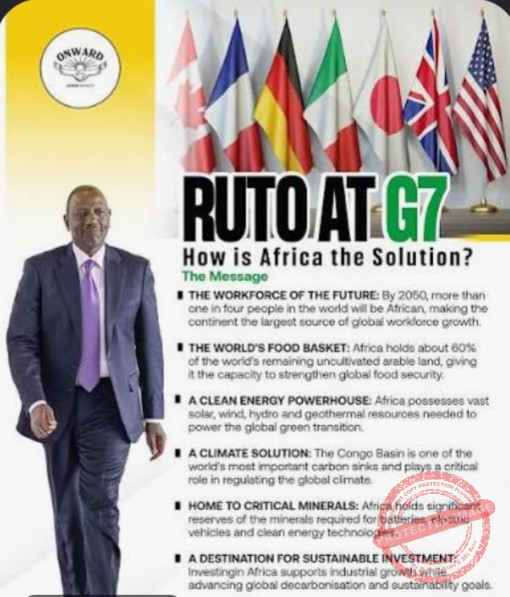
The recent G7 Summit in France may ultimately be remembered not for its official declarations but for what it revealed about the future of the international system. Behind the diplomatic ceremonies, carefully crafted communiqués, and public displays of unity, a deeper reality emerged: the post-Cold War order is under strain, and the assumptions that governed relations between the United States, Europe, and Africa for decades are rapidly being challenged.
The reported tensions between French President Emmanuel Macron and U.S. President Donald Trump were not simply the result of personal disagreements. They reflected a growing divide over who should bear the costs of global security, international development, and geopolitical stability.
For decades, the United States provided the military backbone of the Western alliance. Through NATO and other security arrangements, Washington assumed responsibilities that allowed many European nations to devote greater resources to social welfare and economic development. Europe, in turn, projected influence beyond its borders through development assistance, humanitarian aid, governance programs, and financial support to international institutions, particularly in Africa. That model is now being questioned.
Trump’s message has remained remarkably consistent. The United States, he argues, can no longer continue underwriting international systems in which others benefit disproportionately while contributing comparatively little. Whether one agrees with this position or not, it signals a profound shift in American thinking. The era of automatic commitments and open-ended financial obligations appears to be coming to an end. For Europe, this presents a strategic challenge.
European governments now face growing pressure to finance their own defense, secure their own borders, and assume greater responsibility for their own geopolitical interests. The comfortable assumptions of the post-Cold War era are fading. Strategic autonomy is no longer a theoretical discussion in Brussels or Paris; it is becoming a practical necessity. Yet the implications extend far beyond Europe.
For decades, Africa has been one of the principal recipients of European development assistance. Billions of euros flowed into government budgets, humanitarian programs, electoral processes, civil society organizations, peacekeeping operations, and regional institutions. These resources undoubtedly financed important projects and provided support during periods of crisis. However, they also created a less discussed reality: dependency.
The Hidden Cost of Foreign Assistance
The dominant narrative has long portrayed aid as an expression of international solidarity and partnership. While there is truth in this characterization, it obscures a deeper question. What happens to sovereignty when governments become dependent on resources controlled by others?
Across Africa, development priorities increasingly became intertwined with donor expectations. Governments seeking access to funding often found themselves adapting policies, institutions, and programs to satisfy external requirements. In many cases, national development agendas became heavily influenced by foreign governments, international financial institutions, and donor agencies. This phenomenon extended beyond individual states.
The African Union itself has struggled for years with the contradiction of promoting African solutions to African problems while depending heavily on external financing. Significant portions of its operational budget, peacekeeping activities, and institutional programs relied on support from the European Union and its member states. Such arrangements inevitably raised questions about independence.
Can institutions claim complete strategic autonomy when their financial survival depends upon external actors? Can governments exercise full sovereignty when critical sectors of their economies and administrative structures are sustained by foreign assistance? These are uncomfortable questions, but they are necessary ones.
From Partnership to Dependency
The result was the gradual emergence of what many African intellectuals describe as a modern form of dependency. African nations possessed flags, constitutions, parliaments, and diplomatic recognition, yet many remained financially vulnerable to decisions made in Brussels, Paris, London, Washington, and international financial institutions.
The language of partnership often concealed profound inequalities of power. When aid becomes essential for institutional survival, it inevitably creates leverage. Donors may not directly dictate policy, but their influence becomes difficult to ignore. Governments learn which positions attract support and which positions risk financial consequences. Over time, dependency can become self-perpetuating.
This does not mean that every aid program was harmful or that every donor acted in bad faith. Rather, it highlights a structural reality: no nation can claim complete sovereignty while remaining permanently dependent on external financing.
The End of the Neo-Colonial Comfort Zone
The emerging post-G7 environment may therefore represent something unexpected for Africa: an opportunity. As Western governments increasingly focus on domestic priorities, defense expenditures, and geopolitical competition, the flow of unconditional financial support is likely to face growing scrutiny. The era in which Europe could simultaneously finance its own welfare systems, support international institutions, fund development projects across Africa, and rely on American military protection is becoming increasingly difficult to sustain. For Africa, this changing reality presents a choice.
The first option is to seek new patrons. China, Russia, Türkiye, Gulf states, India, and other emerging powers are all expanding their influence on the continent. Replacing one dependency with another may provide temporary relief, but it does not solve the underlying problem. The second option is far more difficult but ultimately more rewarding: building genuine self-reliance.
Sovereignty Requires Self-Reliance
True sovereignty has never been merely a legal concept. It is an economic reality. Nations are truly sovereign when they can finance their own institutions, secure their own borders, develop their own economies, educate their own populations, and determine their own priorities without external coercion.
This requires difficult choices. It requires stronger domestic revenue systems, accountable governance, industrial development, regional integration, and the political courage to prioritize long-term independence over short-term convenience. The challenge is immense, but so is the reward.
An Africa capable of financing its own institutions would possess greater freedom to pursue its own interests. An African Union funded primarily by African states would enjoy greater credibility and autonomy. Governments accountable primarily to their citizens rather than donors would be better positioned to reflect national priorities. The path to sovereignty has always passed through self-reliance.
The Lesson for Ambazonia and Emerging Nations
The same lesson applies to emerging nations and self-determination movements. Political freedom without economic independence remains fragile. Liberation movements often focus on obtaining recognition, but sustainable nationhood requires institutions capable of surviving without permanent dependence on external benefactors.
For Ambazonia and other movements seeking political self-determination, the changing international environment offers both warning and opportunity. The future will belong not to those who depend on foreign rescue but to those capable of building resilient institutions and strategic partnerships grounded in mutual interest rather than dependency.
A New Era Begins
The G7 Summit did not mark the collapse of Western influence. Nor did it signal the end of cooperation between America, Europe, and Africa.What it did reveal is that the old model is becoming increasingly unsustainable.
The world is entering a period defined by burden-sharing, strategic competition, and national interest. In such an environment, dependency becomes a liability and self-reliance becomes a strategic necessity. For too long, Africa has existed within a system that often confused assistance with empowerment and partnership with dependency. The gradual unraveling of that system may create short-term challenges, but it also offers the possibility of something far more valuable.The opportunity to build genuine sovereignty.The post-G7 world may be less comfortable for Africa. But it may also be far freer.
— Ali Dan Ismael Editor-in-Chief The Independentist News





Leave feedback about this