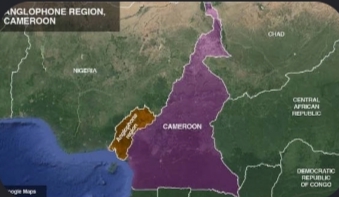


Ambazonia is aspirational — a name that points to what some of us hope to build. Anglophone is fictional — a name that describes no country, no territory, no people, only a colonial school report. The Southern Cameroons is real. It has a map. It has a history. It has a capital, a coastline, a legislature that once sat in Buea, an entry in the archives of the United Nations, and a generation still living who remember when it was the name of their country. It is the ground beneath every other name we might choose.
By Nji, The Independentist News contributor
The Irish were never called “Anglophones” during their long fight for independence. The Algerians were never called “Francophones” while they bled for theirs. The Vietnamese, the Indians, the Kenyans — none of them allowed the language imposed by a colonial school system to become their name.
Yet Southern Cameroonians do. We use it ourselves. We let foreign journalists, diplomats, humanitarian agencies, and international organizations use it. We have allowed a colonial adjective to become our political identity. In doing so, we have allowed our struggle to be misnamed, our history to be flattened, and our claim to justice to be weakened before it is even heard. The word is “Anglophone.” It must go.
A Name That Erases a History
Before “Anglophone,” there was a country. The British Southern Cameroons was a United Nations Trust Territory with its own administration, its own legal tradition inherited from English common law, its own educational system, and its own legislative house in Buea. In the 1961 plebiscite, its people voted not to be absorbed into Nigeria, but to enter into a federation with the Republic of Cameroun — two states, equal in status, joined by treaty.
That federation was dismantled in a 1972 referendum that even the most generous historian struggles to call free. In 1984, the very name “United Republic of Cameroon” was deleted, leaving only “Republic of Cameroon” — the same name the Francophone state had used at its independence in 1960, before any union existed at all. The Southern Cameroons, as a constitutional entity, was administratively erased.
What was left? A territory without a name. A people without a country. And so the world reached for the only word that seemed to describe them: “Anglophone.” The English-speaking ones. As if the only thing worth knowing about them was the language of the school they had been forced to attend.
Consider what this means in a single life. A grandmother in Kumba was born in a country called the Southern Cameroons. She voted, as a young woman, in the 1961 plebiscite. She raised her children in a federated state with two capitals. She watched that federation dissolved without her consent in 1972, and watched the very word “United” struck from the country’s name in 1984. By the time her grandchildren were in school, the country she was born in had been edited out of the map, and she herself had been issued a new identity by people who had never asked her: she was now an “Anglophone.” One woman, four names for the place she had never left. Multiply her by three generations and ask what has been done to a people.
The Trap of Linguistic Framing
A name is also a diagnosis. If a people are defined by a language, then their problem must be a language problem — and the solution must be translation. Bilingual road signs. French classes for English-speaking civil servants. A bilingual commission. Promotion of “the two official languages.”
This is precisely what successive governments and international mediators have offered. And it is precisely why nothing has been resolved. The grievances of the Southern Cameroons were never about language. They were, and remain, about a federation that was unilaterally dissolved, a common law tradition systematically displaced, an educational system progressively dismantled, and a political voice methodically silenced.
When you accept the word “Anglophone,” you accept the premise that your suffering is a translation error. You let your interlocutor reduce constitutional injustice to a question of vocabulary. You let them respond to a demand for self-determination with a textbook of conjugated verbs.
What Lies Beneath the Colonial Label
The label also conceals a richer truth: the people called “Anglophone” were not Anglophones before they were colonized. They were Bakweri and Bafut, Bali and Bayangi, Kom and Mbo, Banyang and Oroko, and dozens of other peoples with kingdoms, councils, languages, and laws that long predate the arrival of any European tongue. Their traditions of chieftaincy, palaver, and consensus did not begin with the British. Their identities are not a footnote to colonial linguistics.
To call all of them “Anglophone” is to do, in a single word, what colonialism set out to do over centuries: to define them by their relationship to a European power. It is to repeat the colonizer’s gesture in the colonizer’s vocabulary.
The Economic Case: A Territory Exploited, a Label That Hides the Theft
Of all the costs of accepting “Anglophone,” the most quietly devastating is economic. A linguistic minority cannot own a resource. A territory can. In 1961, the Southern Cameroons entered the federation with assets that any small nation would have envied. The Cameroon Development Corporation, built on the rich volcanic soils around Mount Cameroon, was already one of the largest agro-industrial concerns in Central Africa. The deepwater port at Victoria, now Limbe, gave the territory its own gateway to the Atlantic. The forests of Mamfe and Kumba held some of the most valuable timber on the continent. Beneath the Rio del Rey basin lay the offshore oil that would, in time, become one of the largest sources of state revenue in the entire union.
The figures tell a consistent story.
The CDC, at its peak in the early 1950s, employed roughly 25,000 workers. On the eve of the present war, it still employed around 22,000, making it the country’s second-largest employer after the state itself. In 2019, half of those jobs were cut. The corporation today reports a workforce of about 16,000, much of it temporary, on plantations that once defined the region’s economy.
Most of Cameroon’s crude oil has been pumped from the Rio del Rey basin, off the South West coast, continuously since 1977. According to the National Hydrocarbons Corporation and its operating partners, the basin has produced more than one billion barrels of oil and still accounts for a major share of national production. Under the standard production-sharing contracts that govern it, the Cameroonian state retains a significant portion of that oil. The National Hydrocarbons Corporation reported revenues of approximately 1.27 billion U.S. dollars in 2022 alone — money that flows to Yaoundé and is not audited by any parliament accountable to the territory whose seabed it drills.
And the gap shows. In the most recent regional Human Development Index figures, the South West — where much of the oil is produced — ranks below the Littoral around Douala, where almost none of it is produced but where much of its proceeds are spent. The North West ranks sixth of ten regions, below the national average. Reviews of Cameroon’s aid management and infrastructure financing show that the country’s crisis-affected regions, including the North West and South West, consistently receive a smaller share of external infrastructure financing than non-crisis regions around the capitals. The territory that helps fund the country is, by every measurable standard, not funded back in proportion.
This is not underdevelopment. It is extraction. Roads in the North West and South West remain among the worst in the country not because the territory is poor, but because the territory has been made poor — its revenues siphoned, its infrastructure starved, its industries left to decay while the proceeds of its land and sea were spent on capitals, ministries, and prestige projects far from the people whose ground produced them.
Now consider what the word “Anglophone” does to this reality. It turns a story of resource theft into a story of cultural marginalization. It transforms a balance sheet into a grievance about signage. It allows the state to answer a demand for economic restitution with a gesture toward translation services. You cannot file a claim for fifty years of stolen oil revenue in the name of a language. You can only file it in the name of a place.
“The Southern Cameroons” restores the ledger. It names a territory with measurable assets, traceable revenues, and a documented history of contribution to a national economy that has not contributed back in proportion. It makes possible the questions that “Anglophone” makes unaskable: How much oil has been pumped from our waters since 1977? Where did the money go? What share of national infrastructure spending has returned to the regions that generated the wealth? Who signed the timber concessions, and who received the fees? What has happened to the CDC, and on whose authority? These are not cultural questions. They are accounting questions. And accounting requires a claimant with a name on the deed.
An Honest Objection, Honestly Answered
Some will say that reviving “the Southern Cameroons” hardens the conflict — that it forecloses the federalist middle ground, hands the framing to secessionists, and makes compromise harder. This objection deserves a serious answer, not a slogan.
The answer is that you cannot federate what you refuse to name. Every federal arrangement in human history, from Switzerland to Nigeria to Canada, has rested on the prior recognition of the entities being federated. A federation between “the Republic of Cameroon” and “the Anglophones” is not a federation; it is an indulgence granted by one named party to an unnamed minority within itself. A federation between the Republic of Cameroon and the Southern Cameroons is, at last, a federation between two recognizable parties capable of signing something.
The territorial name is therefore not the enemy of the federalist position. It is its precondition. Restorationists and federalists may disagree about the destination, but they share a starting point: a place that exists, with a history, and a people entitled to speak in its name. To insist on that starting point is not to choose secession. It is to make any honest settlement — federal, confederal, autonomous, or otherwise — possible at all.
The Strategic Cost
Words shape what is politically thinkable. “Anglophone” places its bearers within a bilingual nation as a linguistic minority — at most twenty percent, easily dismissed, structurally outnumbered, perpetually in need of “protection” by the majority. It is a word that fits comfortably inside the existing state.
“Southern Cameroonians,” by contrast, is a word that points outside it. It names a territory, a history, and a people with a constitutional case to make. It is the difference between asking for accommodation and asserting a right. It is why the term is so quietly resisted by those who prefer the linguistic frame — and so quickly seized upon by those who understand that names are the first battleground of political legitimacy.
The Power of “The Southern Cameroons”
To name something correctly is to summon it into existence. “The Southern Cameroons” does what “Anglophone” never could: it summons a country.
It is, first, a name with paperwork. The Southern Cameroons exists in the archives of the United Nations as a Trust Territory under British administration. It exists in the 1961 plebiscite as a defined electorate. It exists in the founding documents of the federation as one of two contracting parties. To say “the Southern Cameroons” is to invoke a legal personality international law has already recognized — a personality “Anglophone” cannot conjure no matter how loudly it is spoken.
It is, second, a name with a map. Linguistic identities are scattered, contested, and blurred at the edges. Territories are not. The Southern Cameroons has borders, towns, a capital in Buea, rivers, mountains, and a coastline. It is somewhere. And a people from somewhere can claim something that a people defined by their grammar cannot: a homeland.
It is, third, a name that includes everyone the colonial label excludes. The Pidgin-speaking trader in Tiko, the elderly farmer in Wum who never finished primary school, the child in Mamfe whose first language is Kenyang — none of them is meaningfully described as “Anglophone.” All of them are Southern Cameroonians. The territorial name gathers; the linguistic name divides.
It is, fourth, a name with ancestors. To say “the Southern Cameroons” is to stand in a line that runs through Foncha and Endeley, through the Buea legislature, through every campaigner who debated and voted in 1961, and through every generation that knew exactly what country they belonged to before the country was taken from them. “Anglophone” has no ancestors. It was invented to forget them.
It is, fifth, a name that dictates the terms of any honest negotiation. A linguistic minority can be offered translators. A territory must be offered something else: federation, autonomy, recognition, restoration. The name itself opens the political doors that “Anglophone” keeps shut.
For those who claim it, “Ambazonian” goes further still: a name chosen rather than received, a name that asserts a future rather than describing a deficit. Whether one accepts that name or not, the principle is the same. A people who name themselves cannot be dismissed as easily as a people who allow themselves to be named.
Toward a Truthful Peace
There can be no honest peace built on dishonest words. A negotiation in which one party calls itself “the Republic” and the other party allows itself to be called “the Anglophones” is not a negotiation between equals. It is a translation exercise dressed up as a political process.
And here, finally, is where the movement can unite. We have argued among ourselves for too long over the right name for our future, while accepting in the meantime the wrong name for our present. Let that end.
Ambazonia is aspirational — a name that points to what some of us hope to build. Anglophone is fictional — a name that describes no country, no territory, no people, only a colonial school report. The Southern Cameroons is real. It has a map. It has a history. It has a capital, a coastline, a legislature that once sat in Buea, an entry in the archives of the United Nations, and a generation still living who remember when it was the name of their country. It is the ground beneath every other name we might choose.
You do not have to be a federalist to say “the Southern Cameroons.” You do not have to be a restorationist. You do not have to have decided. You only have to be honest about where you are from.
Freedom begins with the right to name oneself. Justice requires that the wrong being addressed be correctly described. Peace, when it comes, must be peace between recognizable peoples — not between a state and an adjective.
A people are not a language. A struggle named correctly is already half won. A movement united around the truth of where it comes from cannot be defeated by those who would prefer it to forget.
For that reason, calling for an “All Anglophone Conference” today is not a harmless choice of words. At best, it is a strategic miscalculation. At worst, it risks obscuring the very truth on which justice must rest. The issue before the world is not an Anglophone grievance. It is the unresolved question of the Southern Cameroons: a territory, a people, a history, a constitutional wound, and a claim that cannot be answered with bilingual slogans.
We cannot follow leaders who overlook the strategic cost of accepting an identity that has left millions of Southern Cameroonians trapped inside a language category rather than recognized as a people with a homeland. Freedom begins when a people know who they are, name themselves truthfully, and refuse to let others reduce their existence to an adjective.
Nji, The Independentist News contributor