








News commentary

We are home to news on Cameroon and the CEMAC region. We are dedicated to honest and reliable reporting. We are the voice of the Cameroonian people and their fight for freedom and democracy at a time when the Yaoundé government is silencing dissent and suppressing democratic voices.

The ultimate test of independence is not the day a new flag is raised, the national anthem is sung or the first president takes the oath of office. It is whether, ten, twenty or fifty years later, the country possesses the institutions, economic strength, constitutional stability and freedom necessary to determine its own destiny. Independence may be proclaimed in a single day. Sovereignty is the work of generations. Sovereignty is not merely declared. It is built, protected and sustained.
By Ali Dan Ismael
Senior Editor-in-Chief, The Independentist News
November 27, 2026
From the interception of 181 drones in Burkina Faso to renewed French military cooperation in Africa, emerging geopolitical realities offer critical lessons for nations aspiring to independence. Africa must come to terms with a fundamental political reality: independence and genuine sovereignty are not synonymous.
A country may possess its own flag, national anthem, president, parliament and military, yet remain dangerously dependent on foreign powers for its security, technology, intelligence, economic survival and diplomatic influence. Political independence establishes the formal existence of a state. Sovereignty determines the extent to which that state can exercise meaningful control over its destiny.
Recent developments across the Sahel and neighbouring African countries should therefore provoke serious reflection, particularly among the peoples of the Alliance of Sahel States (AES) and Ambazonians aspiring to independent statehood.
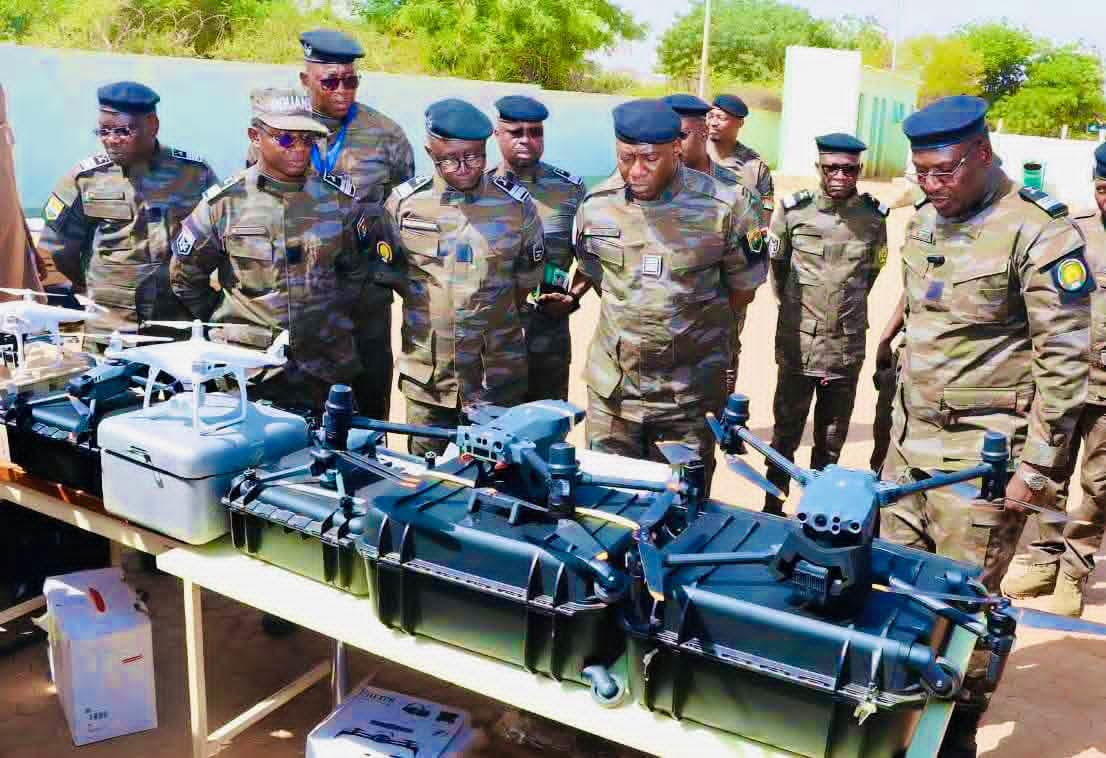
– On November 25, 2026, Burkina Faso’s customs authorities announced the seizure of 181 drones, military-related equipment and Starlink satellite communication terminals at Ouagadougou International Airport. The intercepted equipment was reportedly valued at more than 80 million CFA francs. – On November 19, French military aircraft, including Mirage 2000 fighter jets and a Hercules transport aircraft, landed in N’Djamena, Chad, amid renewed military cooperation between the two countries. – Earlier in November, Côte d’Ivoire hosted FANGHA 2026, a multinational military exercise involving Ivorian, French and Gabonese forces.
These developments do not, individually or collectively, establish that France or any other foreign power is preparing military action against the AES. Nor does the seizure in Burkina Faso establish a connection with French military activities elsewhere. They nevertheless illustrate an important reality: the geopolitical environment is constantly evolving, and the preservation of national sovereignty requires institutional competence, strategic awareness and preparedness.
INDEPENDENCE WITHOUT SECURITY IS AN INVITATION TO VULNERABILITY
The interception of drones and communication equipment in Burkina Faso illustrates the changing nature of national security in the twenty-first century. National defence is no longer exclusively about soldiers carrying rifles, tanks crossing borders or fighter jets dominating the skies.
Technology, satellite communications, cybersecurity, intelligence, regulatory oversight and the protection of critical infrastructure have become increasingly important dimensions of national security. A country that cannot effectively regulate sensitive imports, protect its communication infrastructure or maintain the integrity of its public institutions faces significant limitations in exercising its sovereignty.
For a prospective independent Ambazonia, this raises fundamental questions about institutional development. Revolutionary enthusiasm may sustain a political movement, but governing a modern state requires professional competence, effective administration, public accountability and respect for the rule of law.
National security must ultimately be understood as the protection of citizens, constitutional institutions, economic assets and territorial integrity—not merely the preservation of those who exercise political authority.
FOREIGN MILITARY PARTNERSHIPS MUST NEVER BECOME FOREIGN CONTROL
The renewed military engagement between France and Chad raises another important question concerning the nature of African sovereignty. There is nothing inherently incompatible between sovereignty and international military cooperation. Such partnerships can provide training, technical expertise, institutional development and access to resources that individual countries may not possess.
The fundamental question, however, is who determines the terms of those relationships. Are agreements negotiated in accordance with national interests, or do they create dependencies that gradually subordinate domestic priorities to those of foreign partners?
The participation of Côte d’Ivoire, France and Gabon in FANGHA 2026 further illustrates the continuing importance of international partnerships within African security arrangements. The issue is not whether African countries should cooperate with France, Russia, China, the United States or other international partners. It is whether those relationships preserve the freedom of African governments and their citizens to determine their own futures.
International partnerships need transparency, reciprocity, constitutional oversight and clearly defined responsibilities. Replacing one form of foreign dependency with another does not necessarily constitute meaningful sovereignty.
INTERNATIONAL SYMPATHY IS NOT A SUBSTITUTE FOR NATIONAL CAPACITY
One of the challenges facing independence movements is distinguishing between international sympathy, diplomatic recognition and the actual capacity to sustain a functioning state. These are related but fundamentally different achievements.
International relationships are frequently shaped by strategic interests, economic considerations, domestic political pressures and changing geopolitical circumstances. A country that expresses solidarity with a political cause today may reconsider its position tomorrow when circumstances change.
This does not diminish the importance of diplomacy. On the contrary, it demonstrates why diplomacy must produce enduring institutional relationships rather than depend exclusively on expressions of goodwill. Academic partnerships, economic cooperation, cultural exchanges, international legal engagement and professional networks can contribute to relationships that survive changes in political leadership.
For Ambazonia, the distinction between diplomatic visibility and institutional capacity deserves particular attention. Relationships with Washington, London, Paris, Moscow, Beijing, Brasília and other international centres of influence may offer opportunities. None, however, can substitute for competent domestic institutions and a sustainable economic foundation.
International cooperation can reinforce sovereignty, but it cannot manufacture it on behalf of another people.
A NEW COUNTRY NEEDS INSTITUTIONS BEFORE IT NEEDS CEREMONIES
Perhaps the most consequential question confronting any independence movement is not simply how to achieve statehood, but how to govern effectively afterwards. The history of postcolonial Africa demonstrates that obtaining independence does not automatically resolve the challenges of governance, economic development, institutional accountability or national cohesion.
What kind of customs administration would a future Ambazonia establish? – How would its ports, airports, telecommunications networks and strategic infrastructure be administered and protected? – Would its judiciary be genuinely independent? – Would its security institutions operate under constitutional authority and civilian oversight? – Would its civil service be organised around professional competence rather than political loyalty, regional affiliation or personal connections? – How would foreign investments be regulated without undermining public ownership of strategic national resources? – What constitutional safeguards would prevent national institutions from becoming instruments of political intimidation?
These questions belong within contemporary discussions about prospective statehood rather than being treated exclusively as matters for a future government. A declaration of independence cannot, by itself, create an independent judiciary, a competent civil service, a functioning economy or an accountable public administration.
These require deliberate institutional development, qualified professionals, sound legislation and a political culture that respects constitutional limitations. The quality of a country’s institutions ultimately determines whether its independence becomes a national achievement or merely a transfer of political authority.
ECONOMIC DEPENDENCE CAN UNDERMINE POLITICAL INDEPENDENCE
Any serious discussion of African sovereignty must extend beyond military affairs and diplomatic relationships. Economic capacity is equally fundamental. A country that depends excessively on foreign assistance to finance its public administration, import essential commodities, maintain infrastructure or provide basic services may find its political freedom constrained by economic necessity.
The challenge is particularly significant for countries that export raw materials while importing expensive finished products manufactured from those same resources. Formal ownership of natural resources does not automatically translate into economic sovereignty. The capacity to transform those resources into productive assets, employment, technological knowledge and sustainable public revenue is equally important.
For a prospective Ambazonia, questions concerning agriculture, industrial development, energy, education, infrastructure, financial institutions and technological innovation are therefore inseparable from questions of statehood. The strength of a nation cannot be measured exclusively by the size of its military or the number of countries recognising its government.
It must also be measured by its ability to educate its children, employ its citizens, finance its institutions, provide essential services and create opportunities across generations. Political sovereignty without productive capacity risks becoming sovereignty on paper.
NATIONAL COHESION AND CONSTITUTIONAL ACCOUNTABILITY
The emergence of the Alliance of Sahel States demonstrates the significance that Burkina Faso, Mali and Niger attach to regional cooperation in addressing their political and security challenges. The effectiveness and long-term consequences of that cooperation remain matters for continuing assessment.
Nevertheless, the relationship between national cohesion and institutional stability deserves consideration in any discussion of prospective statehood. Political fragmentation, institutional rivalries, personal ambitions and competition for authority can undermine the effectiveness of a country’s governing institutions.
Unity, however, must not be confused with political uniformity or unquestioning loyalty to individuals. A healthy constitutional society accommodates disagreement, protects legitimate opposition and provides peaceful mechanisms for resolving competing political interests. National cohesion is most sustainable when it rests upon shared constitutional principles rather than personal allegiance.
For a future Ambazonia, this distinction would have profound implications for the relationship between political leadership, public institutions and ordinary citizens. Individuals come and go. Governments change. Political parties rise and fall. Durable institutions must survive them all.
THE REAL MEANING OF AFRICAN SOVEREIGNTY
There is a persistent misconception that African sovereignty can be achieved simply by removing Western influence. The issue is considerably more complex.
Genuine sovereignty means possessing the freedom and institutional capacity to determine which international relationships serve national interests, how resources are managed, how economic priorities are established and how citizens are governed.
It means possessing sufficient economic resilience to withstand external pressures, diplomatic competence to navigate international rivalries and constitutional maturity to accommodate political disagreements without destroying national institutions. It also means protecting the fundamental rights of ordinary citizens.
National sovereignty cannot be separated from the dignity, liberty and security of the people in whose name political authority is exercised. A government that invokes sovereignty while disregarding the rights of its own citizens exposes a fundamental contradiction in its understanding of independence. Recent developments across the Sahel and neighbouring countries should therefore encourage informed reflection rather than panic, speculation or unsupported conspiracy theories.
The central question for Africa is not merely whether foreign powers remain influential on the continent. It is whether African societies possess the institutional, economic and intellectual capacity to negotiate those relationships on terms consistent with their own interests.
For Ambazonia, the underlying question is equally consequential: would prospective independence establish a fundamentally different model of governance, or reproduce the institutional vulnerabilities that have characterised many postcolonial states?
The ultimate test of independence is not the day a new flag is raised, the national anthem is sung or the first president takes the oath of office. It is whether, ten, twenty or fifty years later, the country possesses the institutions, economic strength, constitutional stability and freedom necessary to determine its own destiny. Independence may be proclaimed in a single day. Sovereignty is the work of generations. Sovereignty is not merely declared. It is built, protected and sustained.
Ali Dan Ismael
Senior Editor-in-Chief
The Independentist News
Share This Post:
An Anonymouse Analyst writes to The Independentist News reacting on the article “STRATEGIC SILENCE IS NOT WEAKNESS” and to a voice from, The voice of Ambazonian International.
Related Post
An Anonymouse Analyst writes to The Independentist News reacting
FROM NORTH AMERICA TO SOUTH AMERICA: IS AMBAZONIAN DIPLOMACY
MBENGWI KIDNAPPING INCIDENT: HOW LONG WILL THE BLAME GAME
THE SYSTEMATIC DISMANTLING OF SOUTHERN CAMEROONS: HOW AHIDJO’S CENTRALISATION
NORWAY AND THE TEST OF JUSTICE: THE AYABA TRIAL
FOUR HUNDRED YEARS OF PLUNDER: CAN AN APOLOGY REBUILD