











By Martin S. Mungwa, Ph.D., Fellow ASCE | Mungwa Legacy Press | 2026
The Independentist News book Review
As Amazon associate this site earns from qualifying purchases
Follow the Amazon link below to get your copies of other publications on productive Sovereignty By Martin Mungwa
Beyond Trade: Why Africa and Brazil Must Build Wealth Together, Not Merely Exchange Goods.
An ambitious examination of the economic relationship between Africa and Brazil—and a challenge to the development models that have too often allowed nations rich in resources to remain poor in productive capacity.
For generations, the relationship between Africa and the wider world has been defined by a troubling economic contradiction: countries possessing extraordinary natural resources, human talent, agricultural potential, and strategic geographic advantages frequently remain dependent on foreign capital, imported technologies, and external industrial systems.
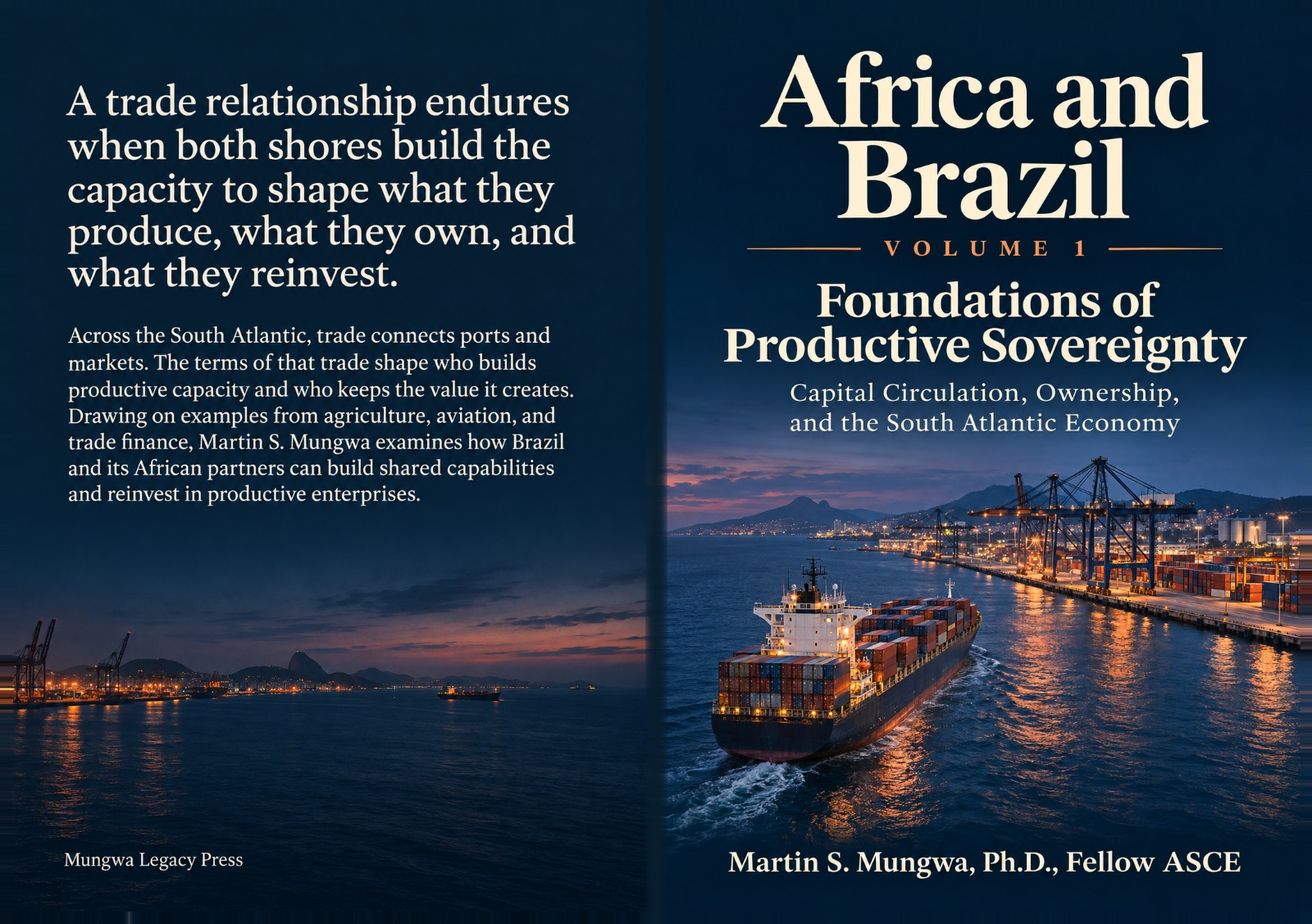
In Africa and Brazil — Volume 1: Foundations of Productive Sovereignty, Martin S. Mungwa challenges the intellectual foundations of this contradiction.
His central proposition is as powerful as it is unsettling: Trade does not necessarily create prosperity. Prosperity emerges when nations develop the capacity to produce, own, control, and reinvest the wealth generated through trade.
This distinction transforms what might otherwise have been a conventional examination of South Atlantic economic relations into a broader argument about sovereignty, industrial development, and the future distribution of global economic power.
A Different Understanding of Economic Sovereignty
One of the book’s most compelling ideas, as expressed in its presentation, is that political independence and economic sovereignty are not synonymous. A nation may possess a flag, a constitution, diplomatic recognition, and internationally recognized borders while remaining structurally dependent on outside institutions for machinery, technological expertise, investment capital, manufacturing, and market access.
Mungwa’s concept of productive sovereignty shifts attention away from the symbolic attributes of independence toward the practical institutions that make independence economically meaningful.
The questions are direct :– Who owns the factories? – Who controls the technology? – Who finances production? – Who retains the profits? – And, perhaps most importantly, who decides how those profits are reinvested?
These questions are especially relevant to Africa’s evolving economic relationships with Brazil, a country whose historical connections to the African continent coexist with significant capabilities in agriculture, aviation, manufacturing, scientific research, and industrial development.
Brazil: A Partner in Production, Not Simply Another Trading Destination
The significance of Brazil in this discussion extends beyond its geographic position across the South Atlantic. Brazil offers an important reference point because it has developed internationally recognized capabilities in sectors that remain central to Africa’s economic transformation.
Agricultural research, food production, aerospace engineering, manufacturing, and industrial financing provide potential areas for cooperation. Yet Mungwa’s conceptual framework implies an important warning. Replacing one foreign trading partner with another does not, by itself, constitute economic liberation.
If African economies merely substitute Brazilian imports for European, American, or Asian imports without developing domestic productive capacity, the underlying structure of dependency remains largely unchanged.
The true opportunity therefore lies in partnerships that facilitate technology transfer, research collaboration, local manufacturing, professional training, joint ownership, and industrial reinvestment.
Under this approach, Brazil becomes more than a market or supplier. It becomes a potential collaborator in creating productive institutions capable of surviving beyond individual trade agreements.
Capital Circulation: The Missing Question in Development
Perhaps the most intellectually promising dimension of the book is its emphasis on capital circulation. Much development discourse concentrates on attracting investment, expanding exports, and increasing economic activity. But these measures leave a fundamental question unanswered: Where does the money go after value has been created?
An economy may export substantial quantities of agricultural commodities, minerals, petroleum, or manufactured components while retaining only a limited share of the resulting profits. If the financial returns are transferred abroad rather than reinvested in domestic engineering capacity, infrastructure, research, and entrepreneurship, increased trade can coexist with persistent structural weakness. The book’s framework therefore invites a distinction between economic activity and economic transformation.
The former measures transactions.
The latter measures the lasting productive capabilities those transactions leave behind. This distinction deserves serious consideration by policymakers, development economists, financial institutions, and universities engaged in South–South cooperation.
The Engineering of Prosperity
Another distinguishing feature is the author’s professional background in engineering, higher education, and industrial management. Rather than treating national development exclusively as a matter of financial policy, the book’s stated approach places productive capability at the center of economic advancement.
This matters because industrial development cannot be achieved through investment agreements alone. Factories require engineers. Agricultural modernization requires scientific research. Aviation requires sophisticated manufacturing ecosystems. Infrastructure requires technical institutions, trained personnel, maintenance capacity, and reliable financing.
Consequently, genuine economic sovereignty must involve more than the accumulation of capital. It requires the deliberate construction of productive knowledge.
This perspective potentially strengthens the book’s relevance to African universities and Brazilian research institutions, where collaboration could move beyond ceremonial agreements into joint graduate supervision, applied research, technology development, and enterprise formation.
A Challenge to African Leadership
The implications for African governments are substantial. For decades, economic progress has frequently been presented through indicators such as foreign direct investment, export growth, infrastructure spending, and international financing commitments.
These measures have value, but they do not automatically reveal whether the country is becoming more capable of producing sophisticated goods and services independently. Mungwa’s framework raises a more demanding standard of accountability.
After a major investment agreement, what new technical capabilities exist locally? How many domestic enterprises participate meaningfully in production? What intellectual property has been developed or transferred? How much value remains within the national economy? And what productive institutions will continue functioning after the foreign investors have recovered their capital?
Such questions move the discussion from the announcement of development projects toward the measurement of their enduring economic consequences.
Why This Book Matters Beyond Africa and Brazil
The larger significance of Foundations of Productive Sovereignty is that the central argument is not limited to two geographic regions. It speaks to a wider international dilemma: how emerging economies can participate in globalization without surrendering control over their productive futures.
The South Atlantic becomes a setting for examining an issue relevant to the Caribbean, Latin America, and other developing regions. – Can countries cooperate internationally while building greater technological and industrial autonomy? – Can foreign investment strengthen domestic institutions rather than perpetuate external dependence? – Can economic partnerships be designed around shared ownership, reciprocal learning, and long-term value creation?
The intellectual strength of the book’s proposition lies in its refusal to accept trade volume as a sufficient measure of partnership success.
Critical Assessment
The book’s declared framework is timely, ambitious, and potentially valuable. Its strongest feature is the integration of three often-separated questions: productive capacity, ownership, and capital reinvestment.
However, the ultimate scholarly strength of the work will depend on how rigorously the full manuscript develops and tests these ideas. A particularly persuasive treatment would establish measurable indicators of productive sovereignty, examine successful and unsuccessful industrial partnerships, investigate asymmetries between Brazilian and African institutions, and address the financial, political, and technological barriers to genuine joint production.
It would also distinguish opportunities for mutual development from the assumption that South–South cooperation is inherently equitable. Brazilian and African interests will not always coincide. Recognizing these differences would strengthen rather than weaken the case for better-designed partnerships.
These are not objections to the book’s central argument. They are the demanding questions that a serious theory of productive sovereignty should confront.
Final Verdict: A Necessary Reframing of the South Atlantic Economic Conversation
Africa and Brazil — Volume 1: Foundations of Productive Sovereignty presents a forceful proposition for the future of international development: lasting prosperity cannot be measured simply by the volume of goods moving across oceans. It must be judged by the productive capacity, institutional knowledge, ownership, and reinvestment those exchanges leave behind.
The book’s stated ambition is to move the Africa–Brazil conversation beyond trade diplomacy toward a more consequential examination of how wealth is created, controlled, and sustained. Its potential audience includes university researchers, economists, engineers, industrial strategists, investors, development institutions, and policymakers seeking new frameworks for international economic cooperation.
Above all, the book asks a question that deserves a prominent place in every economic partnership negotiation: When the ships depart, the contracts expire, and the profits are counted, what productive capacity remains in the hands of the people whose resources and labor made the trade possible? That is the question at the heart of productive sovereignty. And it is a question Africa, Brazil, and the wider developing world can no longer afford to ignore.
Editorial assessment:
This is a substantive, publication-ready conceptual review based on the supplied front and back cover, including the book’s description and stated themes. It is not a verified evaluation of the complete manuscript, which has not been provided. A chapter-by-chapter scholarly review, including a defensible numerical rating, would require the full text.
Suggested publication headline for any News publication: AFRICA AND BRAZIL: A NEW BOOK CHALLENGES THE GLOBAL TRADE SYSTEM AND ASKS WHO REALLY OWNS THE WEALTH
As Amazon associate this site earns from qualifying purchases
Follow the Amazon link below to get your copies of other publications on Productive Sovereignty By Martin Mungwa
The Independentist News editorial desk





Leave feedback about this