











The answer will not be found in the prestige of the convenors or the elegance of their declaration. It will be found in their independence, their accountability, and their willingness to confront the sovereignty question. The people do not need another performance of statecraft. They need a political process capable of producing justice, legitimacy, and lasting peace.
By Ali Dan Ismael
Editor-in-Chief, The Independentist News
As Amazon associate this site earns from qualifying purchases
Buy your copies of books on Ambazonia’s productive Sovereignty and statecraft By Martin Mungwa from Amazon
YAOUNDÉ – 17 October 2026 – When dialogue fails, political promises collapse, and yesterday’s solutions become today’s disappointments, an exhausted political establishment often discovers another vocabulary. Yesterday, it was national dialogue. Then came Special Status.
Today, community reconciliation is being promoted as a pathway to peace. Tomorrow, perhaps, it will be consultation, collective ownership, and statecraft.
The names change. The declarations multiply. New personalities occupy the stage. Yet the fundamental political question concerning the former British Southern Cameroons remains unresolved.
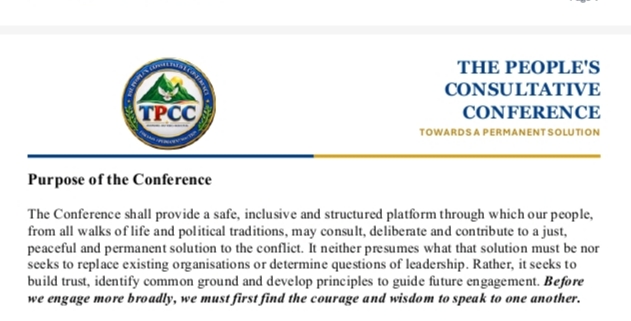
The latest initiative is the proposed People’s Consultative Conference (TPCC), announced under the banner Towards a Permanent Solution. Its three-page declaration invokes six decades of unresolved political and constitutional questions, recognizes competing political identities, and proposes broad consultations culminating in a physical conference during the first quarter of 2027.
At first glance, the initiative appears conciliatory and inclusive. But political legitimacy cannot be established through attractive language alone. After nearly a decade of armed conflict, the people of Southern Cameroons/Ambazonia are entitled to demand more than another gathering, another declaration, and another promise of collective understanding.
The central question is not whether Southern Cameroonians should talk to one another. It is whether yet another consultative conference can resolve the political dispute that previous dialogue initiatives have failed to settle.
And if this conference cannot identify the authority, mechanism, and political conditions through which that dispute will be resolved, what exactly is its promised permanent solution?
I. The Historical Record: Six Decades of Unsettled Questions
The TPCC declaration begins by recognizing more than six decades of unresolved questions concerning the governance, identity, rights, and constitutional future of the former British Southern Cameroons Trust Territory. That acknowledgment is significant.
The political dispute did not begin with the demonstrations of lawyers and teachers in 2016, nor with the subsequent armed conflict. Its historical roots reach into decolonization, the 1961 plebiscite, the federal constitutional arrangement, and the dismantling of that arrangement in 1972.
The declaration cites the First All Anglophone Conference of April 1993 in Buea, which advocated a return to federalism, and the Second All Anglophone Conference of 1994 in Bamenda. These conferences were milestones in Anglophone constitutional advocacy.
But they must not be confused with the state-sponsored Grand National Dialogue of 2019. The earlier conferences sought to articulate political demands from within Anglophone society; the 2019 dialogue was convened by the government whose policies and authority were themselves central to the dispute. That distinction matters.
Human Rights Watch documented that the 2019 Grand National Dialogue, held from 30 September to 4 October, proceeded without the participation of the principal separatist organizations and major opposition parties. The subsequent Special Status arrangement did not end the armed conflict. The problem was not simply inadequate attendance. It was the absence of a mutually accepted political framework capable of addressing the rival constitutional positions.
For Southern Cameroons independentists, the question concerns the restoration of sovereignty. For federalists, it concerns constitutional restructuring and meaningful regional self-government. Unionists maintain a different conception of Cameroon’s political future. These are substantive disagreements over political authority. They cannot be settled simply by inviting everyone to attend another meeting.
II. The TPCC Declaration: Inclusivity Without a Defined Mandate
The TPCC convenors deserve acknowledgment for recognizing the diversity of political identities among Southern Cameroonians. Page one of their declaration expressly accommodates those who identify as Southern Cameroonians, Ambazonians, Anglophones, or English-speaking Cameroonians.
It also states that participation does not require individuals to abandon their preferred political positions. Page three expressly invites unionists, federalists, and independentists. These provisions are welcome in principle. But inclusion is not the same as representation.
A political conference becomes credible not merely because different views are permitted, but because participants possess clear mandates, decision-making procedures are transparent, and outcomes have an identifiable pathway toward implementation. Here lies the fundamental weakness.
On page two, the declaration states that the conference will not predetermine the political solution, replace existing organizations, or decide questions of leadership. It proposes instead to build trust, establish common ground, and develop principles for future engagement.
What, then, is the authority of the conference? Will its conclusions bind anyone? Who will negotiate their implementation? Can a conference that expressly disclaims political leadership nevertheless claim to offer a permanent solution? There is a profound difference between facilitating a conversation and possessing the authority to negotiate a political settlement.
The first can be organized by concerned citizens. The second requires legitimate parties, an agreed mandate, and enforceable commitments. The TPCC declaration explains the first. It does not adequately establish the second.
III. The Question the Convenors Cannot Avoid: Who Are the Relevant Authorities?
Perhaps the most consequential provision appears on page two under the heading Engagement with Relevant Authorities. The declaration acknowledges continuing engagement with the authorities concerning the proposed conference. This disclosure raises an immediate question. Which authorities?
If the convenors are referring to LRC officials, what precisely is the nature of their engagement? Is it limited to administrative notification, public safety, and lawful assembly? Or does it extend to the selection of delegates, control of proceedings, approval of constitutional topics, financing, or anticipated political outcomes? The distinction is critical.
There is nothing inherently improper about informing public authorities of a peaceful gathering. But political independence cannot rest upon an assumption that all governmental involvement is harmless. Nor should anyone automatically treat administrative communication as proof of collaboration. The matter demands evidence, not rumor.
The convenors should publish the terms of their engagement with the relevant authorities and clarify whether those authorities possess any direct or indirect influence over the conference. They should also disclose the initiative’s funding arrangements and explain how participants will be protected when advocating positions contrary to the constitutional preferences of Yaoundé.
A conference discussing independence must establish whether independence can genuinely be discussed without intimidation, censorship, or political consequences. Until these questions are answered, declarations of autonomy and collective ownership will remain assertions rather than demonstrated institutional facts. A conference cannot claim independence merely by announcing it. Independence must be established through transparent governance and conduct.
IV. The Great Substitution: Turning a Constitutional Conflict Into a Community Problem
One of the most troubling developments in the handling of the Southern Cameroons conflict has been the recurring tendency to emphasize community reconciliation without giving equivalent attention to the political relationship between Southern Cameroons and Yaoundé. Communities unquestionably need reconciliation.
Families have suffered. Villages have been devastated. Education has been interrupted. Livelihoods have been destroyed. Civilians have experienced abuses committed by different armed actors. Healing these wounds is essential. But healing the consequences of war is not identical to resolving its political causes.
From The independentist News perspective, this conflict cannot be reduced to disagreements among neighboring communities. It involves competing claims over political status and the authority exercised by the LRC state. The distinction is not academic. If the dispute is framed primarily as a community disagreement, then the apparent solution becomes community dialogue.
If the dispute is recognized as a constitutional and political conflict, then meaningful settlement requires engagement with the competing political claims and the actors capable of implementing an agreement. This is why the renewed language of community dialogue deserves scrutiny.
The TPCC initiative may have legitimate civic purposes. Yet its proposed emphasis on internal consultation could unintentionally reinforce the same political framing if its results are presented as a substitute for addressing the relationship between Southern Cameroons and the LRC state. That is the danger.
A population may reach agreement on education, humanitarian access, reconstruction, or community welfare without agreeing upon sovereignty. Indeed, unity on humanitarian priorities may coexist with profound constitutional disagreement. Political disagreements cannot be wished away through the vocabulary of communal harmony.
The convenors must therefore explain how their internal discussions will connect to the actual political dispute, rather than merely producing another catalogue of desirable social outcomes.
V. Distinguished Convenors Are Not a Substitute for Democratic Legitimacy
The TPCC declaration identifies a College of ten convenors drawn from traditional, religious, academic, and other community backgrounds. Their standing may help facilitate discussion. Their experience may provide useful guidance. And their contribution to humanitarian reconciliation may prove valuable. But distinction does not automatically confer political representation.
On page three, the convenors explicitly state that they do not constitute another political leadership and do not claim authority to determine the future on behalf of the people. That admission is commendable. It also exposes the central institutional challenge. If they do not possess a representative mandate, how will the conference obtain one?
Will participants be elected by their communities? Will political organizations nominate representatives? How will internally displaced persons, refugees, prisoners, and exiles participate? Will the opinions of ordinary individuals carry the same institutional weight as the mandates of organized constituencies? How will disagreements be recorded? Will decisions be reached through consensus, majority voting, or another procedure? None of these questions is satisfactorily answered in the declaration.
The convenors use the traditional image of elders gathering the community in the village square. But the constitutional future of Southern Cameroons cannot be determined by the mere convening of a village assembly, however respected its elders may be.
The village square is a legitimate forum for consultation. It is not automatically a constitutional negotiating institution. Representation must be demonstrated, not presumed.
VI. Religious Authority, the Pope’s Visit, and the Limits of Moral Diplomacy
The declaration draws inspiration from the peace message associated with Pope Leo XIV’s April 2026 visit to Cameroon. On 16 April 2026, the Pope visited Bamenda and addressed a gathering devoted to peace at Saint Joseph’s Cathedral. His appeal for reconciliation, justice, and human dignity deserves serious respect.
The spiritual and humanitarian contributions of religious institutions must not be dismissed. Yet the Pope’s moral appeal does not provide a political mandate to any particular conference. Religious leadership can encourage restraint, forgiveness, and the protection of civilians. It cannot independently establish the legitimacy of a constitutional settlement.
Indeed, the Pope’s message also warned against the political manipulation of religion. This warning is particularly relevant whenever religious authority becomes associated with political initiatives whose institutional relationships remain unclear. That does not mean the TPCC convenors are manipulating religion. The declaration provides no basis for such a conclusion. It means that moral credibility must remain distinguishable from political authority.
The weekly invitation to prayer contained in the declaration may offer spiritual solidarity. But prayer cannot substitute for an agreed negotiating framework. Peace needs moral leadership. A permanent political settlement also needs legitimate institutions, accountability, and enforceable agreements.
VII. Statecraft: The Difference Between Managing Disagreement and Resolving It
The word statecraft has become increasingly fashionable in political commentary. But statecraft is more demanding than the organization of conferences and the drafting of declarations. It involves identifying political interests, defining authority, negotiating competing claims, creating credible commitments, and establishing institutions capable of sustaining agreed outcomes.
A political conference without these elements may facilitate useful discussions. It cannot, on that basis alone, claim to offer a permanent solution. The TPCC proposal contains no publicly defined mechanism for translating consultations into a negotiated constitutional arrangement.
It identifies no mutually accepted negotiating parties. It sets out no binding implementation procedure. It offers no clear answer to the question of what happens when independence, federalism, and unionism prove politically irreconcilable. These are not technical omissions. They concern the very purpose for which the conference claims to exist.
For proponents of a sovereign Southern Cameroons, the political question cannot be settled by redefining it as an internal disagreement among Anglophones. For federalists, constitutional guarantees cannot be secured merely through community consensus. Even unionists seeking institutional reforms would require an enforceable agreement concerning those reforms. Across these different positions, the same principle applies.
Consultation is a method of gathering views. Statecraft is the disciplined process of turning legitimate political decisions into durable arrangements. Confusing the two produces not a permanent settlement, but another procedure whose political consequences remain uncertain.
VIII. Another LRC Gimmick — Or an Independent Initiative at Risk of Being Politically Appropriated?
The historical pattern naturally invites suspicion. The LRC government has repeatedly promoted national dialogue, regional administrative reforms, and reconciliation as responses to the conflict. Yet the fundamental constitutional disagreement persists.
The TPCC now proposes another initiative whose language emphasizes consultation, inclusivity, and collective purpose while leaving unresolved the question of political authority. Its declaration also acknowledges engagement with relevant authorities. These similarities justify rigorous political scrutiny. But they do not establish that TPCC was created, financed, or directed by Yaoundé. That distinction is essential to responsible journalism.
A conference need not be an official government operation to produce outcomes that benefit the government. If a consultation redirects attention from the relationship between Southern Cameroons and the LRC state toward disagreements within Southern Cameroonian society, Yaoundé may derive political advantage from the shift.
If it presents internal consensus-building as the principal prerequisite for peace, the state may face less immediate pressure to address the constitutional dispute. And if its conclusions are eventually publicized as evidence that Southern Cameroonians have chosen reconciliation within existing institutions, the political meaning of the exercise could extend far beyond the intentions of individual participants. These are plausible risks, not proven outcomes.
That is precisely why the convenors must establish safeguards against the political appropriation of their process. The essential question is not whether every organizer secretly serves Yaoundé. It is whether the conference’s design sufficiently protects the political independence of its participants and prevents their contributions from being used to support conclusions they never authorized.
The most dangerous political instrument is not always one deliberately created as an instrument. Sometimes it is an independent initiative whose weaknesses allow others to determine its eventual meaning.
IX. The Six Tests TPCC Must Pass
If the People’s Consultative Conference intends to distinguish itself from previous initiatives, its convenors should publicly answer six questions before inviting the people to endorse its process.
First: Independence. Who finances the conference, who controls its administration, and what agreements have been reached with the relevant authorities?
Second: Representation. How will delegates obtain legitimate mandates, and how will refugees, prisoners, exiles, displaced populations, and politically marginalized communities be represented?
Third: Political freedom. Can every participant advocate a preferred constitutional outcome, including independence, without coercion or retaliation?
Fourth: Scope. Is the conference merely gathering public views, or does it claim to establish a basis for political negotiations?
Fifth: Implementation. Who will receive its recommendations, what obligations will follow, and how will the process move from consultation to credible negotiations?
Sixth: Protection against appropriation. What safeguards will prevent governments, movements, or individual leaders from misrepresenting the conference’s conclusions as consent to positions the participants have not endorsed?
Without credible answers, the initiative’s greatest promise—collective ownership—may become its greatest weakness. An event can be attended by many people without being authorized to speak for them. A declaration may be welcomed without being binding. And a conference may conclude successfully in ceremonial terms while achieving nothing decisive in political terms.
X. Conclusion: The Costume Changes, but the Sovereignty Question Remains
The former British Southern Cameroons has witnessed many political initiatives. There were the All Anglophone Conferences of the 1990s, born from demands for constitutional change.
There was the Grand National Dialogue of 2019, organized under the authority of the LRC government. There followed Special Status and continuing calls for reconciliation. Now another conference has emerged, promising to bring the people together in pursuit of a permanent solution.
Its convenors may be sincere. Its participants may act in good faith. Its consultations may produce useful humanitarian and civic recommendations. But none of these possibilities resolves the central question.
How will this initiative address the competing claims concerning sovereignty, constitutional authority, and the political future of the former British Southern Cameroons? The declaration does not yet provide a convincing answer. That is the weakness at the heart of the proposal.
After years of conflict, a population burdened by displacement, insecurity, and political uncertainty should not be expected to confuse a new consultation with a new settlement. Nor should it be asked to surrender political skepticism merely because the invitation comes from respected personalities.
Political legitimacy must be earned. Independence must be demonstrated. Representation must be established. And the pathway to a lasting settlement must be defined. Otherwise, the recurring sequence of dialogue, reform, reconciliation, and consultation risks becoming an elaborate means of postponing the questions that must ultimately be negotiated.
When dialogue fails, another conference may be convened. When Special Status disappoints, community reconciliation may be offered. When community reconciliation proves insufficient, consultation may emerge under the more sophisticated language of statecraft.
But changing the political costume does not change the underlying conflict. The convenors of the People’s Consultative Conference now have an opportunity—and a responsibility—to demonstrate that their initiative represents something more substantial than another variation of this familiar pattern.
Until then, the people are entitled to ask: Is this a credible pathway toward a permanent political settlement, or simply another conference that risks allowing an unresolved conflict to survive beneath a fresh vocabulary?
The answer will not be found in the prestige of the convenors or the elegance of their declaration. It will be found in their independence, their accountability, and their willingness to confront the sovereignty question. The people do not need another performance of statecraft. They need a political process capable of producing justice, legitimacy, and lasting peace.
As Amazon associate this site earns from qualifying purchases
Buy your copies of books on Ambazonia’s productive Sovereignty and statecraft By Martin Mungwa from Amazon
Ali Dan Ismael
Editor-in-Chief, The Independentist News
Political Analysis | 17 October 2026





Leave feedback about this