










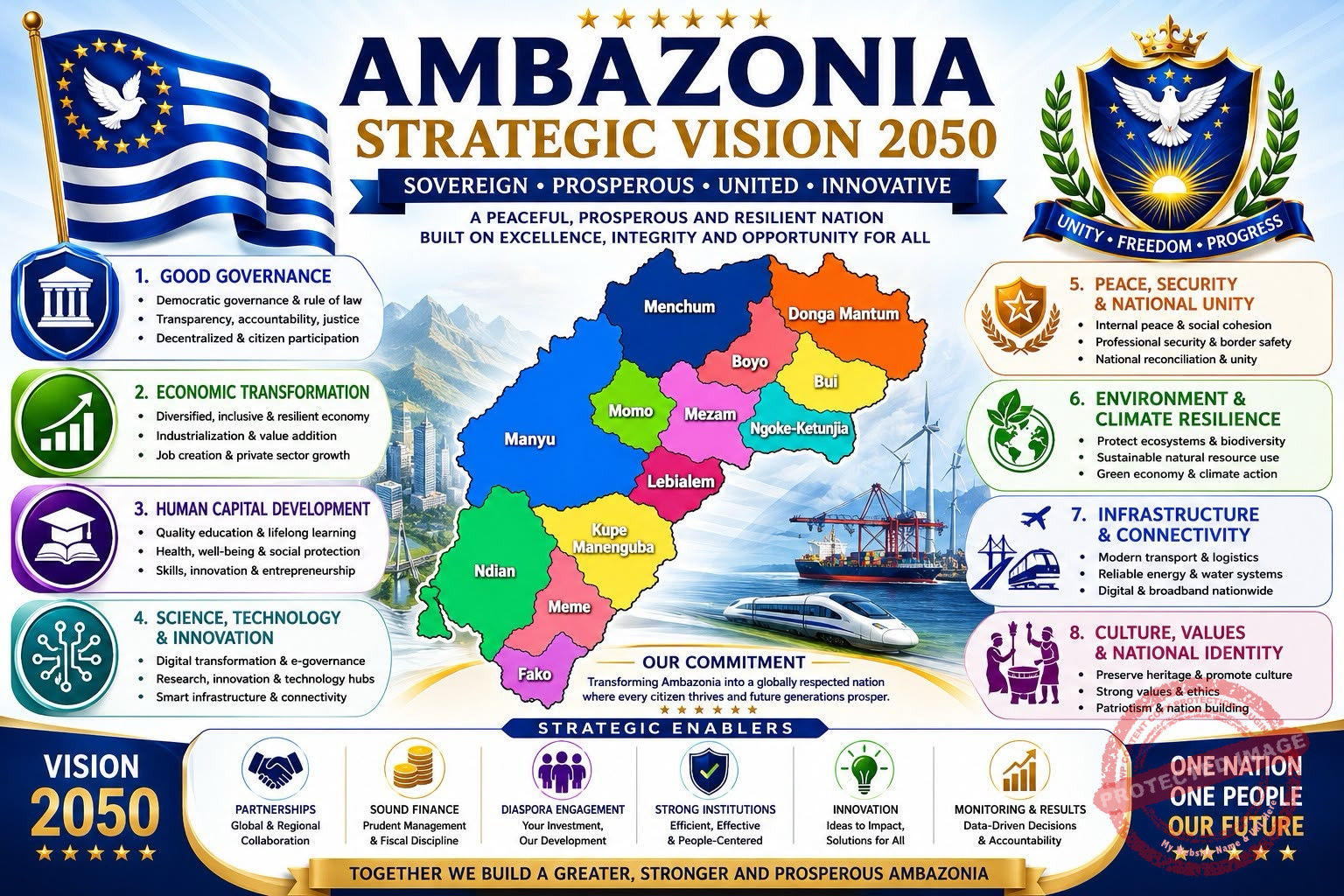
Editorial commentary

We are home to news on Cameroon and the CEMAC region. We are dedicated to honest and reliable reporting. We are the voice of the Cameroonian people and their fight for freedom and democracy at a time when the Yaoundé government is silencing dissent and suppressing democratic voices.

The challenge before Ambazonia is therefore larger than political independence. It is to build enough constitutional, economic, intellectual, productive, and institutional redundancy that no single gate can ever hold the Republic hostage. And the greatest mistake a future Ambazonia could make would be to win the political struggle while leaving that imperial gate exactly where empire built it.
By Martin S. Mungwa, Ph.D., Fellow ASCE
Contributor The Independentist News
Empires do not survive for centuries by fighting every adversary. They survive by knowing when to fight, when to trade, when to negotiate, when to retreat, and when to allow somebody else to carry the visible burden of control. That distinction matters enormously to Southern Cameroons.
Britain is frequently remembered as the empire of the Royal Navy, colonial governors, missionaries, plantations, and red uniforms, but British power was also commercial. Shipping, banking, insurance, commodity markets, ports, finance, professional services, and access to overseas markets could preserve influence long after formal political control had ended. The lesson is not that Britain somehow reconquered the United States through free trade. It did not. The United States became an independent republic and eventually a formidable rival. The more useful historical lesson is that Britain discovered that commercial influence could survive political defeat.
Political sovereignty and economic influence are not the same thing. A country does not have to occupy another physically to benefit disproportionately from its productive system. Influence can operate through finance, ownership, processing, shipping, insurance, technology, market access, and control over where value is added. The flag may leave while the economic gate remains.
That observation raises the question that should sit at the center of every serious African discussion of decolonization: Who owns the productive asset, who captures the recurring economic return, who carries the risk, and what remains in the producing society after the commodity has left?
When Free Trade Becomes Strategy
After losing political control of the American colonies, Britain did not decide that every relationship with the new republic must end. British merchants, manufacturers, financiers, and shipping interests remained deeply connected to the expanding transatlantic economy. America was politically sovereign, yet British commercial interests could still participate in and profit from its growth.
The strategic lesson was important. Military occupation is expensive. Commercial relationships can preserve influence without the administrative burden of ruling another people. Governors may be expelled while contracts survive. Flags may change while banks remain. Colonial ministries may disappear while commodity relationships, maritime networks, financial connections, and professional services continue.
A sophisticated imperial power therefore asks a different question from the ordinary conqueror. It does not ask only whether it can govern a territory. It asks whether it can continue benefiting from that territory’s productive flows without carrying the military and political cost of governing it directly. That is where Southern Cameroons enters the story.
Federalism Made America Harder to Capture
There was another reason Britain could remain commercially influential in America yet could not restore political domination. The American constitutional order developed something that an engineer immediately recognizes: redundancy.
The United States is one sovereign federal republic, not fifty independent countries. Yet significant constitutional authority is distributed among the federal government and the states, while economic power is further dispersed among cities, municipalities, courts, legislatures, universities, ports, financial centers, industries, and regional economies. Washington is immensely powerful, but Washington is not America.
California did not need to become the national capital to develop world-class technology and agriculture. Texas developed enormous energy capacity. New York became one of the world’s great financial centers. Massachusetts built extraordinary concentrations of universities, medicine, research, and biotechnology. Washington State developed aerospace and technology. Illinois became a major center of transportation, commodities, industry, and finance. That is polycentric power.
Britain could trade with America. It could lend to America, invest in America, and profit from America. But there was no single American gate that London could capture and thereby command the entire republic. This distinction is fundamental. In engineering, we deliberately avoid unnecessary single points of failure. If the survival of an entire system depends upon one component, one feeder, one transformer, one communication channel, or one control center, the system is vulnerable by design.
Nations are not electrical grids, but the systems principle is remarkably similar. A state whose political, financial, administrative, regulatory, and economic power converges excessively at one point creates its own strategic vulnerability.
What Different Institutional Systems Taught Me
I came to appreciate this distinction not from political theory alone but from moving through very different institutional cultures during my own professional journey. I was educated within the British academic tradition and later entered the French engineering and research environment. I taught engineering and held administrative responsibility within Cameroon’s Francophone École Polytechnique in Yaoundé. My professional journey eventually brought me to the United States, where I worked within engineering, infrastructure, management, and business institutions.
What struck me about America was not simply its wealth. It was the geographical dispersion of productive power. Washington governed, but New York financed. Houston powered. California innovated. Boston educated and researched. Chicago traded and transported. Productive centers emerged hundreds or thousands of miles from the political capital.
As an engineer, I recognized the principle immediately. Redundancy creates resilience. Yet many African states inherited almost the opposite architecture. Political authority was concentrated. Budgets were concentrated. Contracts were concentrated. Security decisions were concentrated. Regulatory authority was concentrated. Foreign relations were concentrated. Then we wondered why gaining influence over the center could provide disproportionate influence over the entire system.
London, Paris, and the Problem of Concentration
Britain and France themselves developed with greater concentration around their capitals than the American federal model. London accumulated enormous political, financial, legal, diplomatic, media, and commercial influence. Paris became even more closely associated with a centralized administrative tradition in which national authority radiated outward from the capital.
This does not mean that Manchester, Birmingham, Edinburgh, Lyon, Marseille, Toulouse, Bordeaux, or other regional cities were economically insignificant. They plainly were not. The important distinction is institutional. Neither Britain nor France historically developed the same type of constitutionally protected territorial autonomy distributed among powerful constituent states that became characteristic of the United States.
The French administrative tradition is especially important because elements of that centralizing philosophy travelled with empire. Colonial systems are easier to administer when taxation, public administration, security, regulation, infrastructure, and political authority pass through relatively few gates. That architecture can survive political independence even after the colonial flag disappears.
Cameroon inherited a strongly centralized version of this logic. Yaoundé became the dominant political and administrative center. Douala became the principal commercial gateway. Regions could possess enormous natural resources while remaining dependent upon decisions made elsewhere. That is concentration rather than genuine polycentric development. And concentration makes capture easier.
The Entente Cordiale and the New Imperial Calculation
Britain and France spent centuries competing across Europe, North America, Africa, Asia, and the seas connecting them. The Entente Cordiale of 1904 changed that strategic calculation. It would be historically careless to argue that the Entente Cordiale was secretly created to dominate Southern Cameroons. It was not. Southern Cameroons in its later constitutional form did not yet exist, and the agreement contained no such provision.
Its wider importance lies elsewhere. Britain and France increasingly recognized that accommodation could sometimes protect their larger interests better than confrontation. Each could tolerate areas in which the other enjoyed greater strategic influence rather than continually contesting every piece of geopolitical terrain.
France later developed durable political, military, administrative, commercial, monetary, and elite relationships throughout Francophone Africa, a postcolonial architecture commonly discussed under the broad concept of Françafrique. Britain developed a somewhat different network through finance, commerce, professional services, education, diplomacy, the Commonwealth, and international markets.
Southern Cameroons eventually found itself caught between these historical systems. France became the more visible external power associated with the centralized state in Yaoundé. Britain became increasingly comfortable in the background. France occupied the foreground while Britain adopted the posture of the concerned spectator.
This does not establish conspiracy. It suggests something more subtle and potentially more durable: strategic convergence and mutual restraint. States do not always require secret instructions when their interests already move in compatible directions. Southern Cameroons Once Contained the Seeds of Polycentric Government
This is why the dismantling of the federal system in Cameroon was more consequential than the disappearance of a constitutional label. Federalism created the possibility that West Cameroon could preserve meaningful political institutions, judicial traditions, educational structures, administrative capacity, budgetary priorities, and productive assets while participating in a larger federal state.
It created institutional redundancy. Buea did not have to become Yaoundé. Victoria did not have to become Douala. Bamenda did not have to wait for every meaningful development decision to travel through the national capital. The Cameroon Development Corporation could exist as a significant regional productive institution. Courts could preserve the common-law tradition. Schools could maintain an Anglosaxon educational culture. Local government could develop administrative competence. Political leadership could emerge from within West Cameroon without complete dependence upon Yaoundé.
This was more than administrative decentralization. It contained the seeds of polycentric government. When federalism disappeared, one of the structural safeguards against excessive political and economic concentration disappeared with it.
The chokepoint tightened.
Centralization Makes External Influence Easier An external power attempting to influence a genuinely polycentric system encounters numerous centers of authority. It confronts different governments, legislatures, courts, corporations, universities, media institutions, local constituencies, investors, and political interests. Capturing one center does not capture everything.
A highly centralized state presents a different opportunity. If political appointments, contracts, resource concessions, major infrastructure, security decisions, taxation, regulation, and foreign relations converge around one capital, an external power needs access to fewer gates. Establish influence over the center and influence over the periphery becomes easier.
This does not mean every centralized government is externally controlled, nor does federalism automatically prevent corruption or foreign influence. The argument is structural: concentrated systems create fewer strategic points through which disproportionate influence can be exercised.
This helps explain why centralized postcolonial states can become convenient partners for powerful foreign governments and corporations. An investor does not necessarily have to negotiate independently with every producing community. A diplomatic partner does not require fifty governors. A corporation seeks the ministry, the regulator, the presidency, and the officials empowered to sign.
What appears administratively efficient can become strategically vulnerable. America’s redundancy helped make domination through one political center more difficult. Cameroon’s centralization created fewer gates. A future Ambazonia should understand the difference. The Conflict Has Also Exposed the Danger of Concentrated Security Systems
The Southern Cameroons conflict has provided another, painful illustration of this principle. One consequence of prolonged conflict has been the exposure of weaknesses that can arise when a security system relies heavily upon centralized command structures, limited logistical corridors, and relatively predictable methods of deployment.
This should not be romanticized. The conflict has destroyed lives, displaced families, damaged schools and livelihoods, and inflicted suffering across communities. Nor should an analysis of institutional weakness become a tactical discussion of how combatants should exploit military vulnerabilities. The broader systems lesson, however, deserves attention.
A government can possess greater manpower, heavier equipment, international recognition, and a larger formal security apparatus while still discovering that concentrated systems may become brittle. If too much operational capability depends upon a limited number of routes, command chains, supply structures, or established patterns of movement, disruption at those points can have consequences disproportionate to the size of the opposing force.
That is the same principle an engineer sees elsewhere. A power network dependent upon one feeder is vulnerable. A financial system dependent upon one gate is vulnerable. A government dependent upon one capital is vulnerable. A security architecture dependent upon too few channels is vulnerable. The persistence of armed resistance despite the enormous asymmetry between the state and local self-defense formations therefore raises an institutional question rather than merely a military one: has centralization produced rigidity where greater adaptability was required?
The lesson for a future Ambazonia should not be how to prolong war. It should be how to prevent the Republic from ever becoming so centralized that disruption at one point can immobilize the whole. A durable country needs redundancy in transport, energy, communications, public administration, emergency response, food systems, financial networks, and constitutional authority. Resilience must be designed before crisis arrives.
Who Wrote the Story?
This is where Professor Bridget Teboh’s scholarship provides an important methodological warning. History cannot simply repeat the record produced by those who possessed power. The historian must ask who created the archive, who was permitted to speak, whose categories shaped official knowledge, and whose experiences disappeared.
Teboh’s approach deliberately places written archives beside oral testimony, African languages, life histories, biography, songs, proverbs, cultural practices, and other forms of evidence. Her work asks how historians can reconstruct fuller histories without simply repeating the silences embedded in the institutions that created the records.
Southern Cameroons requires precisely that method. British documents matter. French archives matter. United Nations records matter. But Southern Cameroonian parliamentary records, community testimony, plantation histories, land documents, corporate accounts, labor experiences, commodity flows, and family memory matter as well.
The colonial administrator cannot be both defendant and sole witness. The archive must be cross-examined. Teboh’s scholarship on colonial labor sharpens the point further. She asks not simply whether colonial change created employment but what kinds of employment were created, who obtained them, what status those jobs carried, and at what social cost. The same questions should be directed toward Southern Cameroons’ political economy. Who owned the productive assets? Who controlled processing? Who determined prices? Who controlled access to markets? Who captured the higher margins? What remained in the producing community after the commodity had left?
The CDC Was More Than a Plantation
The Cameroon Development Corporation provides a powerful example. For generations, the CDC was one of the most important productive institutions in Southern Cameroons. Describing it merely as a plantation company misses its institutional significance. It created employment and accumulated practical knowledge. Workers learned organization. Supervisors learned management. Communities developed around productive activity. Transport, processing, healthcare, housing, and social systems grew around the enterprise. The CDC therefore contained something more valuable than bananas, rubber, or palm oil. It contained institutional capability.
A serious analysis of extraction cannot stop at asking how many tons of produce left the territory. It must ask how much productive knowledge, processing capability, ownership, finance, technology, management experience, and reinvestment remained where those commodities originated.
If bananas leave Tiko while higher-value margins accumulate elsewhere, the plantation can remain productive while the surrounding community remains economically weak. If rubber leaves Southern Cameroons in lower-value form and returns embedded in expensive manufactured products, somebody else captured the industrial transformation. If palm oil is cultivated locally while processing, branding, finance, and distribution are predominantly controlled elsewhere, the producing territory remains close to the bottom of the value chain. The problem is not trade. Trade is indispensable. The problem is trade that fails, generation after generation, to accumulate enough productive power where the resource originates.
PAMOL and the Question of the Surplus
PAMOL raises the same structural issue. It is not enough that plantations generate palm oil, rubber, employment, and export income. We must ask what happens to the surplus. Does it regenerate the productive asset? Does it improve infrastructure? Does it finance agricultural research and downstream industries? Does it help create engineers, agronomists, managers, entrepreneurs, and owners? Does it build locally controlled capital capable of financing another generation of productive enterprise? Or does the commodity leave while the producing territory remains dependent upon external capital, technology, markets, and decision-makers? That is the difference between an economy that circulates value and one that merely exports it.
The Banana Leaves—What Comes Back? The banana economy makes the question impossible to avoid. A banana grown in the fertile coastal belt of Southern Cameroons leaves the plantation and enters a much longer economic chain. Shipping, insurance, importing, distribution, finance, packaging, logistics, and retail all contribute additional value.
That does not automatically constitute exploitation. Legitimate value chains require multiple functions, and each participant may create genuine economic value. The developmental question is different: does the producing society progressively acquire ownership and capability further along that chain, or does it remain permanently confined to its lowest-value stages?
If one generation grows bananas and the next generation is still merely growing bananas while other societies control finance, branding, logistics, technology, distribution, and access to the final consumer, political sovereignty has not yet produced full productive sovereignty. The banana is not the problem. The architecture surrounding the banana is.
Britain’s Extraordinary Transformation Into a Spectator
Britain deserves particular scrutiny because it administered Southern Cameroons under international trusteeship. Britain was not an innocent outsider at the constitutional beginning. It participated in the process leading to the 1961 plebiscite. It understood that Southern Cameroons and the already independent La République du Cameroun emerged from different colonial experiences and possessed distinct legal, educational, political, and administrative traditions. Yet as federal institutions were progressively dismantled, Britain increasingly treated the consequences as matters belonging principally to Cameroon’s internal political order.
The trustee became the spectator. The administering authority became the concerned foreign government. The country involved in the political transition eventually appeared to stand at a distance from the constitutional consequences. Britain can legitimately argue that contemporary Cameroon is a sovereign state. Southern Cameroonians can legitimately ask in return: When does respect for another state’s sovereignty extinguish historical responsibility for the consequences of a trusteeship transition in which one participated? That question deserves historical examination rather than diplomatic avoidance.
France in Front, Britain Behind
France’s postcolonial role has always been easier to see. French administrative influence, political relationships, military cooperation, and commercial connections were comparatively visible. Britain required less visibility. Once France became the dominant external partner of Yaoundé, Britain did not necessarily need to compete for precisely the same position. The older logic of Anglo-French accommodation created another possibility: tolerate France’s more visible relationship, preserve diplomatic cooperation, avoid destabilizing a recognized state, maintain commercial relations, express humanitarian concern when conditions deteriorate, encourage dialogue, and remain distant from the foundational constitutional question. No secret conspiracy is necessary to produce such an outcome. International systems often reproduce themselves because powerful actors find the existing arrangement compatible with their interests.
Chatham House and the Architecture of Strategic Knowledge.
Empire has always required more than soldiers and merchants. It also requires ideas. Somebody defines a problem before government decides how to respond. Somebody influences which governments are described as stable, which political movements are considered credible, which conflicts are classified as internal, which commodities are regarded as strategic, and which African demands become respectable subjects of international diplomacy.
Today, that intellectual work occurs across universities, policy institutes, financial institutions, diplomatic forums, consulting firms, development organizations, and international agencies. Chatham House, the Royal Institute of International Affairs, represents one influential part of that British policy ecosystem.
Calling Chatham House a literal imperial command center would go beyond the evidence. Its actual importance is more sophisticated. Institutions of this type participate in producing, debating, and circulating strategic knowledge. They help frame problems, convene political and economic actors, and shape the vocabulary through which policymakers interpret foreign societies. Ideas precede policy much as design precedes construction.
The deeper question is therefore not whether Chatham House gives commands. It is whether African societies possess institutions with equivalent intellectual capability to define African problems according to African priorities. If London interprets Southern Cameroons primarily through security, humanitarian relief, decentralization, or stability, British policy will naturally be influenced by that framework. If Paris frames the matter principally through territorial integrity and state security, France responds from that perspective. If Washington views Africa primarily through strategic minerals, competition with China, terrorism, migration, or markets, American policy will reflect American priorities. Who defines Southern Cameroons from the standpoint of Southern Cameroonians? A people unable to define its own problem will eventually receive somebody else’s solution.
The Final Chokepoint May Be Intellectual
This may be the most sophisticated form of dependency. Once a society understands itself entirely through categories produced somewhere else, empire no longer needs a governor. Resources become “investment opportunities” before citizens ask who owns them. Political grievances become “security challenges” before their constitutional origins are examined. Extraction becomes “foreign direct investment” before anyone measures what productive capability remains. Obedience becomes stability. Dependency becomes partnership. At that point, the chokepoint has moved from the port to the mind. Southern Cameroons therefore cannot outsource its strategic thinking. Political liberation without intellectual sovereignty remains incomplete.
America and the Modern Enforcement System
The United States adds another layer to this architecture. America itself was born in rebellion against British imperial rule, yet it eventually became one of the central organizers of the postwar financial, technological, commercial, diplomatic, and security system.
American influence today does not depend primarily upon colonies. It operates through finance, multinational corporations, technology, diplomacy, sanctions, alliances, intelligence relationships, consulting, lobbying, and international institutions. This does not justify describing Americans collectively as corrupt, nor does it mean America is merely Britain’s empire under another name.
The more serious question concerns political, corporate, financial, lobbying, consulting, and other actors who may profit from arrangements that make extraction efficient while describing those arrangements as development. Modern empire does not always require imperial loyalty. Sometimes it requires only a profitable contract.
A consultant designs a transaction. A bank finances it. A law firm writes the agreement. A lobbying firm protects reputations. A corporation controls the asset. A political adviser supplies the language of reform. Everything may be legal.Yet the developmental questions remain. Who owns the asset? Who controls the technology? Who determines the price? Who controls processing? Who retains the intellectual property? Who receives the recurring return after the original investment has been recovered? These questions distinguish partnership from extraction.
London Thinks, Paris Protects, Washington Enforces?
One provocative shorthand would be to say that London thinks, Paris protects, and Washington enforces. It should be understood as an analytical metaphor, not as an allegation of a coordinated command structure. There is no need to imagine Britain, France, and the United States sitting in one room directing an imperial machine. Functional convergence is enough.
British institutions may help produce influential policy frameworks. France can draw upon longstanding political, commercial, military, and administrative relationships across Francophone Africa. American financial, technological, corporate, diplomatic, and security power can reinforce an international order that prizes recognized governments, enforceable contracts, strategic access, and geopolitical stability.
Nobody has to issue secret instructions. The system can reproduce itself because incentives converge. That is more important than conspiracy. The Flag Can Retreat While the Invoice Remains Discussions of empire often remain trapped in outdated imagery. People search for colonial governors and conclude that empire has disappeared because the governor has gone home. Contemporary influence can operate through markets rather than ministries, banks rather than barracks, ownership rather than occupation, intellectual property rather than annexation, and financial agreements rather than imperial decrees. The flag can retreat while the invoice remains.
A country can possess an anthem, parliament, president, and internationally recognized borders while remaining heavily dependent upon external actors for capital, technology, markets, processing, security, and the monetization of its own resources. That is sovereignty in law without full productive sovereignty in practice.
Follow the Commodity, Not Only the Constitution
Southern Cameroons therefore needs two histories written simultaneously. One must follow the constitution and ask what happened to federalism, legal institutions, education, local administration, and political guarantees. The other must follow the productive asset.
Follow the banana from Tiko. Follow palm oil and rubber. Follow timber and petroleum. Follow the professional whose education was financed by family and community sacrifice but whose productive life subsequently enriches another economy. Follow the contract. Follow ownership. Follow where processing occurs. Follow where the recurring return accumulates. Then another geography becomes visible.
The most important colonial border may not always be drawn on a map. Sometimes it runs through the value chain. Ambazonia Must Not Build Another Yaoundé This brings the argument back to federalism and to the future. A future Ambazonia would make a profound mistake if it removed Yaoundé only to reproduce Yaoundé in Buea.
The Republic should be deliberately polycentric. Buea can perform constitutional and coordinating functions without absorbing the country. Victoria can develop as a maritime, port, commercial, and international logistics center. Tiko can become an airport, agro-industrial, and logistics center. Bamenda can strengthen its role as a highland center of education, enterprise, agriculture, technology, and national institutions. Mamfe can function as an important northwestern transportation and commercial connector. Counties and local governments should be encouraged to develop productive specializations of their own rather than becoming administrative dependents of a distant capital.This is not duplication for duplication’s sake. It is strategic redundancy.
It disperses opportunity. It limits political capture. It encourages regional innovation. It keeps more productive value near the communities in which that value originates. Most importantly, it makes the Republic harder for either a foreign power or a domestic ruler to dominate through one political gate.
The United States demonstrates the resilience that multiple productive centers can create. Ambazonia should learn from that experience without mechanically copying it. Do Not Replace One Gatekeeper With Another It is easy to condemn Britain, France, or powerful American actors. It is harder to guarantee that tomorrow’s Ambazonia will not reproduce the same architecture under new management.
If independence produces a small domestic elite capable of signing away forests, minerals, petroleum, ports, fisheries, data, infrastructure, or future tax revenues in exchange for immediate cash, the flag will have changed while the extraction mechanism remains. If foreign investors own the productive assets while citizens receive wages but accumulate little ownership, the gate remains.
If leaders spend resource revenues without building education, technology, infrastructure, research, and replacement productive assets, the gate remains. If diaspora elites merely replace Yaoundé elites, the gate remains.Liberation cannot mean changing the person guarding the extraction gate. It must mean redesigning the gate.
Ambazonia Needs Its Own Intellectual Command Center
A future Ambazonia must therefore develop institutions capable of independent strategic thought. Not propaganda offices. Not praise houses for presidents. Independent institutions capable of studying energy, artificial intelligence, trade, finance, security, constitutional law, infrastructure, agriculture, climate, public health, education, natural resources, and international markets. They must be able to tell a president that he is wrong. They must be able to tell an investor that a contract is bad. They must be willing to challenge liberation leaders and diaspora assumptions.
If Britain has Chatham House, Ambazonia should eventually build institutions whose scholarship and analysis are taken seriously in London, Washington, Brussels, Abuja, Addis Ababa, and New York. A nation that imports all of its strategic thinking will eventually import somebody else’s priorities. That is why intellectual sovereignty matters.
The Five Tests and the Hard Measurement of Freedom
A future Ambazonia should ultimately be judged not by the emotional force of liberation rhetoric but by five demanding tests: constitutional legitimacy, administrative effectiveness, civilian protection, productive capacity, and external relations.
A legitimate republic must derive authority from constitutional consent rather than revolutionary credentials alone. It must administer competently rather than merely declare sovereignty. It must protect civilians regardless of political allegiance. It must build and preserve productive capability rather than consume inherited assets. And it must conduct foreign relations without surrendering the strategic autonomy it fought to obtain.
These tests are connected. Constitutional legitimacy without administrative capacity produces frustration. Administrative effectiveness without civilian protection produces authoritarianism. Civilian protection without productive capacity becomes fiscally fragile. Productive capacity without sound external relations leaves the economy vulnerable. External recognition without legitimate domestic institutions produces a state that may exist internationally while remaining hollow internally.
Beneath all five tests lies one recurring economic question: Who owns the productive source, who receives the recurring value, and what remains for the generation that follows? That is a more serious measurement of independence than the presence of a flag.
Time Is Money—and Sovereignty Is Also About Time
Successful societies understand that time itself is productive capital. As an engineer, I learned early that delay has a cost. A project delayed does not merely arrive later; capital remains tied up, escalation increases costs, opportunities disappear, and the public waits longer for the asset it financed. The same principle applies to nations. A commodity delayed at a port loses value. A business trapped in bureaucracy loses opportunity. A child who loses five years of education loses more than classroom time; the country loses years of future productivity.
A conflict continuing for another decade consumes not only lives but engineers never trained, factories never constructed, farms never modernized, research never undertaken, businesses never established, and taxes never collected. Extraction is therefore not only about what leaves. It is also about what never gets created. That may ultimately become one of the greatest economic costs of the Southern Cameroons conflict.
A More Sophisticated Africa Must Demand a Different Relationship The time of reckoning should not mean revenge. It should mean accounting. Britain should confront the constitutional and economic consequences of its trusteeship decisions. France should confront the legacies of Françafrique and centralized political relationships that frequently favored continuity and state stability over institutional pluralism. American political, financial, and corporate actors should be judged by whether their investments create durable local capability or merely make extraction more efficient.
Cameroon’s authorities must confront the fact that military force has not resolved the underlying constitutional grievance. Ambazonians must confront something equally difficult: whether the institutions they propose are actually better than those they condemn. There is no liberation in replacing one extraction network with another.
The Empire Adapted. Ambazonia Must Learn Faster
Britain’s historical genius was adaptation. When direct rule became expensive, commercial influence could remain. When confrontation with France became strategically inconvenient, accommodation became useful. When formal empire became politically unsustainable, other networks of influence survived. France adapted as well. America learned to exercise enormous international influence through finance, technology, diplomacy, security, and markets. But America also demonstrated another lesson worth studying: a large polycentric federation containing multiple productive centers is much harder to dominate through a single gate.
The Southern Cameroons conflict has revealed the same systems lesson in a harsher setting. Concentrated political, economic, and security structures may appear powerful, yet concentrated systems can also become brittle. Resilience does not come from pretending failure will never occur. It comes from ensuring that failure at one point cannot bring down everything else. That is what states do when they think strategically. They design systems around their interests.
The greatest mistake Ambazonians could make is expecting Britain, France, the United States, China, Russia, Nigeria, or any other external power to design Southern Cameroons’ future primarily for Southern Cameroonians. They will protect their interests. Ambazonia must learn to protect its own. That means studying treaties while following the money, studying constitutions while following commodities, studying foreign investment while examining ownership, studying exports while measuring what value remains at home, and studying think tanks while asking who defines the problem.
It also means designing a Republic with enough constitutional, economic, institutional, logistical, and intellectual redundancy that no president, city, ministry, corporation, foreign state, financial institution, communication system, or transport corridor can become its single point of failure. That, to me, is one of the deepest lessons engineering offers political economy. We do not create resilience by assuming that nothing will ever fail. We create resilience by designing systems capable of surviving failure, disruption, capture, and change.
A Republic deserves the same seriousness of design. Empire does not always have to defeat a people on the battlefield. Sometimes it only needs to control the gate through which their wealth, ideas, technology, and strategic choices must pass. The challenge before Ambazonia is therefore larger than political independence. It is to build enough constitutional, economic, intellectual, productive, and institutional redundancy that no single gate can ever hold the Republic hostage. And the greatest mistake a future Ambazonia could make would be to win the political struggle while leaving that imperial gate exactly where empire built it.
Martin S. Mungwa, Ph.D., Fellow ASCE
Contributor The Independentist News
Share This Post:
SAKO’S PRESS CONFERENCE: AMBAZONIA HAS SURVIVED THE STORM—NOW IT MUST BE WATCHFUL, Ten Years After It Was Expected to Collapse, the Southern Cameroons Question Remains Alive.
NEW IN THE INDEPENDENTIST NEWS: (DEAR SPIRITUAL LEADER) A New Spiritual, Personal, and Family Guidance Column for our readers
Related Post
AMBAZONIA’S WAR- IS BIGGER THAN YAOUNDÉ: BRITAIN, FRANCE AND
THE DAY SEPTEMBER 22 1961: — WHAT AMBAZONIA CAN
TRUMP’S “SUPER INTELLIGENCE” ERA: WHAT IT REALLY MEANS —
Why Is Ambazonia More Powerful Than many Imagine.
THIS DAY IN HISTORY SEPTEMBER 22, 2017: THE DAY
A President Unseen, a Country Waiting: Yaoundé’s Succession Uncertainty