








Commentary

We are home to news on Cameroon and the CEMAC region. We are dedicated to honest and reliable reporting. We are the voice of the Cameroonian people and their fight for freedom and democracy at a time when the Yaoundé government is silencing dissent and suppressing democratic voices.

As history has repeatedly shown, when governments become increasingly anxious about controlling information, observers inevitably begin asking why. And when official denials become louder than the questions they seek to silence, many conclude that there may be more at stake than the authorities are willing to admit.
By Lester Maddox. Guest Contributor, The Independentist News, Oakland County, California
YAOUNDÉ – 21 June 2026 – Political systems often reveal their greatest weaknesses not during moments of open crisis but during their attempts to deny that a crisis exists. In highly centralized states, where power is concentrated in a single individual or a small ruling circle, official reactions to rumors and speculation can sometimes become as significant as the rumors themselves. This dynamic has once again come into focus following reports concerning the health of Cameroon’s long-serving president, Paul Biya, and the unusually forceful response issued by government officials.
Recent reports published by the pan-African magazine Jeune Afrique alleged that President Biya experienced a serious medical episode following his appearance at the May 20 National Day celebrations and was subsequently transported to Switzerland for specialized medical care. The reports attracted widespread attention across Africa and among international observers because they touched upon a question that has long remained politically sensitive within Cameroon: the health and succession of a leader who has governed the country for more than four decades.
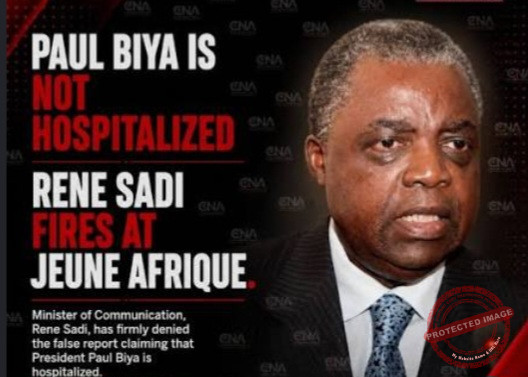
The government’s response was swift and unusually aggressive. René Emmanuel Sadi, Minister of Communication and official government spokesperson, strongly rejected the reports, describing them as false, malicious, and intended to destabilize state institutions. Official statements warned media organizations against repeating what authorities characterized as unfounded speculation.
Yet it was precisely the intensity of this response that generated further discussion. For many observers, the government’s reaction appeared disproportionate to the reports themselves. Rather than ending speculation, the forceful denial encouraged additional questions regarding why the matter had provoked such a strong official response. In politics, as in ordinary life, attempts to suppress discussion can sometimes attract more attention than the original claims.
The controversy highlights a deeper structural issue within highly personalized political systems. When power is concentrated in a single individual for decades, the stability of state institutions can become closely associated with the physical condition of that individual. Questions regarding leadership succession, continuity of governance, and institutional resilience inevitably become matters of public concern. The longer a system depends on one central figure, the more sensitive those questions become.
For many years, information regarding the president’s health has been treated as a closely guarded matter by the authorities. Public appearances have been carefully managed, official communications tightly controlled, and speculation routinely dismissed. This culture of secrecy has contributed to an environment in which rumors flourish precisely because reliable information is scarce. When transparency is absent, uncertainty naturally fills the vacuum.
Critics argue that the recurring controversy surrounding the president’s health reflects a broader weakness within the political system itself. Strong institutions are designed to function regardless of the condition of any single individual. In contrast, systems built around one dominant personality often struggle to reassure citizens and investors when questions about leadership arise. As a result, discussions about the health of the head of state become inseparable from debates about the future of the nation.
For Ambazonian observers, the situation carries additional significance. Many view the uncertainty surrounding leadership in Yaoundé as evidence of the fragility of a political structure that has resisted meaningful institutional reform for decades. They argue that a system dependent upon the continued authority of one aging leader inevitably faces growing pressure as questions about succession become unavoidable.
Whether the reports concerning President Biya’s health are entirely accurate or not, the political reaction to them has revealed important realities about governance, transparency, and public confidence. Governments secure trust not through censorship or defensive statements but through openness, accountability, and strong institutions capable of functioning beyond the tenure of any individual leader.
The debate sparked by the recent reports is therefore about more than one man or one medical condition. It concerns the future stability of Cameroon itself and the ability of its institutions to withstand the challenges that accompany political transition. In that sense, the controversy serves as a reminder that the true measure of a state’s strength is not the longevity of its ruler but the resilience of its institutions.
As history has repeatedly shown, when governments become increasingly anxious about controlling information, observers inevitably begin asking why. And when official denials become louder than the questions they seek to silence, many conclude that there may be more at stake than the authorities are willing to admit.
Adapted from commentary concerning recent reports about the health of President Paul Biya and the political response of Cameroon’s communication authorities.
Lester Maddox Guest Contributor, The Independentist News, Oakland County, California
Share This Post:
THE ABSENT DICTATOR AND THE CONSTITUTIONAL FARCE—WHERE IS PAUL BIYA?
THE GEOPOLITICAL SILENCE: WHY INTERNATIONAL INSTITUTIONS FAIL TO CONFRONT THE AMBAZONIAN GENOCIDE
Related Post
AMBAZONIA’S WAR- IS BIGGER THAN YAOUNDÉ: BRITAIN, FRANCE AND
THE DAY SEPTEMBER 22 1961: — WHAT AMBAZONIA CAN
TRUMP’S “SUPER INTELLIGENCE” ERA: WHAT IT REALLY MEANS —
Why Is Ambazonia More Powerful Than many Imagine.
THIS DAY IN HISTORY SEPTEMBER 22, 2017: THE DAY
A President Unseen, a Country Waiting: Yaoundé’s Succession Uncertainty