











This is not a book for everyone. It will frustrate those looking for quick answers. It will overwhelm those unwilling to reflect. It will be ignored by those comfortable with the status quo. But for a select few—those willing to confront their financial reality and rebuild it from first principles—it offers something rare: a path to reclaiming control
By The Independentistnews Editorial desk
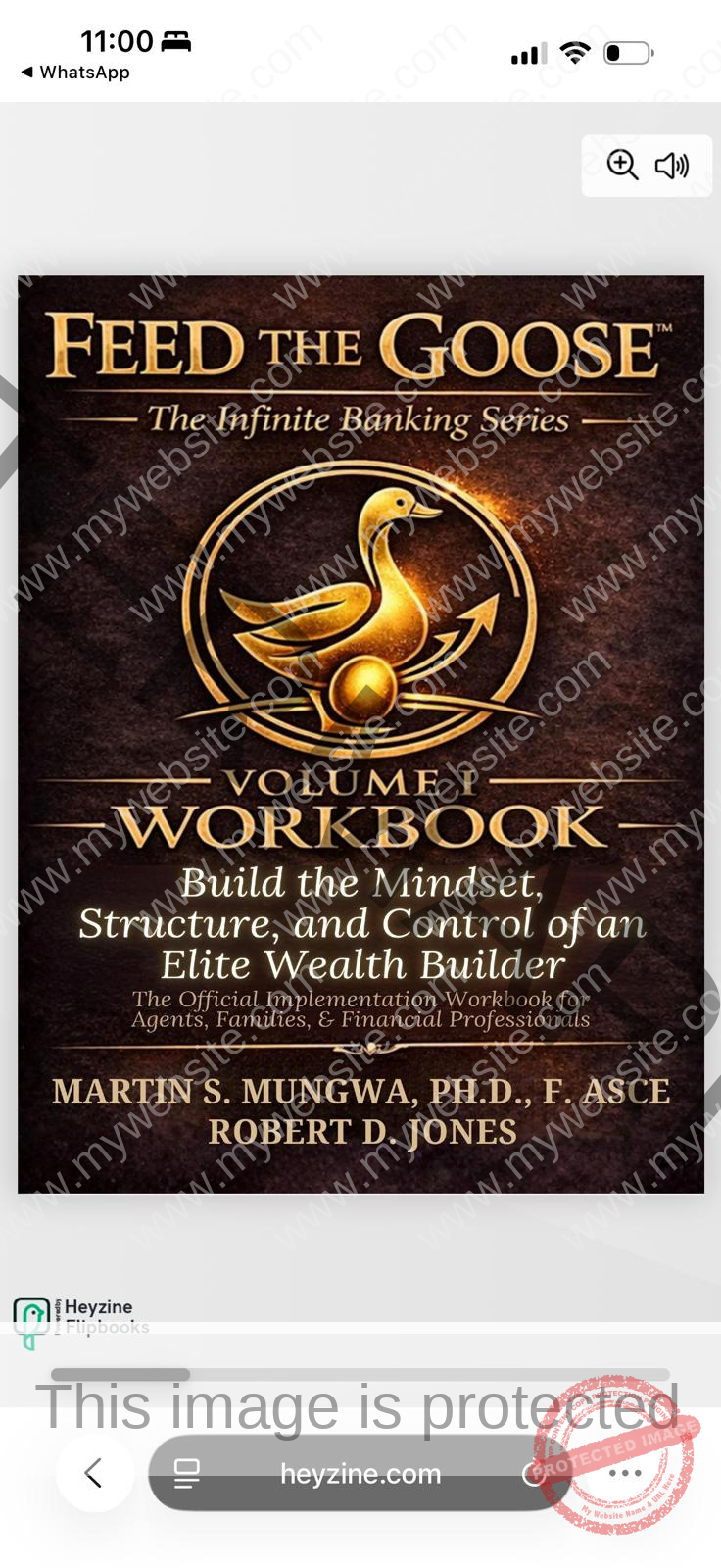
There are books you read—and there are books that read you. Feed The Goose: Volume I Workbook by Dr. Martin S. Mungwa and Robert D. Jones—spanning ten parts across 119 pages—belongs firmly in the latter category. It does not entertain comfort. It does not flatter the reader. It interrogates. It exposes. And, if taken seriously, it reconstructs the very foundation upon which individuals relate to money, control, and ultimately—freedom.
At a time when financial discourse is saturated with shortcuts, speculative hype, and algorithm-driven illusions of wealth, this workbook emerges as something far more dangerous: a manual for independent financial sovereignty.
First: the quiet crisis of financial dependency
Across continents—from Wall Street to small-town communities—millions of individuals operate within financial systems they neither designed nor fully understand. Income flows in. Obligations pull it out. What remains is often too little, too late, and too fragile to build anything enduring. The tragedy is not merely economic—it is structural.
People are not poor because they lack effort. They are constrained because they lack control over the architecture of their money. It is this silent crisis that Feed The Goose confronts head-on.
Second: the goose is not income—it is the system
The central metaphor of the “goose” is deceptively simple. Most people chase the golden egg—income, returns, payouts—without ever asking what produces it. Dr. Mungwa and Jones reverse the equation.
The goose represents a protected, disciplined financial system—a reservoir of capital that is not consumed but circulated, reused, and grown. The egg is merely the byproduct. This distinction is not academic. It is revolutionary. In a world trained to spend first and save what remains, the workbook demands a radical shift: build the system first—then let the system produce.
Third: from passive reading to forced confrontation
Unlike traditional financial literature, this is not a book one “finishes.” It is a book one engages—or avoids at one’s own peril. Each section forces the reader into uncomfortable territory: where is your money actually going? Who controls its movement? What structures are silently eroding your future?
There are no easy answers provided—only structured pathways to discovery. In this sense, the workbook functions less like a guide and more like a mirror. And mirrors, as history shows, are rarely welcomed in systems built on illusion.
Fourth: a philosophy of circular power
Perhaps the most disruptive idea embedded in the workbook is the rejection of linear finance. Traditional systems operate on a straight line: earn, spend, lose control, repeat. The Feed The Goose model proposes a circle: earn, store, deploy, recover, reuse, expand. This circularity is not merely efficient—it is empowering. Money that returns home does not weaken the individual. It strengthens the system. It compounds not only financially, but psychologically—reinforcing discipline, awareness, and independence.
Fifth: why this work matters beyond finance
At first glance, Feed The Goose appears to be about money. It is not. It is about control. And control, when properly understood, extends into every domain: families that build generational stability, institutions that escape predatory financing, communities that fund their own futures. In this light, the workbook becomes something larger: a blueprint for self-determination in an age of structured dependency.
Final verdict: a tool for those ready to take responsibility
This is not a book for everyone. It will frustrate those looking for quick answers. It will overwhelm those unwilling to reflect. It will be ignored by those comfortable with the status quo. But for a select few—those willing to confront their financial reality and rebuild it from first principles—it offers something rare: a path to reclaiming control.
Conclusion: the dangerous simplicity of truth
There is a reason systems of dependency persist. They are easy to follow and difficult to question. Feed The Goose: Volume I Workbook does the opposite. It simplifies the truth while demanding complexity from the reader. Protect the goose. Stop chasing eggs. Build a system that outlives your effort.
In the end, the message is as unsettling as it is liberating: freedom is not a product you purchase. It is a structure you build.
The Independentistnews Editorial desk





Leave feedback about this