

The record may open the door. Statecraft must carry us through it. That is the recalibration. That is the work before us. And that is why I remain confident—not because victory is automatic, but because Southern Cameroonians now possess enough historical experience, professional talent, international exposure and institutional knowledge to make the transition from grievance to governance if we choose discipline over division.
By Prof. Martin Ayim
Commissioned Secretary of State, Home Affairs Commission, Government-in-Exile of the Federal Republic of Southern Cameroons–Ambazonia contributor to The Independentist News
As Amazon associate this site earns from qualifying purchases
Its back to school on Amazon
https://www.amazon.com/s?k=back+to+school+needs&rh=p_6%3AA2N0PBIRR6F78F&dc=&ds=v1%3A1nbdSoXGtNwH6%2F4WC3U9ftjZoWRiEZVr3ED%2BlK%2BzQnc&qid=1788373179&rnid=331539011&linkCode=ll2&tag=njokings-20&linkId=121539b67db07537802409cfc33dfcef&language=en_US&ref_=as_li_ss_tl
There are moments in a liberation struggle when emotion must give way to evidence, when slogans must give way to institutions, and when advocacy must mature into statecraft. I believe Southern Cameroons–Ambazonia has reached such a moment.
For decades, our people have argued that the Southern Cameroons question is not simply an “Anglophone problem,” not merely a disagreement over language, and not simply an internal administrative dispute within Cameroon. The historical record is considerably deeper. It concerns the political status of the former British Southern Cameroons, the terms under which it entered a federal relationship in 1961, the subsequent dismantling of that federal structure, the survival of a distinct political identity, and the unresolved question of what legitimate political relationship can now command the consent of the people.
We should make that argument forcefully. But we should also make it accurately. Our cause becomes stronger when we distinguish what a court actually decided from what a party argued before the court; what a political leader actually said from what we infer from his words; what an agreement actually accomplished from what we wish it had accomplished. Statecraft requires that discipline.
BIYA’S OWN WORDS MATTER—BUT LET US USE THEM PRECISELY
President Paul Biya’s remarks at the 2019 Paris Peace Forum deserve serious attention. Explaining the origins of the crisis, he acknowledged the juxtaposition of territories shaped by British and French colonial systems and discussed the possibility that the English-speaking system might have been integrated into the majority Francophone system. Contemporary reporting and subsequent academic analysis have treated the remarks as a significant acknowledgment of the assimilation problem and the persistence of distinct identities.
Ambazonians do not need to exaggerate those remarks. Their importance is precisely that they came from the President of Cameroon himself. When the head of state publicly acknowledges different inherited systems, different cultural identities, and the difficulty of absorbing one system into another, he confirms something Southern Cameroonians have argued for generations: the problem cannot honestly be reduced to a handful of disgruntled English-speaking citizens. There is a historical and institutional problem. That is the point we should make.
BAKASSI: CAMEROON’S OWN CASE BEFORE THE ICJ IS IMPORTANT
The Bakassi litigation before the International Court of Justice also contains material that Southern Cameroonians should understand carefully. In Cameroon’s own written observations before the Court, Cameroon argued that the Bakassi Peninsula had been part of British Cameroons throughout the mandate and trusteeship periods and stated that Bakassi became attached to the Republic of Cameroon as part of Southern Cameroons following the 1961 UN-supervised plebiscite. That is significant.
It means that, when defending its title to Bakassi, the Republic of Cameroon itself relied upon the historical territorial relationship between Bakassi and British Southern Cameroons. But we should state the next part with equal precision.
The ICJ did not thereby adjudicate that Southern Cameroons is today an independent state, nor did the Court decide the contemporary Ambazonian self-determination claim. The 2002 judgment resolved the Cameroon–Nigeria boundary dispute and held that sovereignty over Bakassi belonged to Cameroon. That distinction does not weaken our argument. It strengthens it.
Our legitimate point is this: Cameroon cannot erase the historical territorial personality of Southern Cameroons when that history was useful to its own international litigation. The record should be studied, preserved and deployed intelligently. That is statecraft.
BANJUL WAS IMPORTANT—BUT LET US SAY EXACTLY WHY
The African Commission on Human and Peoples’ Rights decision in Kevin Mgwanga Gunme et al. v. Cameroon is another important part of this record. The Commission found that the people of Southern Cameroon qualified to be regarded as a “people”, citing characteristics including common history, linguistic tradition, territorial connection, political outlook and self-identification. That is an important finding.
The Commission also found violations of rights protected by the African Charter and recommended constructive dialogue to address constitutional questions and grievances. But intellectual integrity requires us to say something else as well. The Commission did not order the independence of Southern Cameroons. On the facts before it, it rejected secession as the remedy it was prepared to recognize and instead urged comprehensive dialogue. Therefore Banjul should not be presented as though an African tribunal handed Ambazonia a certificate of independence.
Its importance lies elsewhere. It placed the existence, identity, rights and constitutional grievances of Southern Cameroonians into a formal African human-rights record. That is substantial. Let us use what we actually won rather than weaken it by claiming what the decision did not give us.
ABUJA ALSO CREATED A SERIOUS LEGAL RECORD
The Federal High Court proceedings in Abuja are likewise important. In Gumne & Others v. Attorney General of the Federal Republic of Nigeria, Southern Cameroonian applicants sought to compel Nigeria to place questions concerning Southern Cameroons self-determination before international institutions. Scholarly legal analysis records that the case resulted in a court-entered settlement under which Nigeria agreed to take steps concerning the Southern Cameroons self-determination question before the ICJ, the United Nations General Assembly and other relevant international bodies. Again, we should describe this correctly.
The Abuja court did not pronounce Ambazonia independent. But the proceedings created a significant legal and diplomatic obligation in the record and demonstrated that the Southern Cameroons question was capable of being formulated as a matter of international legal and political concern. That record should not be forgotten. It should be studied. It should be followed up. And where obligations remain unimplemented, statecraft means identifying the proper legal and diplomatic mechanisms through which they may still be pursued.
ON BAMENDA: PRODUCE THE JUDGMENT
References are frequently made within our movement to the Bamenda High Court proceedings as another legal victory. If we are going to rely upon that judgment internationally, then our standard should be simple: Produce the certified judgment. Place the case number, parties, date, orders, reasoning and certified text before lawyers, diplomats, academics and the international community.
A liberation movement moving into statecraft cannot ask the world to accept legal conclusions because they circulate on social media. Documents must replace folklore. If the judgment says what we believe it says, then its authority will increase when the complete authenticated record is available for anyone—including our opponents—to examine. That should become our standard everywhere.
THE GREENTREE AGREEMENT MUST NOT BE MISUSED
There is one argument that requires particular correction. The 2006 Greentree Agreement did not generally require Cameroon to withdraw to the territorial boundaries it possessed on January 1, 1960. Its purpose was much narrower and more specific: to establish the modalities for Nigeria’s withdrawal and the transfer of authority in Bakassi following the ICJ’s 2002 boundary judgment. The United Nations explicitly described the Agreement as implementing that judgment.
We therefore should not claim that President Biya signed Greentree as an acknowledgment that Cameroon must surrender all territory not held by the Republic of Cameroun on January 1, 1960. That interpretation goes beyond the document. But the broader historical point remains available to us: the Cameroon–Nigeria litigation repeatedly required international institutions and the parties themselves to examine the boundaries, mandate history, trusteeship history and political evolution of British Cameroons. That historical record matters. We do not need to rewrite Greentree to make the case.
THE 1961 FEDERAL CONSTITUTION SPEAKS CLEARLY ENOUGH
The federal constitutional record is also important and should be quoted accurately. Article 1 of the 1961 constitutional revision stated that the Federal Republic of Cameroun would consist of the territory of the Republic of Cameroun, thereafter called East Cameroon, and the territory of Southern Cameroons formerly under United Kingdom administration, thereafter called West Cameroon. That language is already powerful. We do not need to insert words into Article 1 that are not there.
It establishes that the federal order was built from two territorially identifiable components with different immediate political histories. What happened subsequently—the replacement of federation, the redistribution of powers, the 1984 restoration of the name “Republic of Cameroon,” and the long-term effects on Southern Cameroons political identity—belongs at the center of the constitutional debate. Let lawyers argue the legal consequences. Let historians reconstruct the sequence. Let political scientists examine consent and legitimacy. And let the people ultimately examine the competing constitutional futures being proposed in their name.
THE GOVERNMENT-IN-EXILE MUST NOW CARRY THE BURDEN OF STATECRAFT
For our Government-in-Exile, this historical and legal record creates responsibility. It does not give us permission to declare the work finished. Quite the opposite. If we describe the present Government-in-Exile as continuing or restoring the governmental tradition associated with Southern Cameroons before and during the 1961 transition, that is a constitutional and political proposition that we ourselves must be prepared to defend. The international community will ask hard questions. What is the constitutional basis? How is authority derived? How are institutions accountable? Who speaks for the people? How are political opponents treated? How will armed organizations come under lawful civilian authority? How will public money be managed? How will competing Ambazonian organizations be reconciled? How will Southern Cameroonians who favor federalism or continued union be treated? Those questions are not insults. They are the questions of statecraft.
President Samuel Ikome Sako and any future Southern Cameroons delegation will be stronger at a negotiating table if the delegation arrives not merely with history, but with institutional preparation, constitutional discipline, diplomatic coherence and a credible plan for peace.
THERE MUST BE ROOM FOR EVERY SOUTHERN CAMEROONIAN
Our struggle cannot mature into statecraft while we treat every political disagreement as treason. Independence advocates, federalists, unionists, civil-society actors, traditional rulers, professionals, people currently serving within Cameroon institutions, diaspora citizens and those who have remained politically silent are still Southern Cameroonians. We may disagree profoundly about destination. But if we believe sovereignty ultimately belongs to the people, then political persuasion cannot cancel citizenship.
The Government-in-Exile should therefore invite participation without requiring the abandonment of conscience. Let people examine independence. Let them examine federation. Let them examine continued union. But require every camp to present a serious blueprint. Who governs? Who taxes? Who protects rights? Who controls security? Who owns productive assets? Who manages relations with Nigeria? Who negotiates with Cameroon? What is the policy toward the African Union, United Nations, United States, United Kingdom and other partners? What happens when a government loses an election? What happens when a president leaves office? What survives the founders? That is where political maturity begins.
FROM THE WASHINGTON STRATEGIC CONFERENCE TO A STATECRAFT PARADIGM
The Ambazonia Stakeholders Strategic Conference held in Washington, D.C., in September 2025 should therefore be understood not merely as another political gathering, but as part of a necessary strategic recalibration. The next phase cannot be measured by the number of organizations we create. It must be measured by the quality of institutions we prepare. Our challenge is not to win Facebook. Our challenge is to become credible before governments, international institutions, investors, scholars, diplomats, neighboring states and—most importantly—our own people. If rival organizations emerge, the answer cannot simply be to label all of them agents of Yaoundé unless evidence establishes that charge. Statecraft requires something more durable: build the institution so credible that fragmentation loses its attraction. Leadership must be earned by performance, accountability, discipline and public confidence.
HISTORY CAN OPEN THE DOOR. IT CANNOT WALK THROUGH IT FOR US.
Southern Cameroons possesses a substantial historical archive. There are United Nations records. There are constitutional documents. There are African Commission findings. There are Nigerian court proceedings. There are ICJ pleadings. There are statements by Cameroon itself. There are decades of scholarship, petitions, diplomatic correspondence and political declarations. But let us understand the limit of documents. A court decision cannot administer Buea. A UN resolution cannot balance a treasury. An ICJ pleading cannot operate a port. A constitutional argument cannot keep electricity flowing. Recognition cannot manage a hospital. A declaration cannot build an economy. That is why our struggle must move beyond advocacy.
THE NEXT VICTORY IS GOVERNING CREDIBILITY
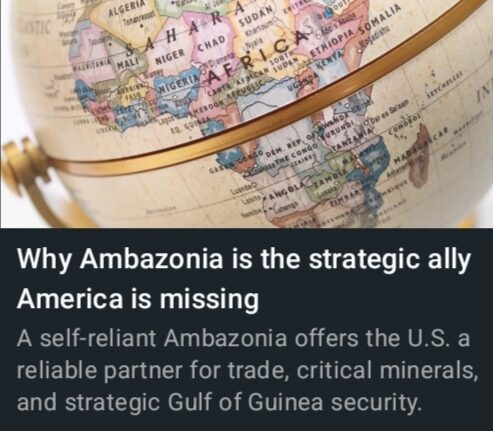
The statecraft phase should now be built around four disciplines. Legal credibility: never claim more from a document than it actually says. Democratic legitimacy: build institutions capable of respecting dissent and political competition. Governing capacity: prepare administration, finance, infrastructure, security, diplomacy and economic systems before the morning after political change. Human-rights credibility: protect civilians and reject abuses irrespective of who commits them. To these I would add a fifth: External reliability. Southern Cameroons must explain how it intends to live with Nigeria, how it intends to live with Cameroon, how it will participate in the Gulf of Guinea, how it will handle regional security threats, how it will negotiate with major powers and how it will welcome partners without becoming captured by them. That is how a liberation cause becomes a prospective state.
AMBAZONIA 2050 & BEYOND: A BLUEPRINT TO BE EXAMINED
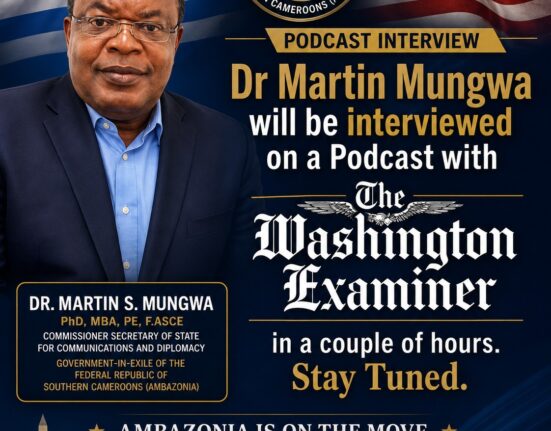
This is why the emerging statecraft literature matters. Ambazonia 2050 & Beyond, developed by Martin S. Mungwa, should be understood as a privately conceived nation-building and statecraft initiative—not as an official publication of the Government-in-Exile. Its value lies precisely in inviting Ambazonians to confront the morning-after questions: What institutions? What economy? What infrastructure? What relationship with America? What relationship with Nigeria? What security architecture? What productive system? What international partnerships? What country are we actually trying to build?Such work should not be treated as sacred doctrine. It should be examined. Criticized. Improved. Expanded. And matched by other serious blueprints. That is how a nation thinks before it governs.
VICTORY IS NOT A DATE—IT IS A CAPACITY
So, is victory at our doorstep? I would put it differently. The historical record has brought us to an important threshold. The legal record contains material we can use. The constitutional argument remains alive. The political grievance remains unresolved. The human cost demands a peaceful settlement. And the international environment increasingly rewards movements that can demonstrate seriousness, discipline, institutional thinking and respect for human rights. But history does not guarantee victory. Law does not automate victory. Suffering does not guarantee recognition. And international sympathy is not sovereignty. Victory requires statecraft.
Our task is therefore to organize the historical case, strengthen the legal case, unify the diplomatic message, prepare governing institutions, protect civilians, develop an economic architecture, engage our neighbors, define our international partnerships and put our plans before the people for critical examination.
The record may open the door. Statecraft must carry us through it. That is the recalibration. That is the work before us. And that is why I remain confident—not because victory is automatic, but because Southern Cameroonians now possess enough historical experience, professional talent, international exposure and institutional knowledge to make the transition from grievance to governance if we choose discipline over division. Good morning, Ambazonia. The era of advocacy alone is ending. IT IS TIME FOR STATECRAFT.
As Amazon associate this site earns from qualifying purchases
Its back to school on amazon
https://www.amazon.com/s?k=back+to+school+needs&rh=p_6%3AA2N0PBIRR6F78F&dc=&ds=v1%3A1nbdSoXGtNwH6%2F4WC3U9ftjZoWRiEZVr3ED%2BlK%2BzQnc&qid=1788373179&rnid=331539011&linkCode=ll2&tag=njokings-20&linkId=121539b67db07537802409cfc33dfcef&language=en_US&ref_=as_li_ss_tl
Prof. Martin Ayim
Commissioned Secretary of State, Home Affairs Commission, Government-in-Exile of the Federal Republic of Southern Cameroons–Ambazonia contributor to The Independentist News