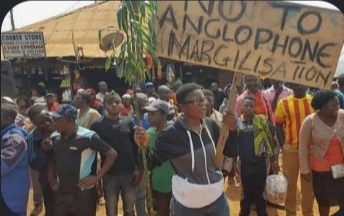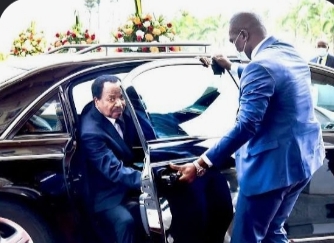


The disintegration of centralized authority in Yaoundé confirms the danger of building a nation around one ruler. It also presents Ambazonia with its own test. Will Ambazonian leaders respond with discipline, institutional preparation, and constitutional clarity?
By Timothy Enongene
Associate Editor-in-Chief, The Independentist News
Buea — August 1, 2026 – The profound administrative paralysis gripping the political establishment in Yaoundé—most recently reflected in highly publicized tensions between the Secretary-General of the Presidency, Ferdinand Ngoh Ngoh, and the Deputy Director of the Civil Cabinet, Oswald Baboke—cannot be dismissed as routine governmental dysfunction. It reveals the structural weakness of a political system built not upon durable institutions, but around the authority, presence, and personal command of a single ruler.
For the Government of the Federal Republic of Ambazonia, this unfolding breakdown does not create the legal basis for restoration; that case rests upon the history of the former British Southern Cameroons, the failed terms of the 1961 union, the destruction of the federal arrangement, and the subsequent constitutional conduct of La République du Cameroun. What the present crisis does is reinforce the political urgency of that legal case. It demonstrates the danger of entrusting the future of an entire people to a centralized state whose continuity depends excessively upon one individual.
After decades of personalized rule, Yaoundé appears increasingly unable to distinguish between the presidency, the ruling party, the government, and the state itself. Institutions that should operate according to constitutional authority instead wait for signals from the presidency. Ministers hesitate. Rival factions maneuver. Senior officials protect their positions while attempting to anticipate an uncertain succession. The result is not orderly government, but administrative survivalism.
A State Built Around One Man
Reports circulating through independent journalistic channels describe mounting anxiety within the Unity Palace, where senior officials are reportedly caught between maintaining the appearance of governmental continuity and protecting their own positions against an approaching transition.
For over and above fifty days, the central figure around whom the Cameroonian political system has been organized has remained physically absent from the country, reportedly receiving medical treatment and recovering in Geneva. In his absence, no transparent constitutional transfer of authority has been announced, no clearly empowered successor has assumed responsibility, and no credible explanation has been provided concerning who is directing the affairs of state.
The issue is not Paul Biya’s right to medical privacy. It is the constitutional right of the population to know who is exercising executive authority. Who is authorizing major decisions? Who is directing the security services? Who is supervising ministers? Who is validating decrees issued in the president’s name? Who bears responsibility when senior officials issue conflicting instructions?
A functioning republic should answer these questions through institutions. A personalized regime answers them through silence, speculation, and factional competition. This is the defining weakness of the Biya system. It was designed to prevent independent centers of authority from emerging. Ministers were made dependent upon presidential favor. Parliament was subordinated to the ruling party. constitutional succession was postponed. Public institutions were weakened so that no official could become more important than the ruler. The system achieved political longevity, but at the cost of institutional continuity.
The Exposure of an Occupying Administration
From the Ambazonian perspective, Yaoundé’s paralysis exposes a deeper contradiction. A government unable to provide transparent and stable leadership within its own central administration cannot credibly present itself as the legitimate and permanent authority over Southern Cameroons/Ambazonia.
For decades, La République du Cameroun has justified its military presence in Ambazonian territory through claims of sovereignty, constitutional order, national unity, and administrative permanence. Yet the present leadership vacuum reveals that the supposed stability of the state depends heavily upon the continued physical and political availability of one man.
An occupying authority operating on administrative autopilot from a foreign clinic possesses neither the moral credibility nor the institutional strength to impose permanent political arrangements upon another people.
This does not mean that the state’s weapons, prisons, administrative offices, and security structures have disappeared. Coercive machinery can continue functioning even when legitimate governance has weakened. Orders may still be transmitted, taxes collected, soldiers deployed, and decrees published. But coercive capacity should not be confused with sovereign legitimacy.
A government may continue occupying territory while losing the political, constitutional, and moral authority necessary to govern it legitimately. The current disorder in Yaoundé reinforces what restorationists have long maintained: the conflict is not merely about administrative grievances within a healthy state. It concerns the forced subordination of a historically distinct territory to a centralized political system whose own constitutional foundations have become dangerously unstable.
The Ambazonian Response Must Be Institutional
The strategic response of the Government of the Federal Republic of Ambazonia should not be to become consumed by succession rivalries inside Yaoundé. The internal competition among Cameroonian political clans is important only to the extent that it affects the security, diplomacy, and political future of Ambazonia.
Ambazonian leaders must resist the temptation to interpret every dispute within the Unity Palace as an immediate victory. The collapse of an occupying regime does not automatically produce the restoration of the occupied state. Political vacuums can also generate military competition, factional violence, renewed repression, opportunistic negotiations, or the emergence of another centralized ruler determined to preserve the same territorial claims.
The immediate task is therefore not celebration, but preparation.
The Government of the Federal Republic of Ambazonia must use this period to strengthen its own institutional credibility, grassroots organization, diplomatic readiness, public communication, and capacity for civilian administration. It must demonstrate that restoration represents more than opposition to Yaoundé. It represents a superior and permanent constitutional alternative.
The population must be shown how public order will be maintained, how local administration will function, how courts will operate, how revenues will be managed, how schools and hospitals will be restored, and how communities will be protected during a political transition. A sovereign claim becomes more persuasive when it is supported by visible governing capacity.
From Resistance to Administrative Readiness
While rival factions in Yaoundé compete over access to the machinery of state, Ambazonia must continue building the institutions necessary for national restoration.
County and local administrative networks should be strengthened. Civilian protection structures should be clarified. Public-service planning should be expanded. Professional associations, traditional leaders, religious institutions, women’s organizations, youth groups, business communities, and the diaspora should be incorporated into a coordinated transition framework.
The objective should be to ensure that no political collapse in Yaoundé creates an administrative vacuum in Ambazonia. The restored republic must be prepared to provide: continuity of essential public services; protection of civilians and property; functioning local administration; emergency health and humanitarian coordination; judicial and community dispute resolution; restoration of schools and educational governance; financial accountability and revenue administration;
protection of minority communities; and disciplined security under civilian constitutional authority.
The strength of the Ambazonian cause will ultimately depend not only upon the weaknesses of La République du Cameroun, but upon Ambazonia’s ability to prove that it can govern differently. Restoration cannot mean replacing one personalized system with another. It must establish institutions stronger than any individual leader, constitutional limits stronger than political factions, and public accountability stronger than wartime loyalty.
The International Community Must Reconsider Its Assumptions
Yaoundé’s present disorder should also compel the international community to reconsider its longstanding assumption that the Biya regime represents stability. For decades, foreign governments treated Paul Biya’s longevity as a guarantee of continuity. They tolerated disputed elections, constitutional manipulation, prolonged absences, institutional weakness, and the militarization of Southern Cameroons partly because they feared that serious pressure might destabilize the country.
That logic has now reached its limit.
A state whose continuity depends upon one elderly ruler is not stable. It is merely postponed instability. A political system without a transparent succession mechanism is not predictable. It is an approaching contest whose participants are already positioning themselves. A government that cannot clearly identify who is exercising executive authority cannot continue demanding international deference on the grounds of constitutional order.
The Commonwealth, La Francophonie, African Union, United Nations, United Kingdom, United States, and other international actors should therefore stop treating the preservation of the Biya system as synonymous with the preservation of peace.
They must prepare for the possibility that Cameroon’s next political transition will be neither orderly nor consensual. They must also acknowledge that Southern Cameroons/Ambazonia cannot be indefinitely held inside a failing political structure merely because the international community fears reconsidering inherited borders.
The Restoration Case Predates the Collapse
The Ambazonian case must remain grounded in history and law rather than opportunism. The claim to restoration did not begin with Biya’s absence. It did not arise from a dispute between Ngoh Ngoh and Baboke. It is not dependent upon the illness, death, resignation, or political removal of any Cameroonian official.
It rests upon the distinct history of the former British Southern Cameroons, its internationally recognized territorial identity, the circumstances of the 1961 plebiscite, the terms under which the union was presented, the destruction of the federal arrangement, and the subsequent restoration by La République du Cameroun of the name it possessed before the union.
The present leadership crisis is therefore evidence of systemic failure, not the source of Ambazonian sovereignty. That distinction is essential. It protects the restoration movement from appearing to build its case upon the personal misfortune of an aging ruler. The argument is not that Ambazonia should be free because Paul Biya is absent. The argument is that the prolonged absence exposes the institutional emptiness of a state that has claimed permanent authority over Ambazonia while refusing to address the legal and constitutional foundations of that claim.
A Window That Must Not Be Wasted
The crisis in Yaoundé has created a strategic window, but windows do not remain open indefinitely. A successor regime may attempt to repackage the same centralized system with a younger face. It may offer selective reforms, symbolic appointments, limited decentralization, or another controlled dialogue designed to preserve the existing territorial order. International partners eager for rapid stability may endorse such measures without addressing the underlying constitutional dispute.
Ambazonian leaders must therefore define their position clearly before the succession struggle reaches its decisive stage. They must articulate the legal basis of restoration, the structure of the future state, the protection of all communities, the treatment of public employees, the management of natural resources, the organization of security, and the terms under which peaceful transitional arrangements could be negotiated.
The movement must speak with sufficient coherence that foreign governments cannot claim uncertainty about its objectives. The collapse of Yaoundé’s leadership structure will not automatically deliver Ambazonia. But it may remove one of the principal barriers that allowed the international community to postpone serious engagement: the illusion that Paul Biya’s Cameroon represented permanent stability.
The Final Test
The disintegration of centralized authority in Yaoundé confirms the danger of building a nation around one ruler. It also presents Ambazonia with its own test. Will Ambazonian leaders respond with discipline, institutional preparation, and constitutional clarity?
Or will they become distracted by internal rivalries, personality conflicts, and premature declarations of victory? La République du Cameroun’s weakness creates an opportunity, but Ambazonia’s readiness will determine whether that opportunity produces restoration or another cycle of uncertainty.
The governing principle must therefore be clear:
The collapse of an occupying system does not by itself restore a nation. Restoration becomes possible when a people possess the legal claim, institutional readiness, civic unity, and governing capacity to replace that system with a legitimate constitutional order. Yaoundé’s paralysis has exposed the failure of personalized sovereignty. Ambazonia must now demonstrate the strength of institutional sovereignty.
Timothy Enongene
Associate Editor-in-Chief, The Independentist News