Officials of the Holy See insist that no formal date has yet been set for the Pope’s visit. The Vatican’s communications describe the mission as “under preparation,” with the Pontiff’s intention being “to pray for peace, forgiveness, and reconciliation among the people of Cameroon.” There is, for now, no confirmed schedule — only an expectation.
By The Independentist Investigations Desk
In the tense weeks following Cameroon’s disputed October 12, 2025 presidential election — an exercise that returned long-time ruler Paul Biya to power with an officially declared 53.66 percent of the vote — a new and calculated drama has begun to unfold between the palace and the pulpit.
Officially, the government speaks of a coming “pastoral mission” by Pope Leo XIV — a visit still under preparation. But behind the Vatican’s silence and Yaoundé’s ceremony lies a deeper political strategy: the manipulation of faith to buy calm, at a moment when Biya himself has reportedly gone into hiding, waiting for the right time to reappear in the capital.
Faith as a Political Sedative
The planned papal visit has already become one of the regime’s most sophisticated psychological operations. Even before the Pope’s arrival, state media and ruling-party clergy have begun invoking the Holy See’s name as a symbol of peace, reconciliation, and national unity — precisely the narrative Yaoundé needs to contain a population on the edge of revolt.
The Catholic Church remains Cameroon’s most influential institution — older, deeper, and more trusted than the state itself. Its bishops have long warned against corruption and bad governance, calling the nation a “powder-keg.” Yet for a political system struggling for legitimacy, the Church now represents both a moral threat and an opportunity for survival.
Analysts say the Biya regime has chosen co-optation over confrontation — leaning on clerical influence to redirect national anger into prayer and obedience. Through selective partnership with figures like Archbishop Andrew Fuanya Nkea of Bamenda, the state has attempted to borrow the Church’s authority to sanctify its own contested rule.
The Archbishop’s Balancing Act
Archbishop Nkea, who heads the Archdiocese of Bamenda, has become a pivotal figure in this balancing act. He has publicly condemned post-election violence, urging citizens to pray instead of protest.
Critics describe him as the regime’s de facto “CPDM religious envoy,” using his pulpit to soften the anger of the faithful. Supporters, however, recall his past appeals for dialogue during the Anglophone conflict and his humanitarian record.
They argue that his current posture may simply reflect a strategy of institutional survival — keeping the Church intact in an environment of fear and repression.
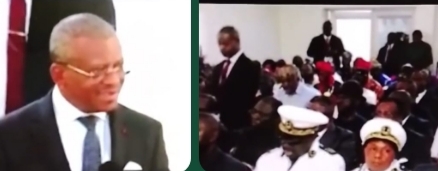
Still, his alignment with Prime Minister Joseph Dion Ngute, who is now stationed in Bamenda under the pretext of “peace missions,” has not gone unnoticed. While Biya remains invisible — reportedly secluded around Kribi, according to multiple intelligence whispers — Ngute and Nkea have been photographed together at the Bamenda Cathedral, projecting an image of order, stability, and divine blessing, a performance — carefully staged to suggest that faith and power are walking hand in hand, even as the state totters.
A Visit That Has Not Yet Happened
Officials of the Holy See insist that no formal date has yet been set for the Pope’s visit. The Vatican’s communications describe the mission as “under preparation,” with the Pontiff’s intention being “to pray for peace, forgiveness, and reconciliation among the people of Cameroon.” There is, for now, no confirmed schedule — only an expectation.
But in Yaoundé, that expectation is being weaponised. Government outlets, state clergy, and regime-controlled media are already treating the prospect of the visit as divine validation — portraying it as evidence that “the world is at peace with Cameroon.”
Meanwhile, opposition voices argue that this staged “papal anticipation” is being used to calm unrest and delay accountability, as protests continue to flare in Douala, Bafoussam, and Yaoundé.
Religion as the Last Refuge of Power
The symbolism, even before the Pope’s arrival, is already working in the regime’s favour. Prayers and homilies now dominate the airwaves.
Citizens are urged to forgive, to wait, and to hope — while those responsible for fraud and repression reorganise behind closed doors.
In a nation where Catholicism shapes millions of consciences, the government has found a temporary sedative more potent than police batons or propaganda — the promise of papal blessing. But the calm remains fragile.
Despite the regime’s attempt to project serenity through Dion Ngute and Archbishop Nkea, public anger is still simmering. The faithful are beginning to question why a Pope’s name is being invoked to silence their pain, and why a visit that has not yet taken place already feels like a moral cover for impunity.
Ambazonia’s View: Calm Before the Collapse
In the English-speaking regions — where the Ambazonian cause continues to resist military and political domination — this papal anticipation is viewed with deep suspicion. 1It is seen as another effort by Yaoundé to use moral theatre to distract from the truth: that the regime is fractured, the President is absent, and the state is governing on borrowed faith.
The symbolism of Dion Ngute and Archbishop Nkea in Bamenda may play well in Yaoundé’s newspapers, but on the ground, the tension remains raw. The people have not forgotten the killings, the burned villages, or the silence of those who preached peace while injustice deepened.
Conclusion: The Silence Before the Storm
The “papal visit” of 2025 may not yet have happened, but its political exploitation is already in full swing. It is being staged as a divine balm for a regime bleeding legitimacy, and as a curtain behind which Paul Biya hides, waiting for the right moment to return to Yaoundé.
But for now, the script is faltering. The people are restless, the protests persist, and faith alone cannot conceal the cracks of a collapsing order. Whether or not the Pope eventually comes, one truth remains clear: in the Republic of Paul Biya, even the idea of prayer is political — and religion, once again, has become the regime’s last refuge.
The Independentist Investigations Desk