












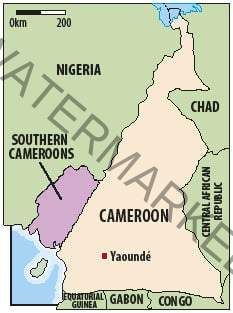
“Re-unification” is not history. It is camouflage. It was designed to blur trusteeship law, erase British Southern Cameroons’ legal personality, and retrofit legitimacy onto a political takeover that never received the people’s consent.
By Kemi Ashu and Mankah Rosa Parks
One of the most enduring falsehoods in Central African politics is the claim that Southern Cameroons “re-unified” with Cameroun in 1961. It is a word chosen carefully, repeated endlessly, and protected aggressively—because without it, the entire legal narrative of French Cameroun collapses. The truth is simple and devastating: there was nothing to re-unify.
The argument pushed by French Cameroun—often with the quiet backing of French intelligence—rests on a deliberate historical distortion. It claims that Southern Cameroons was once part of a “greater Cameroon” during the German era, and that 1961 merely restored a broken national unity. This claim does not survive even the most basic legal or historical scrutiny.
Trusteeship, Not Germany, Defined the Question
After World War II, the international legal status of territories was not determined by colonial nostalgia, but by trusteeship law. Southern Cameroons was not petitioning the world as a former German possession. It was making its case as a UN Trust Territory under British administration. That distinction destroys the re-unification argument.
If Southern Cameroons had been legally inseparable from Cameroun, there would have been no trusteeship question at all. Yet the United Nations treated British Southern Cameroons as a separate territory with a distinct administrative future, subject to a plebiscite—not a merger of former German provinces.
Ahidjo’s Defeat Exposed the Fiction
When Ahmadou Ahidjo attempted to advance the claim that Cameroun was merely reclaiming its historical territory, the argument failed precisely because no such state existed in law.
There was no recognized entity called “German Cameroon” that survived World War I as a state capable of later reunification. German Kamerun was a colonial possession, dismantled and redistributed by international agreement. Large portions of it were absorbed into what are now Congo, Central African Republic, and Gabon. No international court, no UN body, and no trusteeship authority recognized “German Cameroon” as a continuing sovereign entity.
So when Ahidjo claimed reunification, the obvious question—never honestly answered—was this: Re-unification with which country? A French Construct Cannot Claim a German Past The lie becomes even clearer when geography is considered.
French Cameroun is a French post-war construction, governed from Yaoundé, designed within French administrative logic, legal culture, and military doctrine. German Kamerun, by contrast, was administered from Buea.
The two entities are not continuous. They do not share constitutional lineage, legal identity, or administrative succession. One cannot credibly claim the other’s history without also inheriting its legal obligations—something French Cameroun has never attempted. You cannot invoke a German colonial past while operating a French colonial state.
Why the Lie Persists
The reason “re-unification” is still used today is not ignorance. It is necessity. Without that word: The annexation of Southern Cameroons has no legal foundation. The 1961 arrangement collapses into forced absorption. The destruction of the federation becomes a violation, not reform. The Ambazonian claim re-emerges as a decolonisation case, not a secession.
“Re-unification” is not history. It is camouflage. It was designed to blur trusteeship law, erase British Southern Cameroons’ legal personality, and retrofit legitimacy onto a political takeover that never received the people’s consent.
The Conclusion French Cameroun Cannot Escape
Southern Cameroons did not re-unify with Cameroun because: It was not German Cameroun in 1961. Cameroun was not German Kamerun in 1961. German Kamerun was not a state capable of reunification. Trusteeship law, not colonial memory, governed the process. What happened in 1961 was not reunification. It was absorption dressed up as history. And no matter how often the word is repeated, a lie does not become law. History remembers structures, not slogans.
Kemi Ashu and Mankah Rosa Parks


Leave feedback about this