









Legal commentary

We are home to news on Cameroon and the CEMAC region. We are dedicated to honest and reliable reporting. We are the voice of the Cameroonian people and their fight for freedom and democracy at a time when the Yaoundé government is silencing dissent and suppressing democratic voices.

If the newly appointed panel is drawn largely from the same judicial cohort that has overseen key legal responses to the Anglophone crisis since 2017, some analysts fear the rehearing may be viewed as a continuation—rather than a departure—from earlier proceedings.
By Lester Maddox, Guest Contributor
The Independentistnews | Oakland County, California
22 March 2026
The Supreme Court’s order for a “fresh hearing” before a newly constituted panel has set off intense speculation in Yaoundé. Although the identities of the three judges who will determine the fate of Sisiku Ayuk Tabe and his colleagues have not yet been officially gazetted, the pool of potential candidates at the Centre Regional Court of Appeal remains relatively limited.
As Elangwe Joseph has observed, the development represents a procedural reset. Yet within Cameroon’s judicial environment, the composition of the bench can often carry as much weight as the legal arguments themselves. Below is an overview of the institutional landscape and some of the figures who could emerge as key decision-makers in the rehearing.
The Presiding Authority: Chief Justice Christine Mekoulou
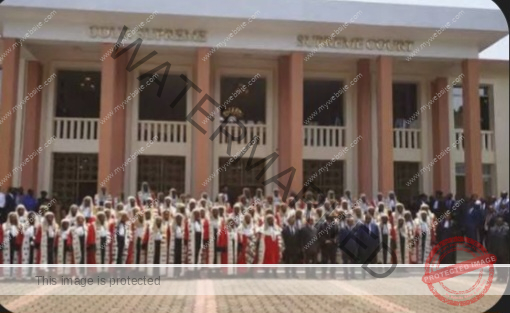
The Centre Regional Court of Appeal is headed by Chief Justice Christine Mekoulou Cunegonde Ngoty. In her capacity as President of the Court, she bears primary responsibility for constituting the new panel.
A seasoned magistrate, Mekoulou has maintained a visible presence at major state functions, including the swearing-in of regional council leaders. Her role in this process extends beyond administration. She must ensure that the panel is formally and procedurally compliant with the Supreme Court’s concerns. Whether she elects to preside personally or delegates the task, her authority will shape the framework within which the “fresh hearing” begins.
The “Safe Pair of Hands” Candidates
In politically sensitive cases, authorities have often relied on magistrates with significant seniority—those who have progressed through demanding roles within the Ministry of Justice. Names sometimes mentioned in connection with complex or high-profile matters in the Centre Region include:
Bahounoui Batende Annie Noël: Currently serving as President of the Special Criminal Court, she is known for her experience handling major financial crime cases. A graduate of institutions in Paris and ENAM, Batende has developed a reputation for procedural rigor and administrative discipline—qualities that can be valued in cases requiring careful judicial management.
Mevoula Ekani Georges: A senior examining magistrate within the Mfoundi jurisdiction. Figures of his generation are often viewed as institutional veterans who possess deep familiarity with the intersection of criminal law, public order considerations, and judicial practice in the capital.
The Exclusion Question: Who Cannot Sit
The doctrine of recusal is central to the Supreme Court’s intervention. Any judge who took part in the September 2020 summary rejection is expected to be excluded from the new panel. This would include individuals such as Advocate General Mindjimba Mindjimba, whose prior involvement contributed to a recusal controversy in late 2025.
In effect, the Court’s ruling calls for a panel that is institutionally unencumbered by earlier decisions in the case, reinforcing the perception of procedural neutrality.
The Independentist Perspective
From the vantage point of diaspora observers, the debate over individual appointments is often seen as inseparable from broader structural questions. Critics argue that the judiciary operates within a governance framework in which the Higher Judicial Council is chaired by the Head of State, raising concerns about institutional independence in politically charged cases.
If the newly appointed panel is drawn largely from the same judicial cohort that has overseen key legal responses to the Anglophone crisis since 2017, some analysts fear the rehearing may be viewed as a continuation—rather than a departure—from earlier proceedings.
Ultimately, supporters of the detained leaders contend that what is required is not merely a newly constituted panel, but one capable of exercising visible independence. In the current judicial climate of Yaoundé, that remains a subject of debate.
Lester Maddox, Guest Contributor
The Independentistnews
Share This Post:
Rigged Before the Gavel? The Defence Strategy to Dismantle the “New” Nera 10 appeal court Panel
New Faces, Old Chains? The “Fresh Panel” Lottery in Yaoundé
Related Post
The Youth Guide to Identifying Influential Leadership in Times
Ambazonian’s quest for Independence: The 2026 Home Front Martyrs’
The 2026 Home Front Manifesto: Duties of the Sovereign
Rigged Before the Gavel? The Defence Strategy to Dismantle
New Faces, Old Chains? The “Fresh Panel” Lottery in
The Legal Labyrinth — Why the “New Panel” Can’t